Showing posts with label pollution. Show all posts

01 May 2009

Manly Beach Drift 'wood' - May

A monthly summary of what has washed onto the shore or beach through the winds, tides, waves or human action. Marine debris, flora and fauna, dead or alive:

Glassing - unintentional/intentional
A stunning lot of freshly cracked G L A S S on the beach. It can be mapped as a post-event phenomena.
On the cemented turf violence with glass, 'glassing' seems to be a popular, mostly alcohol-fuelled activity. There were a lot of bare-footed people on the beach. Which 'stakeholder' is responsible for this potentially dangerous 'externality'?

Airborne Bird Feces and Public Health

At prime visitor time the main cement stairs along the Corso beachfront were sprayed with a high pressure hose. The stairs tend to get caked in bird feces and 'fast food'. The odd butt and wrapping thrown in too. The worker wore no protective mask/ respirator while blowing the nutrient-rich accumulations of bird droppings, feathers and debris in the beach direction. Nearby visitors seated on the stairs received a good dose of of the moist, pulverised, and airborne mix. If OHS is an alien term, then at least the health hazards associated with bird feces and food wastes should be taken into consideration not just in times of pandemics.

Stingers
An unusual jelly, a squarish transluscent bell and short, pink tentacles.(Purple Stinger, Pelagica noctiluca?) Never seen before. It seemed the only medusa on the beach.

An almost hot day with dense white clouds. The horizon uncluttered. 010509

Herbicide in runoff
Various plants around Manly suburbs seem to have been sprayed with herbicide. That classical plant around the pole that petrol-fuelled 'gardening' could not eradicate.

At the beach, along the wall where a few endemic grasses and other plants strain to stabilise the sand, the same 'yellowing'. The bio-cide seems to have flowed as surface runoff and finally came out of a drain, just above the beach vegetation. People often sit on these patches, but 'no worry' - it's just a bit of pesticide at the beach. 020509Crested Tern Habitat: Eutrophication Pipes
Awesome having Crested Terns bomb-dive next to one's head in the surf. Almost hot water. A Pelican flying circles, looking for a habitat. Many types of shells. Some post-event glass freshly chipped. Some fishing string.
At the Manly Life Saving Club, developments race on. Extreme pollution around that premise: a cacophony of debris blowers and diesel-fuelled deliveries of 'fast food' - all blowing into the building. A place to avoid. 040509

More than 24 Crested Terns with offspring. White Cockatoos grazing on conifer seeds. Styropore flakes seem to have come down the hill, washed out of the pipe and got flushed back in. A lot of them. The "Green" machines are disturbing the peace and quite. Fecal matter on the stairs being moistned and dispersed as aerosol by a high pressure hose again. 050509

Unusual mushroom-shaped sponges. Many leg-less seagulls. Why? Large Bluebottles.
All streetlights along North Steyne are on in the daylight. Too much money? Not enough CO2? Pollution from smokers, diesel vehicles and rancid restaurant oils mingling at the beach.
Elsewhere they are flying a blue flag at the beaches to assure users/visitors that the water is clean and the shore-line free of anthropogenic debris. 110509

Dense schools of different sized fish in the surf. Gannets diving for them (video) Seagulls chasing Crested Terns and Gannets for their rich catch. At places the ocean looked like it was 'boiling' with life. A few Willy Wagtails (Rhipidura leucophrys) checking out the dunes and a few Butcherbirds calling (audio) from the pines. 130509

A very large variety of shells today. Many Crested Terns still fishing. The surf had very large fish nosing around our legs. The usual plastic junk, fishing/diving garbage and chunky glass.

All streetlights blasting energy during the day from Queenscliff to North Steyne Surf Club. This has been going on for ages now, they must have money to burn! Their offspring might ask them one day why this planet has become so uninhabitable. (PDF) 150509

Diesel and noise pollution at the Queenscliff end: The smell of 'kelp' or the substance that flows out of Manly Lagoon has been exchanged for industrialising the beach and lagoon mouth with noisy and stinking machinery. 180509

The last oysters scratched off by very hungry and needy people at the Queenscliff rocks end. Street lights still blasting in the day as if there is no tomorrow. Dead fish and a lot of garden refuse washed down to the beach from the subs. 'Throw-away' lighters and very large, sharp pieces of glass. Boat-parking on the Cabbage Tree Bay Aquatic Reserve. Who needs biodiversity when in need of parking that petrol-guzzling 'recreational' aquatic vehicle? 190509

A second Shy Albatross found with a fishing hook in its eye and the fishing string tighly wrapped around its legs. Many dead fish and many sepia. The usual 'event' glass and one-mouthful wrappings.
People that look at things at the beach seem to be either small children or foreigners. For the rest it is a (free) gym or a path to the surf. 200509

Wild weather conditions pound the coast. The row of pines in full seed seem to emit a castanets' sound before the lorikeet frenzy starts. Two Pelicans glide over the beach without a movement.
The sand was covered in small pieces of volcanic rock that have blown in. Large Cuttlefish sepia bones.

Along the sandstone wall some native vegetation is re-establishing itself, holding the sand in place: Knotted Club Rush (Isolepis nodosa), Pigface (Carpbrotus glaucescens), NZ Spinach (Tetragonia tetragonioides) and Scaevola sp.
At the southern end the surf is lapping at the stairs, signs of erosion become visible.
The heavy rain washed suburbia clean again. Down the hill it all goes, all the unwanted externalities.
The plastic Junkspace contained fishing and surfing paraphernalia. Fast food 'throw-away' cutlery and dishes, a lot of balloons with fancy long strings, dummies, spray cans, furniture and crates.
An adult man flying plastic kite in the air, endangering others. Usually the plastic debris gets tangled in the tall pines and stays there for the birds.
A lot of fruit rolled around the shore: apples, figs, grapefruit, oranges, tropical mysteries. The gulls prefer apple.
The usual daytime light pollution and energy waste from Pine Street to the north all along North Steyne.
Around Pacific St. the dunes are reclaiming lawn territory from the underground.
An army plane flying low over the Pacific horizon. 210509

Wild weather still pounding the shoreline.
Audio: Pounding surf, White Cockatoos screeching.

Fauna: An abundance of Nudibranch (Glaucilla marginata). Crested Terns are still blending in with the Seagulls.
Jellyfish: Many Velella, the unusual Bluebottles mingling.

Vegetation matter: Most vegetation matter seems anthropogenic, cut branches, weeded grass tufts, weeds etc. Possibly washed down 'externalities' from sub-urbia.
Plastic: Many bags, 'party balloons' and extra long strings and fancy ribbons ready to entangle wildlife.

Glass: Only one extra large, sharp piece today.
Dogs: Black plastic bags, full (of feces) and empty blowing around the shoreline. Illegal dog packs ON the beach.

On the parade: the same pine vegetation as if the council's idling 'green' machine has never been there. 220509

Wild ocean, even the gulls are uncomfortabe at the beach. The volleyball infrastructure on the beach eroded and scrambled like toothpicks. That bit of 'real estate' on the beach won't be 'monetizing' for a while. The stairs are challenged by the pounding waves, the large sharp rocks from under the sand/ beach are exposed by the erosion. 230509


The erosion and plastic pellets have their own post. There was an unusual amount of anthropogenic debris on the beach. Mostly plastic, a lot of it minced. Giant rope knots, plastic cables etc, ideal to entangle. Most crested terns have disappeared. The smell was not the best and it was not kelp! 250509

Erosion, especially at the south end of the beach. Large rocks, cement lumps, iron bars and mysterious fibrous mats surfacing. The last upright volley poles are going.

Plastic junk and plastic ropes and fishing lines, knotted in thick entanglement balls. The "litter free" North Steyne beach was like the rest of the beach full of plastic garabage and plastic resin pellets.Kelp is arriving to replenish the (northern end of) beach and grasp the sand. Sea tulips and live marine creatures are also amongst it, so the human community will scream 'stinky weed' again and deprive the beach of what it needs. Strange insensitivity towards the other most overwhelming smells...
Jellyfish, large red/burgundy with a huge bell.

Motorised: Wheelies on the ocean, idling green machines on the parade and tractors at the beach stemming the tide of human junkspace. 260509


Kelp: At the north end of the beach: 150+ cm high kelp covering the pool's edge, the beach and surf. Sea Tulips are also mingling. Swarms of Swallows chasing thick swarms of 'kelpflies' in their habitat.

Sponges: A great variety, many still in their colour.
Jellyfish: a couple of the huge bell in red/burgundy.

Junkspace: Minced plastic junk all along the beach.
In front of the childrens' hospital the pines now even become a tip for long and thick fishing strings, high up in the trees, ready to entangle Lorikeets or any other bird. Junkspace making has many dimensions.
Horizon: Thick brown haze pollution. Romatic fireplaces, pollution from a car-dependent nation? 270509
Kelp: + 150 cm high especially at the northern end, sloshing in the surf and reaching into the lagoon and pool. All along the beach as well. As it is mixed with Sea tulips and Cunjevoi it will smell of decomposing animals. That is aside from the Manly lagoon smell, the many eutrophication pipes leading into it and the ocean, funneling the 'externalities' of Sub-urbia into the Pacific.

Sponges
in great variety, Shark eggcases and Sea Urchins.
Swallow cleaning up the kelp and marine life 'flies'.

Plastic Junkspace: The old finely minced plastic with the plastic resin pellets from days ago, distributed along the dunes. A fresh lot in the thick kelp of mainly plastic bottles and fast food, eat & chuck debris. And all that on a 'litterfree beach'.

Dogs and more dogs illegally at the Queenscliff end of the beach.

Queenscliff cliff edge: Most woody vegetation (trees) rolling down the cliff 'sponatenously'. Even the endemic wetland reed (Phragmites australis) looks as if it is sick and tired of stabilising the cliff edge. Another habitat going for Herons and Ringtail possums. Only a bare and eroding cliff face/headland would be recognisable as iconically 'Australian'. 280509
See also Driftwood of:
April, March, February, January, 2009

30 March 2009
Manly Life Saving Club and Sandcastles

Test drilling at the Manly Life Saving Club this morning. Diesel fumes spewing particles into the prime end of the swimming area is converting the beach and parade, yet again into another noisy and polluted building site. Enlarging the club to fit more fossil fool gear into it, fitting more merchandise, business venues or party space into it seems inappropriate. Out goes the nice terrazzo, in ye old laminate, as seen in the other reno jobs.

Heard of rising sea levels and "planned retreat" from Sydney's northern beaches ?
Who will benefit from a long and noisy building site?
What will be the impact on bathers, walkers and residents?

12 March 2009

Oil Spills, Ships and Readiness - The Moreton Island Case

The spill of toxins, explosives etc in Queensland is serious. More from the Moreton Bay Blog, Bayjournal


Australian Senator Discusses Oil Spill
Video via cheatah55

15 January 2009

Manly Beach Drift 'wood' - January

A monthly summary of what has washed onto the shore or beach through the winds, tides, waves or human action. Marine debris, flora and fauna, dead or alive:

Each day washes another type of jelly fish up, today bluebottles, yesterday a mysterious 2 cm 'button' with a dark blue short fringe. The entire beach filled with them. The day before, transluscent blobs. Heating up the ocean, turning it into an acid brew and eradicating the predators of jellyfish (Sunfish, turtle etc) will produce an ever denser 'bloom' of more or less stinging jellies to wade and 'swim' in.

Many different types of kelp in beautiful shapes. A living hermit crab (Pagurus sinuatus) walking about in a big shell. One cuttlefish whole and the other with arms and tentacles cut off, cooking on the sand. 'Cheap bait'? Desperate fishing people swish nets of stinking fishheads on the sand, maybe to attract sharks? An abundance of fishing junk all along, reels, nylon etc.

At the pipes of sub-urban eutrophication lingers a mysterious smell. Intertidal critters do their best to coat the pipe. Terns love the safety of the tall signs. Real driftwood, washed in by the king tide.

The human contribution: Smoking all over the beach, toxic butts in the surf. Large groups of young people all with unprotected heads in the water and on the beach. Their coaches and carers are well covered from uv radiation.
On the sand and in the surf, the smell and sound of petrol racing. Roaring, smelly boats in 'operational areas', getting close to bodies in the surf. Buggies racing along the sand, without an apparent urgency for speed. One day it will be termed an 'accident'.
Commercial speed boats spin right into the Cabbage Tree Bay Aquatic Reserve, depriving the marine fauna of a safe habitat. Swimmers and divers are in great danger form aquatic 'wheelies'. The airspace also has more frequent hovering of helicopters, private and commercial 'joy flights'.

On the litter front, the usual 'one mouthful' wrappers and containers, many balloons, gift wrapping and other marine debris on the shore line.

Denise Ellis Kelly pointed out how a speeding motor had killed a Little Penguin. She also mentioned how the shark net tangled and drowned a dolphin at xmas. (Manly Daily, 140109, p. 22) This is probably just the visible 'tip of an iceberg'. The motor boat and living body interface is as deadly and polluting as terestial traffic. Ban, reduce and lower speed. Motorised lifesavers' high speed is only warranted if life is in danger.

Aerial plastic tangle in the form of kites, string and balloons are left in the tall pines for animals to get entangled in.

The extreme light pollution along the beach from North Steyne Club to Queenscliff pool is an “ecological trap” for wildlife and a blinding nuisance for people. One light bellows out CO2 pollution during the day as well. What a waste.


150109 Image 2 & 4 :Penguin art exhibition by children in the Manly Library. "Boats can hurt penguins. Slow down!"

A moray eel washed up, strangled by fishing line right behind the neck. Another inhabitat of the Cabbage Bay Marine Reserve reef became victim of fishing by-kill.
More Crested Terns (Sterna bergii) indicating heat to come.

The daily junkspace: unwanted flimsy plastic sun tents, generously left behind when broken down after a low usage rate. Large sheets of plastic tarp and the usual unwanted plastic bits.

On the beach walkway - many cars, unloading their commercial loads for the day. The council “green machine” billowing black smoke, repelling people from using the beach parade. The noise and pollution impact on beach users from driving on pedestrian paths is considerable. Operators stop for long periods to engage in long 'ride on conversations' – all with running motors of course, as it is customary in CO2 belching hot Australia. The accumulated fumes from the diesel-intensive mechanical sweeping and the decibel pollution drives people from the public space which is apparently being 'cleaned' for them. 220109Another large dead moray eel with a tumor/growth? on the side of its body. A dead frog and many blue bottles. A hot ocean and the feeling of desertification racing. Despite it all, SUVs and airconditioners are pumping up the Hot Planet. 300109

20 October 2008

Marine Conservation and The Use of Beaches

Marine Parks - the only way to go
The battle over 'No Take' and 'Grab it all Now' is grinding along Australia's coastline. Moreton Bay Marine Park , rich in biodiversity is having 16 % of the Bay declared free from fishing and boats have to "go slow" to not continue injuring the dugongs and turtles. It is " home to 750 species of fish, 120 species of coral, an abundance of dolphins, migratory whales and the world's largest population of dugong next to a capital city.""Each year some 200 turtles are found dead, sick or injured in Moreton Bay Marine Park and an average of 15 dugongs die from human impacts." The Australian Marine Conservation Society says that at least 30 % of the bay should be protected. "It exposes actually a whopping 84 per cent of the marine park to intense fishing pressure".
Manly Cove, Sydney Harbour and the Pacific hugging the Northers Beaches should also go 'slow' and have an effective 'no take' Marine Park to conserve some of the biodiversity for the future.

An observant person on Bribie Island wanted to report a loggerhead turtle stranding. He rang the Environmental Protection Agency's hotline just to be diverted to a call centre in Indonesia. The stranding was never followed up. Sounds soo familiar... abc 201008

A whale sanctuary has been created off Chile's coast, ensuring save passage for the cetaceans migration over 3,400 miles (5,500 km). Here, news of entanglement, starvation etc is almost daily. Noisy obstacles, such as human infrastructure off shore probably do not aid the journey of the giants.

Taking the beach away to attract beach holiday seekers
It is interesting to see how far 'developers' in the tourism industry go: They carted their biggest asset away, 500 truck loads of beach sand to build a a $1 billion resort with it. In the absence of the key feature, the project is now on hold. It will take 100 years for the forces of nature to replace the stolen sand. BBC

Choking on the air and pulverised stuff
"Australia's asthma mortality rates are one of the highest in the world according to a new report by the Australian Institute of Health and Welfare." HealthInsit.au does not mention car pollution as a 'cause'. It all seems a matter of 'managing' it by medical professionals, not preventing it by involving urban planning. Elsewhere, they have found that tree-lined streets can make a difference.

Privatising public spaces
At dark, Manly's coach-led body-fitness customers are cluttering up the paths, dipping into the doggy lawn and punching into the night. All apparently unregulated. Most businesses have to pay the rent, events have to register and pay a fee, but feral businesses occupying public space with business activities seem to be exempt. "City of Yarra and several other municipalities are following the lead of five bayside councils, which recently moved to clamp down on boot camps that operate on beaches and foreshore parks.But Yarra has gone a step further and proposed a ban on commercial exercise groups of more than six people from 18 public parks in Fitzroy, Clifton Hill and Richmond. Fitness classes will also be prohibited from exercising within 10 metres of playgrounds or 15 metres of picnic sheds and park benches." It might be... "reasonable to pay a fee to conduct a business in a local park", but is it desirable to privatise public spaces?

08 October 2008

Dead Fish and Noisy Motors at Manly Beach

Dropping anchors onto the aquatic reserve
In the Marine Reserve today 'leisure crafts' were throwing their heavy anchors into the low reef today to pop some champagne.Motorising the beach, air and land
Helicopters hovered over Manly beach and sub-urbs, giving it that VN ambiance. Are there any restrictions on people perving from above, destroying the space with their noise? How many noisy aircraft routes can Manly Beach handle, in addition to the diesel-spewing coaches, running their air-conditioners hot?
Beach findings
On the shore of Manly Beach an unusual number of ocean/leather/mosaic jackets. We mentioned that an unusual amout of puffer fish and moray eel were also washed up onto Manly Beach. They all seem to have been dislodged from the safety of the reef caves of Cabbage Tree Aquatic Reserve. Maybe they are all just ploughed into the industrial beach sweeper and disappear with the tonnes of garbage into the tip? Does anyone record why there were so many dead reef fish last week?

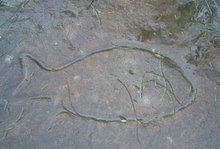
Images: Some of the dead fish (ocean leatherjacket, pdf & Eubalichthys mosaicus) washed up on Manly Beach 071008 and possibly an Eora engraving from the Pittwater region.

27 September 2008

Manly Beach Bike Week - Sustainable Mobility

Manly Council is hosting the NSW Bike Week, (pdf) (RTA) on Sunday, 280908 from 10 am to 4 pm at North Steyne.
The key objectives are to
" Raise the profile of the use of bicycles for short local trips.
Promote safe cycling and the use of shared bicycle/ pedestrian facilities
."
The Road and Transport Authorities main aim is to improve safety on the roads.

Once one has "dusted off" one's push bike and obtained safety gadgets it is off to a high risk territory of armoured and petrol-powered vehicles.
The motorised community's behaviour hits the attention-economy daily with news of road rage, bullying, 'hit and run' and ploughing into pedestrians or their houses. "Accidents", speeding and intoxicated vehicular manslaughter are the norm. Bodily harm is also caused by the noise and chemical pollution that is being inflicted on all. Pedestrians and cyclists wishing to share this space seem to be perceived as a lower species with less rights, as they are not obtaining power derived from fossil fuels. Not contributing to Australia's record emissions they are treated as being 'in the way'.

Awareness needs to be raised not in the community that is achieving sustainable mobility, but in the petrol vulnerable car-dependent nation and its mind-sets. Structural change needs to to facilitate safe and emission free transportation.

Many bikes in Manly still arrive on/in cars. The 'leisure bikes' get unpacked with idling motors at the beach/car-park. Variations range from plastic uniformed racing bikes, to large family groups, with children often on dysfunctional cheap 'throw-away' bikes and mounting-bikes looking for municipality tree-edges to crack. Of course, there are some real-life cyclists arriving on bikes as well. But all are seeking to join in on the heel-to heel packed 2.4 kilometre (1.5-mile) Pacific beach path. The cycle/walkway proper is situated along the beach car park with many cars having hard or sharp protrusions right over the cycle path. At night the beach walkway has racing bikes endangering pedestrians. Off the beach drag, the fragmented bike paths are often parked on. Without the provision of physically-separated bicycle paths the life of a bare body on a wire frame is taking a higher risk. Arriving for ones "short local trip" there are insufficient bike racks to do the shopping. The odd bicycle bar is often taken up by motor-bikes, conquering the pedestrian paths increasingly. Resorting to tie the bike to trees/palms further degrades the neglected trees.

Leaving the bike and attempting to cross any marked pedestrian path is a struggle, and one had better run. The designated 'pedestrian zones' are most of the time filled with delivery trucks and trades vehicles. Idling is the norm. Car design regulations in Australia are lagging behind causing injury and death to walking people and cyclists. Fatal injuries could be avoided by spending a bit on reducing harm to the 'collided objects'.

"About 300 pedestrians and cyclists are killed in vehicle-related accidents on Australian roads each year and another 3000 sustain serious injuries.
The most common injuries are serious head injuries, broken legs and ribs and fractures to the pelvis.
"
Cycling is a wonderful form of mobility, but the mind set of the car addicted community and their practices has to be targeted and structural urban changes have to be realised and enforced.
Images:
1. Corso 'bike path'
2. Beach bike path with dangerous protrusion in ya face
3. Beach bike path with knife-like instrument at head level
4. Manly Cove pedestrians & push bikes only!, 3 large motorbikes, one idling bus.


Links:
Update 021008
- They complain about birds swooping cyclists in their breeding season as they run out of habitat. Pity, there are no corresponding articles about the deadly dangers posed to pedestrians and push-bike riders by urban tanks steared by aggro drivers at pedestrians, push-bike riders and birds. (Manly Daily 021008, the dead-tree version is most reliable!)

24 September 2008

North Head NP Occupied - More Toxic Diesel in Wildlife Habitat

North Head, Lady Fairfax walk today. Toilet litter all over on the ground from mass-tourism (without the facilities). The National Parks sign is a sure indicator for what is to be expected: dogs, bikes, litter. The rare Banksia vegetation had been damaged on the 'walkway' by cars. Although there were no black plumes (soot) visible from ocean-going vessels, the entire air around the walk seemed saturated in diesel fumes. And then there it was again - another giant infrastructure development IN the national park, placed on the main 'tourist-attracting' look-out, directly on the cliff of North Head.

Diesel-belching clutter IN the wildlife refuge (NP)
A huge diesel-belching, humming demountable, with a large spinning radar antenna had been placed in the middle of the Sydney Harbour National Park's territory. Seeking to “add value to all aspects of Sydneys port operations... (and) protect the environment and have regard to the interests of the community “, the Sydney Ports Corporation planted this air-conditioned, video and radar surveillance object into a wildlife refuge. This 'state-of-the art' technology (pdf) is to aid in the intensification of trade and logistics from Botany Bay to Sydney Harbour (North Head).
Intensify - more for more, 'exploit & open up NPs'
The “Vessel Traffic Service (VTS) provides active monitoring and navigational advice for vessels in particularly confined and busy waterways with complex traffic movements...Sydney’s ports alone handle over $50 billion of international and domestic trade annually. Total trade through Sydney’s ports was 29.2 million mass tonnes, 5.0 per cent higher than last year.” Obtaining ROI in a harbour full of tinnies is not easy. Infrastructure is likely to be erected in various harbour sites and widening the bays (dredging) is already starting in Botany Bay and elsewhere.

Deadly trade
As in colonial times, the growing population (pdf) is still dependent on the boats coming in, bringing the essentials. Only this time, the huge diesel-powered vessels (container ships, tankers, bunk carriers, tugboats and cruise ships) are costing lives and health. Most diesel powered ocean-going vessels are significant contributers to air pollution in the heads, the harbour, ports and cities. Ports, handling the bulk of imports, are among the biggest sources of air pollution and greenhouse gas emission. “Each step of the goods movement process is powered by diesel fuel, which releases greenhouse gases and toxic, smog-forming air contaminants...ports pose "grave health risks" to millions of people living in metropolitan coastal areas, especially those living nearest the ports." In 2002 "60,000 people living in coastal communities along major shipping routes died from lung and heart complaints as a result of high sulfate emissions from ships". Particulate matter from ocean-going ship causes asthma, heart attacks, hospital admissions, and premature mortality. “Particle pollution from shipping to tens of thousands of premature deaths each year, most of them along coastlines in Europe, East Asia, and South Asia." This dirty trade is causing harm to public health and to the environment.The ocean, its life and the atmosphere becoming degraded
"Ships use the tar-like, sulfur-concentrated remains of petroleum left once the gasoline, oil and all other products have been extracted. This high-sulfur fuel is responsible for the significant environmental impacts of ship sulfur emissions. Regionally, sulfur emissions contribute to acid rain, which can pollute freshwater lakes and rivers, and damage vegetation." Even cloud formation over the Pacific is influenced by trade-carrying cargo ships powered by diesel engines."The annual costs of sea traffic’s contribution to air pollution, climate change and marine pollution are estimated to amount to 260 billion euro for the world fleet and 57 billion euro for the EU fleet." These 'externalities' are probably not lower for the Asian/Pacific region.

Intensifying diesel-powered traffic that 'costs the Earth' and has negative impacts on the marine foreshore and protected wildlife refuges is unsustainable.

Links:
- International Maritime Organization
- "In accordance with the Australian Government's responsibilities and policies, Australia's obligations under IMO Conventions and AMSA's functions specified in Section 6(1)(a) of the Australian Maritime Safety Authority Act 1990, AMSA coordinates a national pollution prevention and response strategy to protect Australia's marine environment from pollution caused by shipping and related activities. This document lists the prevention components of this strategy, based largely on several IMO Conventions given effect by domestic legislation, implemented and enforced by Commonwealth and State/NT Governments." Protection of the Sea - Conventions and Legislation in Australia, AMSA, Australian Government
- Protection of the Sea (Prevention of Pollution from Ships) Act 1983, NSW
- The National Parks and Wildlife Service, DECC
- National Parks & Wildlife Act 1974
- NCC/NPA Submission to Taskforce on Tourism and National Parks, Submission of The Nature Conservation Council of NSW and the National Parks Association of NSW and the Blue Mountains Conservation Society. 0808, pdf 1,2MB

Update 111008
"The International Maritime Organization on Thursday adopted stringent new controls on airborne pollution from the world’s 300,000 oceangoing vessels. Emissions from ships steaming into ports from Rotterdam to Shanghai to Long Beach, are blamed for about 60,000 premature deaths around the world annually. Sulfur emissions are a major source of airborne fine particulates, which have been associated with pulmonary and cardiovascular disease. In some ports in Europe and in the United States, environmental groups, using the courts, and local governmental bodies have required ships to shut off their engines and plug in to the local electrical grid to keep ship operations functioning while in port." NYT 101008

10 October 2007

Immersing in Manly's smells, sounds and...

Olfactory ambience: sewage stench, at Shelley Beach, at Manly Beach and North Head. Dense plumes of nicotine at every doorway and corner.

Auditory ambience: A frenzy of buildings noises overpowering the surf all along the beach and walkway. Have a nice holiday!

Walkability: All “pedestrian zones” were parked out with numerous vehicles all over. Air-pollution in your face when they throw the motors on to “warm er up”.

Bathing: Shelly Beach is a shit and water mash-up. What a waste for such a nice beach. Too poor to keep up infrastructure with population growth?

Garbage and Plastics pollution: Convenience food and drinks encouraged and the anti-products socialised.Image 2: Surfers against sewage
Previous:
On the use of water and the creation of dead zones
Drinking water, sewage and emerging bugs
Daily beach reports

02 October 2007

Jellyfish wading and Noise pollution at Manly Beach

Jellies in a Hot Ocean
Manly Beach swim today was like wading in sago. Tiny translucent jellyfish filled up the surf and the beach. No they were not Bluebottles.

How to repel visitors to Manly
Council did its best to chase visitors away by blowing the sand off the many stairs with a very loud debris blower. Just months ago this work was done with a broom. Additionally, the 'green machine' stood on the walkway for ages with the loud motor running and not cleaning. Again - people fled the space. Both machines were causing pollution right on the beach promenade. In other places blowers are banned as a noise nuisance, some places restrict these inefficient gadgets
.The industrialisation of the beach is degrading a potentially beautiful and unique environment.

27 September 2007

More on Sydney Water, Health and Pollution

Sydney water news:
A lot of googling for Sydney water, gastroenteritis, diarrhea and food poisoning.
The pond we are drinking from has a thick algae mat (HABSs) stretching 58 kilometres now. 75 % of Warragamba Dam is covered in this slimy growth. We put, so to speak a straw down the murky pond and suck. They have found "levels of microcystins, toxins that could cause skin irritations and stomach upsets in large doses." "The results are below the National Health and Medical Research Council guidelines."

Interesting news on water pollution (eutrophication) just out. Pouring our waste into the waterbodies leads to algae growths, this in turn leads to parasites, these enter amphibians and cause severe deformities. "What we found is that nitrogen and phosphorus pollution from agriculture, cattle grazing and domestic runoff have the potential to significantly promote parasitic infection and deformities in frogs."

Previous information on Water, Health and a dead World:
Sydney Drinking Water & Healthy Water Bodies II
Drinking water security, sewage and emerging bugs III
On the Use of Water - or the Creation of Dead Zones
Sick seals, sick ocean, sick people
Water, Food & Restaurants in Sydney
Microcystins
Neurotoxins

26 September 2007

Ivanhoe Park/ Manly Oval as source of noise pollution

The privatisation and intensification of public spaces is racing ahead in most urban places. Industrial commercialisation seeks out urban places (with infrastructure) where people aggregate. It relieves them of their money and is a 'block-buster' for the adjoining residential community.

Popcorn -Yoo Hoo!
Manly already has lost a lot of public space to sectional interests. At this stage Manly Council “has given its provisional support” to allow late night open-air movies in Manly Oval/ Ivanhoe Park. This small 'green space' already hosts a variety of sport, childcare and alcohol-related activities.
The impact of such a 'movie', blasting advertisements and films over the block would constitute noise trespass for the adjacent residents. Parking and traffic congestion, light spill/glare, littering, garbage, smashed glass and increased vandalism are sure to follow. The pumping noises of the large inflatable screen would further add to the outdoor noise pollution.

24/7 open air entertainment
The issue of noise is a serious health concern for people who live in this area. The strategies are not to prevent noise, but to manage, “regulate” it to acceptable noise intrusions in homes. Initial 'recommendations' , 'restrictions' and practices will find their way to a 24/7 open air entertainment in the end.

Noise kills
Noise complaints already have risen dramatically in the last few years. People do need a place to recuperate and sleep. The suburbs are already very loud and noise simply kills. If you don't like it, you might resort to complain. You can ring till your fingers are numb, if there is a response, then be ready for a bungle of noise experts and the muddle of the decibel haggle and a lot of silent buck-passing. There is no shortage of laws, regulations etc.

Vibrant Manly – Luv it or...
With the degradation of an 'residential area' the most sensible thing is probably to pass on the rest-less 'home' to the “vibrant community” that never sleeps, needs commercial entertainment 24 hrs and only lives off alcohol (and other stimulants). Then Manly is THEIR place!.

What's a park good for anyway?
And there is the poor park, already so built over and ruined by foreign water-loving pansies. It was once renowned for its beautiful native flora. More and more birds and possums get flattend on busy Raglan St. Many people might have moved there, because of the 'quite green space'.The authorities will probably do a professional flora and fauna impact study before further developing the 'park'.

Links:
EPA, Noise Management, NSW
EPA, Noise Guide for Local Governmnt
WHO, Noise & Health, EU
Noise and Health Journal
Noise concerns expressed at North Sydney ,0507(pdf)
'Acoustic Management Strategy' example for “Open Air Entertainment” 0807 (pdf)

21 September 2007

Reducing risks when eating out

The right to know.. What's in the stuff, where is it from?
Occasionally restaurants specify the origin or the quality of their produce.
Free-range eggs being the most commonly declared product in Manly. Most other ingredients, one has to trust, but one can not engage in informed consent. If one does not want to consume food with detrimental health effects, there is very little information provided.
” In Australia alone, more than $1 billion worth of herbicides, fungicides and insecticides are applied each year.“ Part of food literacy might also be that one would like to know the origin and treatment of the food and the ecological footprint of the resource.
In various cities people eat local now, even restaurants offer locally produced foods.

Menus with imagination and consideration would be appreciated. Instead it often is the usual fish&seafood-mash up, platters full of lobster by the kg or just meat. Vegetarian dishes containing protein are as rare as organic vegetables on the menus.

Bugs in food and water can cause sickness and death - Sydney 'Gastro'
“In Australia, there are an estimated 5.4 million cases of food-borne illness every year ” In Queensland for example it has “...caused an estimated 10 deaths and 750 hospitalisations in the state every year.” In Sydney, customers do not seem to have a right to know which eateries did not pass as “ the names were best kept secret as revealing them could damage the businesses unnecessarily.“

“Over 80% of foodborne gastroenteritis due to ‘known’ pathogens is caused by pathogenic E.coli, norovirus, Campylobacter and non-typhoidal Salmonella. 32% of all gastroenteritis may be transmitted via contaminated food. Foodborne gastroenteritis results in about 1.2 million people visiting the doctor, 300,000 prescriptions for antibiotics and 2.1 million days of work lost each year.” (pdf) Water as well as food is of course a medium of possible transmission.

Hygiene – as infrastructure and practice

A measure for good hygiene in eateries (or anywhere) are the bathrooms. Facilities and updated cleaning are essential. There seems to be a general decline in the tradition of washing hands (properly, video), often the infrastructure to do so for staff and clients is also lacking.
Recently it was
overheard in Manly that a small boy wished to wash his hands after a pee. His male carer convinced him that it is not important. With eateries that do not offer a lavatory one is forced to use the public ones which are in dubious states.
Having (lap-)dogs on seats or eating off dishes is common and a health hazard.

Olfactory assaults
As most bathrooms lack windows some businesses offer 'air freshner sprays' in
each cubical. This practice seems more hazardous (pdf) than the previous fumes, the artificial volatile chemical vapours have been distributed into the small confined space. Some of the effects of Volatile Organic Compounds are: ”Eye, nose, and throat irritation; headaches, loss of coordination, nausea; damage to liver, kidney, and central nervous system. Some organics can cause cancer in animals; some are suspected or known to cause cancer in humans”

More cocktails to inhale
Other ambient pollutants in Manly are of course air and noise pollution from motor vehicles, which often gets topped up with gas/fire heaters (even unflued inside). Occasionally 'romantic' candles add to the cocktail of pollutants. “ Paraffin-based candles.. tend to use wicks which are made with a metal core like zinc or possibly lead." Passive smoking is still an issue, while trying to smell and taste your food. As reported before, most eateries reserve the fresh-air area for people polluting the air. Just where the air is to enter the premise, the combined toxic fumes of the smokers enter the 'non-smoking part' and accumulate there.

Mental spam pollution – while having a drink
Apart from many neon-lit 'convenience' places springing up, another new form of enforced attention grabber has sprung up. Huge screens peddling 'solid state spam', unwanted and unwelcome messages "


It would be advisable to have ecological and ethical audits for businesses, as well as for municipalities, to encourage an open transparent communication with their clients that is sustainable and reciprocal.

See also: Manly Restaurants and Eateries - a Wishlist

Links:
-"...Three-quarters of the world's fish stocks have been over-exploited, mainly by commercial fishing"
- Disclosure on industrially 'farmed fish'
- Choosing sustainable seafood, ca
- Food, Mindfully
- Public rating of restaurants, web 2.0
- One Los Angeles menu boasts dishes where 90 percent of the ingredients were raised within 400 miles.