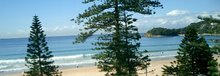
Shelly Beach is a small sheltered beach, facing Manly Beach. A coastal walkway, leads along the Cabbage Tree Bay Tree Aquatic Reserve to Shelly, which has one of the few small unbuilt headlands with native vegetation on it. Some of original cabbage tree palms were replanted as they once fringed the watercourses leading to the beach. The headland leading back to Manly beach has been undergoing intense development for years. The beach facilities are also under intense demand.
Dead Fish, how come?
Last week (02 & 03.1008) many dead puffer fish and a moray eel were washed up on Manly beach. We assume, these 'cave dwellers' were from the 'Aquatic Reserve'. On the 051008 the first blooms of an apparent red tide was visible at Shelly Beach. On the 021008 "a mysterious red sludge", believed to be red algae bloom was found on a beach in the Manly area, at Clontarf.(Image)
Nice Beach as a drain, growing harmful bacteria?
The walkway from Manly beach to Shelly beach along the aquatic reserve is studded with old, often decayed pipes of all sizes, draining the dense sub-urban  development on top of the headland, down into the little bay/'reserve'. The mossy green rocks are the sure-sign for 'rich run-off'. The little creek behind the restaurant, has spaghetti-like pipes all leading into it and straight into the beach. Most of the properties, strain to grow water and nutrient intensive foreign vegetation. A large paved car park on top of Shelly, is increasingly denuded, leading to even more run off. Numerous dogs on the beach and unleashed along the walkway help to contribute their untreated feces into the adjacent cabbage bay aquatic reserve. Sydney on the whole “dumps a billion liters of sewage into the ocean every day...” (Maude Barlow, Blue Covenant, 08 p28.) Habitat degradation, generous run off and extreme warming of the atmosphere and the ocean is a guaranteed recipe for 'red tides', then harmful algea (HABs), then hypoxic or 'dead zones'. The beaches become at first unusable, smelly and might irritate the skin and eyes. Later, even just breathing the 'mist' can cause health problems and fish suffocate in the o
 xygen-deprived sludge, “fish-kill” (video). Marine species have their central nervous systems attacked by the poisons generated by the bacteria and also seek to 'leave the ocean' gasping for oxygen. Marine mammals, such as humpbacks are also poisoned and 'beached'. 'Food-species' can become deadly to fish, shellfish and people. Sea and shorebirds fall out of the sky(pdf). The stench would repel any visitor, closing beaches becomes very costly for the human economy. Rehabilitating the ecology of a 'dead zone' is usually left for the next generations.
Beyond denial - Doing something against the red tide
Elsewhere environmental groups are enforcing measurable standards to prevent the fouling of their beaches."..To set numeric limits on the excess nutrients which trigger harmful blooms of blue-green algae...Blue-green algae - also known as cyanobacteria - produce "dermatoxins" that can create severe dermatitis and are known tumor promoters; "neurotoxins" which interfere with nerve cell function; and "hepatotoxins" which attack the liver. Exposure to blue-green algae toxins through ingestion, skin contact or inhalation can cause rashes, skin and eye irritation, allergic reactions, gastrointestinal upset, serious illness, and even death..."
Their drinking water" is now subject to almost year-round blue-green algae blooms as a result of nutrient pollution"
It is too dear to not act
The red tide algae, Karenia brevis, "costs approximately $20 million per bloom in  economic damage off the coast of Florida alone." The beauty of a beach is lost forever.
Ocean Care includes the acknowledgement of eutrophication, it seeks to alter the behaviour of individuals and the authorities bestowed with the stewardship of an biome and urban planning.
Images:
1. Shelly Beach, Google Maps, 2008
2. The walkway from Manly Beach to Shelly beach along the Cabbage Tree Bay Tree Aquatic Reserve on the one hand and the suburb on the other, Google Maps, 2008
3. Shelly Beach looking back onto the walkway with thick streakes of 'red slime' 051008
4. Shelly Beach with 'red slime'', with view to Manly Beach opposite
Update:
Red Tide 11.2010: North Head images, 1 & 2,
06 October 2008
Preventing 'Red Tides' at Shelly Beach, Manly

02 October 2008
Manly Ocean Care Day - Of Albatrosses and Red Tides
 As another 'ocean care day festival' is approaching in Manly it is time to focus on the 'care' bit. In the holiday season the beach is specially subjected to a tidal wave of of unwanted 'convenience' packaging and 'recreational' plastic.
Out of the ordinary was a large Shy Albatross (image) (Diomedea cauta cauta, pdf, measuring some 95-100 cm, wingspan 240-260 ) found at the North Steyne end of the beach on 300908. 10 puffer fish were also rolling on the sand. This giant bird is still hunted for 'sports' and chokes on human plastics. As there is no habitat left for it in the Manly region, the next possible place could be just north of Sydney. Five albatrosses and pelicans have been found poisoned at Tuggerah Lakes. "It was believed the sudden outbreak of botulism was caused by rain washing chemicals and fertilisers into the stagnant water of the lake."
If it isn't run-off from human settlements that has killed the birds and polluted the water, then it is also possible, that it is the mix of high temperatures, due to human-caused emissions, as well as the flushing of unwanted wastes into the water bodies. The result is a warm brew encouraging the growth of toxic micro-organisms. Even if no red tide is visible, the toxins (brevetoxins) still lingering, damage the nervous system, just like the botulism bug. Maybe the shy giant made it out to sea and was overcome by the HABs, to finally get washed up at Manly. Does anyone care?
A red tide is at the moment hovering around the corner in Clontarf's Sandy Bay, (Manly Daily, 021008, image). Red tides love warmth + plenty of human caused run off. They then breed toxins which have the ability to kill life in the ocean/bay and on land. Although there is a fine of $ 1 million for dumping baddies into the water-ways, there seems to be none for doing it with a trickle (eutrophication) over time.
Clontarf / Bantry Bay Estuary Management Planning Process - Data preparation in 0807, (pdf) reveals a lot about the the Sydney Harbour Foreshores and Waterways Area, such as Castle  Rock and Bantry Bay and includes parts of the Balgowlah Heights, Clontarf and Seaforth suburbs.
65.5% of the space is for human habitat, 22.0% for their sealed roads and 10.2% for parks and public spaces. The 'storm water drainage network' is visualised in this document. The appropriation of freshwater is also accounted for. Giant lawns and pools spill into the 'bush', which is often cleared to see the marina (image). The foreshore appears transformed into a space for fossil fuel vessel parking. The estuary/bay is slowly looking like a large boat-parking area. Private dinghies clutter up the 'public' reserve. As in Manly, unleashed dogs are emptied of their untreated feces into the bay.
The environment- human interface is summed up as being in conflict:
The degradation of the environment does not only rob species of a habitat, but it also diminishes life quality for all living and to come. Running out of space and resources in an ever shrinking world
- "Seawalls for protection of properties versus its damaging impact on natural ecosystem
- Groundwater abstraction and possible saline water intrusion in aquifer
- Beach raking for safety versus its impact on invertebrates
- Dog walking off leash and impact on shore birds
- Powered and sailing boats and their wake impacting on seawalls and beach erosion
- Access to mooring versus their impact on sea grass beds, ability to spread caulerpa taxifolia
- Powered boats and the safety aspects for swimmers and kayakers
- Ad hoc boat storage and its impact on amenity and habitat:
- Ad hoc access ways to foreshore for convenience versus destruction of habitat." (pdf)
 is no fun. The diy cocktail of heat, plus draining liquid wastes equals red tides, or dead zones, that are void of life and toxic to ALL. Just breathing the mist is a hazard, eating the contaminated fish/seafood can be deadly. Jelly invasions ( the only creature thriving on this human-made environment ruin the beach- Beach closures, due to toxic blooms or jelly blooms are costly. 'Business as usual' in a risk-society could play it all away in just a generation.
The oceans are getting so hot, acid and degraded by us. Species are either fished out by us or their habitat is ruined. Lobsters, seals, whales, dolphins and crabs etc etc are affected by the red tide toxins and are wishing to leave their habitat, they thereby die.
It would be a sad world which leaves a
red ocean behind
no fish and life in it
no ocean and foreshore birds on the horizon
no beach or bay without a noisy smelly and dangerous motor
no beach or bay without human infrastructure cluttering up the landscape
Let's care!
Images:
1 & 2 Dead Shy Albatross on Manly Beach, 300908
3 Sandy Bay, Clontarf, Google Maps
4 Clontarf/Spit Bridge, Google Maps
Animation: Ocean care day animation, Manly Beach
Links:
Toxic Blooms: Understanding Red Tides, FATHOM
HABs, Harmful Algae and Red Tides, Woods Hole Oceanographic Institution
Sea Birds affected by red tide toxins, Florida conservation 2006
Entanglement in or ingestion of anthropogenic debris in marine and estuarine environments - key threatening process listing, DECC
Rock Snot, a hazardous algae in Tasmania, has had devastating effects on inland river catchments in New Zealand abc 270808
Update 101008
- The red tide at Clontarf mentioned above has been identified as Noctiluca scintillans (Manly Daily p3, 101008). The same type of algae bloom has also been found at Seaforth, west of the Spit Bridge and Woollloomooloo Bay. NSW Health recommends that people avoid contact with all blooms. This dinoflagellate is also linked to " anthropogenic eutrophication...along the southeast coast of Australia". In India, it has been implicated with "the decline of fisheries". At night Noctiluca glows in a bright blue bioluminescence, as viewed on Manly Beach before.
Suspected blooms should be reported to the Regional Algal Committee during business hours (02 4729 8138), or the Department of Environment and Climate Change’s Environment Line (131 555) after hours. Toll-Free Algal Information Line - 1800 999 457 according the the NSW Department of Water and Energy
Update 231008
- Brush et al. Historical Land Use, Nitrogen, and Coastal Eutrophication: A Paleoecological Perspective. Estuaries and Coasts, 2008; DOI: 10.1007/s12237-008-9106-z "During the past 300 years, many of the wetlands have been drained, and the landscape was converted to agricultural fields and urban and suburban development. Since precolonial time, the mesohaline estuary has become increasingly eutrophic and anoxic."
20 October 2007
Shelly Beach Palm Gully Creek
 Walking along Marine Parade (Manly Beach to Shelly Beach) today. Wondering why most of the large figs are so sparse and losing their leaves. Herbicide? Better views? Dogs, off leashes chasing the few Eastern Water Dragons trying to rest on the hot sandstones. Bulging black (leaking) plastic bags of untreated! feces hanging around picnic-lawns, near the walkway and beach. Weeds spilling down the nice sand stonewalls from the properties above.
 On the Ocean side, at the Cabbage Tree Bay Aquatic Reserve huge boats parked right in the little bay, stirring up the bottom of the delicate “reserve”. Swimmers and divers risk their lives swimming near these motorised McMasions.
Finally at busy Shelly Beach, all seem to be unaware of the high pollution at the beach, mixing fecal bacteria with blue Pacific water. It is a mystery why Shelly Headland is not part of the National Park or a Reserve. Just handed over to car parking and as a dog loo. Middens and Stone tools mashed up as cement to bang in access for easy fishing. Cunningham's Skinks (pdf) are deserting the area and Bandicoots are living dangerously there at night with dogs hunting.
A state of shame in water management
The stairs near the Kiosk lead up to a remnant of a creek that used to flow into the Palm cove of Shelly Beach in the old days. Today a walkway leads to Bower Street and the water management is a disgrace. Years ago a beautiful rainforest has been planted alog this creek, which has its origin on North Head. Most properties have weeds spilling into the (name-less?) 'reserve'. But the biggest shame are the many blatant PVC pipes directing their point source pollution INTO that water which flows into Shelly Beach. The point at the bridge, where most pipes discharge their private waste looked like oily smelly yuck.  Surface runoff from building sites also just flows into the little gully. How can such a waterway and bushland be treated so carelessly?
But then there are many pipes flowing all along Marine Parade into the Aquatic Reserve. The thick green 'fur' on the rock testifies to this eutrophication which in turn causes harmful algae to grow.
Images: 1.Swimmers having to swim around a yacht on Cabbage Tree Bay Aquatic RESERVE, 2 & 3 Creek Gully, stairs to Bower St. from Shelly Beach, re-vegetated wit run-off at many points.
Update:
Preventing red tides at Shelly Beach, 061008
Links:
Streamwatch
Managing Wastewater in Coastal Urban Areas
19 October 2007
Can Manly afford not to share North Head with Penguins?
 Manly is fortunate to still have a population of the endangered Little Penguins. The 30 cm tall flightless seabird only weighs between 1000 and 1200 g . They are very social and like to live in some foreshore shelters, when they are not in the ocean/harbour hunting for fish and squid.
Humans are deciding at the moment whether they should have a right to a home or even a life. Habitat destruction/robbery, polluted water quality and unleashed dogs are the main threats to the existence of these little Fairy Penguins.
Some humans have already built a big building on top of a penguin colony in the National Park. That is not enough, they now would like to make it bigger and bring many more people to the place. They are willing to spend $21 million to turn the nice bush-land into an “eyesore”. There will be more cars, bright lights, noises and dogs – all of which the little fellows get scared of.  Other people think, that they should build the big buildings and roads where there is already infrastructure. They also would like their hunting ground, the water, protected and made into a Marine Reserve. That would mean, no more dirty runoff, noisy stinking boats, throwing fish corpses and plastic debris around, or even turning little penguins into bait. It is a tough struggle to give these unique creatures a right to exist.
Elsewhere the government has realised how these Penguins contribute to the economy and attract many visitors. They decided to invest many million dollars and buy them a big home: foreshore and ocean where they can live happily for a long time. No noisy, yucky building sites or dogs on the loose will threaten them in their new home there.
In such a place they can do what they naturally like doing, stay with their mates (cohorts), walk together in a ‘synchronized parade’, hunt for food and spend most of their time and life in that little in-group. Only disturbance, mostly from humans and dogs, makes them give up their normal social life.
Previous:
North Head Developments, before and after
Penguins or dogs
Leave some of Manly as Penguin Habitat
Links:
Penguin Images
Poisonous plankton blooms killing Fairy Penguins
Video animation: The plight of the Little Penguin, Animation Oz, Act now!
Images: 1. Street art Manly, 2. Sign on gutter, urging not to pour pollutants down the drain, then to the ocean, then to the fish, then in to penguins or humans.
10 October 2007
Immersing in Manly's smells, sounds and...
 Olfactory ambience: sewage stench, at Shelley Beach, at Manly Beach and North Head. Dense plumes of nicotine at every doorway and corner.
Auditory ambience: A frenzy of buildings noises overpowering the surf all along the beach and walkway. Have a nice holiday!
Walkability: All “pedestrian zones” were parked out with numerous vehicles all over. Air-pollution in your face when they throw the motors on to “warm er up”.
Bathing: Shelly Beach is a shit and water mash-up. What a waste for such a nice beach. Too poor to keep up infrastructure with population growth?
Garbage and Plastics pollution: Convenience food and drinks encouraged and the anti-products socialised. Image 2: Surfers against sewage
Previous:
On the use of water and the creation of dead zones
Drinking water, sewage and emerging bugs
Daily beach reports
08 October 2007
Tornado at Manly Beach
 A small tornado shot out of a dense cloud and whipped up the ocean at 10.45 am today.Yes, you probably want some pics from the eye of the tornado, here are some big ones. More on tropical cyclones! in NSW. And the video:
Update:
280509 another tornado whirling along Manly beach.
300509 Three tornados breaking out of one mega dark cloud.At 10.30 am a very dark cloud formed over Manly Beach. It seemed to be reaching in long 'threads' for the ocean. In the north ( off Queenscliff) one developed a large waterspout, twisting the ocean for a long time. A small one at Manly beach and a third one behind North Head. The giant super-organism broke into heavy rain.
13 September 2007
Antarctic Seals on Sydney Beaches - “ The anatomy of a sea lion is not too dissimilar to the human anatomy”
Pack-ice animals in Sydney? The arrival of seven 'debilitated' sub-Antarctic Leopard Seals on the coast of NSW is unprecedented. Two Leopard Seals, malnourished, injured and near death, were washed on to Sydney's beaches (Wattamolla, Clovelly Beach) recently. Scientists are 'baffled' about the “seven animals in the last two months” which are out of their habitat. Living on Antarctic ice shelves normally they are 'out of place'. ”If they get this far north, they are very sick.” said a NPWS wildlife management officer.
The Leopard Seal (Hydrurga leptonyx) inhabits Antarctic pack ice as most of the time as a top predator catching Penguins, Squid and Krill. Antarctic Krill makes up 45 % of its diet, for which the species has specially adapted teeth.
Inhospitable coasts – nowhere to rest
Seals in distress, being marine and terrestial are in need of rest. On a densely populated coast, 'real estate' for seals only remains in name as 'Seal Rocks'. Authorities implore the public to allow animals to rest ("hauling-out") on the foreshore and not allow their dogs to savage and harass them. A fur seal also had to be disentangled out of a shark net recently. 'Fishing gear and plastic litter' are the other human-made hindrances for these marine mammals.
Krill- the stuff that feeds most Krill are the keystone species of the food web for many, such as Leopard Seals, whales, penguins, squid and fish. The bioluminescent Antarctic Krill grazes on drifting algae and small zooplakton. “ Most krill species display large daily vertical migrations, thus feeding predators near the surface at night and in deeper waters during the day.” Like a lawnmower, they also “scrape the green lawn of ice -algae from the underside of the pack ice.”
Human induced changes on the planet:
Human activities heating up the planet, deprive the inhabitants of these extreme cold regions, of their habitat. The melting ice and associated higher temperatures are a threat to the fauna.
- The increased temperatures disrupt the food chain, Krill swarms recede and Salps (Salpa thompsoni) explode.
- Human beings 'harvest' massive amounts of Krill by vacuuming them with high tech to deliver as feed in industrial fish farms,add to medical and cosmetic products.
- Seals and Penguins lose out in the competition for Krill. Food supplies are disrupted.
- Dumping waste (eutrophication fertilizers/toxins) into the world's warmed water bodies nourishes pathogens for all living beings.
- Growing tourism is straining the environment.
The 'Death March of the Penguins' in the Antarctic continues, numbers are dwindling. “As cracks, gaps and relocated chunks appear, it becomes harder and harder for penguins to forage under the ice for Krill or make their way quickly to the water.“ Landlocked animals cannot reproduce. Where penguins interface with human dwellers (Tasmanian coast) and their pets, the outcomes are predictable: “Dogs are capable of killing a penguin just by closing their jaws on the penguin's skull… A few years ago, 50 to 60 penguins were killed by dogs in one night."
At the Earth's northern region: the Arctic
Seals are running out of ice lairs for their pups, both polar bears and indigenous hunters will get to feel their absence as a direct effect of the warming.
With the disappearance of the sea ice, walruses are out of solid ground. ”Pinnipeds are carnivorous aquatic mammals that use flippers for movement on land and in the water. All pinnipeds must come ashore to breed, give birth and nurse their young. That platform has been shrinking.”
'Skinny' Grey Whales - warmer temperatures and vanishing sea ice are forcing them to find non-customary food sources.” But switching food could expose them to parasites that contribute to their emaciated condition”
“Bering Sea wildlife species are threatened by an array of complex problems, including commercial fishing, global climate change and pollution ”. 12 % of all vertebrates are at risk.
Homeless beings, out of food and rest get sick
Malnourished seals, whales and penguins, struggling to reproduce also have to live in water bodies saturated with pathogens and toxins. A weakened immune system is more susceptible to pathogens.
The case of toxic algae and bacteria pandemic killing seals
There has been “... a steady upswing in beach strandings and mass die-offs of whales, dolphins and other ocean mammals on U.S. Coasts...More than 14,000 seals, sea lions and dolphins have landed sick or dead along the California shoreline in the last decade. So have more than 650 gray whales along the West Coast. ” It was found that seals had ingested toxic algae bloom accumulated in anchovies and sardines. “ The surge in mortality has coincided with what Florida wildlife pathologist Greg Bossart calls a "pandemic" of algae and bacteria...” Fuelled by human waste and other nutrients of coastal areas the 'bad bugs' explode. “Toxic algae thrive on the same elements that turn lawns green and make crops grow — nitrogen, phosphorus and iron”
One bug, Pseudo-nitzschia, covering '155 square miles of coastal waters produces' a potent neurotoxin. Anchovies and sardines eat the red tide organisms unharmed, but if they in turn get eaten by seals, they get the accumulated toxic dose. The domoic poisoning disorients the animals and they lose orientation. “Some swam hundreds of miles out to sea and were never seen again, bizarre behavior for
 creatures that spend their lives in coastal waters.” Usually, they are emaciated , disoriented, suffer seizures, and finally the hippocampus becomes severely atrophied. One is reminded, that “ The anatomy of a sea lion is not too dissimilar to the human anatomy.”
The displacement of the inhabitants of the Antarctic and Arctic might be a sign that the Earth is being turned into a hot and in-hospitable place for all, a primordial atmosphere.
Questions:
- Could it be that disoriented, malnourished and injured seals at our 'doorstep' are a sign of the large mammal decline that is principally anthropogenic?
- Are our actions robbing them of a habitat, food and a place to rest ?
- Is our effluent and waste making the ocean unfit for life?
- Who is monitoring the coincidences of HAB tides and marine mammal stranding in Australia?
- Is out own food security compromised?
Previous:
On the Use of Water - Or the Creation of Dead Zones
Drinking Water & Healthy Water Bodies Pt II
Drinking water security, sewage and emerging bugs III
Links:
- Altered Oceans, Kenneth R. Weiss, Usha Lee McFarling and Rick Loomis (Toxic algae that poison the brain have caused stranding and mass die-offs of marine mammals — barometers of the sea's health.)
- Penny Chisholm, Video: The Invisible Forest: Microbes in the Sea
- Earth Observatory, NASA
04 September 2007
Drinking Water & Healthy Water Bodies Pt II
 Sydney's drinking water,we are being told 'is no public health risk'.
"A, there is nothing we can do about it;
B, it's a perfectly natural phenomenon which is a response of lots of nutrients being washed into the water;
C, it's not toxic”.
The 'non toxic' growth of blue-green algae expanded over the weekend from 14 to 26 km (image) in Warragamba Dam. Daily 'water quality results' do not show up any 'blooming'.
While industry and government representatives are being instructed on 'water quality management and health risk reduction' the public is ensured that Microcystis aeruginosa (pdf) species is only 'potentially harmful', but you ”may notice a change in taste and odour.”
Australia's Water Quality and Treatment states the following in its 'Blue Green Algae Guide (pdf)
“Blue-green algae produce three main types of toxin:
• Endotoxins are thought to produce allergic reactions, skin rashes, irritation of the eyes, and gastroenteritis.
• Neurotoxins damage nerves and can cause muscle tremors, especially in the muscles animals and people need to breath.
• Hepatotoxins damage the liver. They may also increase the risk of certain types of cancer.
To put the toxicity of blue-green algae in perspective, Microcystis, one of the blue-green algae found in Australian waters, produces a toxin called microcystinLR. Microcystin LR is 200 times more toxic than cyanide.
Blue-green algal toxins are colourless, odourless,and can remain present in the water weeks after the blue-green algae have disappeared. They are not destroyed by boiling affected water.”

A town water supply was closed down due to cyanobacteria (HABs) some time ago in NSW. WHO recommends that " levels of 10 cells mLˉ" of cyanobacteria should not get in contact with humans. “The major route of human exposure to cyanobacterial toxins is the consumption of drinking water” (WHO, pdf) Unfortunately we are not told the levels of Sydney's bloom in the drinking water or the ocean.
In some places “the highly toxic algae Microcystis aeruginosa” threatens human health. “Health experts warn that even modest exposure to the toxin produced by the algae, called microcystin, can lead to skin rashes, vomiting, and diarrhea.” Various stakeholders believe that “ the regional water board not only has the authority but the mandate to protect the public from toxins like these in water bodies.”
Once HABs are present in the 'red surf' of the ocean, the sea breeze blows toxic aerosol over the coastal residents. “During the red tide, admissions for pneumonia, bronchitis, asthma, sinus infections and similar afflictions rose 54%.” Surf club's sign read: "Some Red Tide = Coughs. Sneezes. Dead Fishes." People wear masks.
“A scientific consensus is emerging that commercial agriculture and coastal development, in particular, promote the spread of harmful algae. They generate runoff rich in nitrogen, phosphorous and other nutrients that sustain these microscopic aquatic plants. In essence, researchers say, modern society is force-feeding the oceans with the basic ingredients of Miracle-Gro.”
“Industrial society is overdosing the oceans with basic nutrients - the nitrogen, carbon, iron and phosphorous compounds that curl out of smokestacks and tailpipes, wash into the sea from fertilized lawns and cropland, seep out of septic tanks and gush from sewer pipes.”

Domestic, industrial and agricultural wastes - 'cultural eutrophication' stimulate the growth of HABs. The list of causes via non point source or Nonpoint Source Pollution seems endless:
- Sewage, partially treated human waste ,septic tanks, untreated dog faeces
- Runoff from cities, suburbs (green lawns, sports-fields, cocktails of chemicals
- Urban 'greening': lawns, use of fertilizers
- Farm run off
- Ballast water from ships
“Toxic algae thrive on the same elements that turn lawns green and make crops grow — nitrogen, phosphorus and iron” Sickness and mortality (pdf) is brought on to marine mammals, fish and birds. Dogs and livestock have been know to drop dead within 30 minutes.
“There is a growing public concern about the environmental quality of most major rivers, estuaries and coastal waters near Australia's large population centres where discharges of industrial, domestic and agricultural wastes are raising the nutrient levels in the water." Some areas of Australian coasts are so polluted, that it “can cause selective inhibition of phytoplankton species”
“The long-term solution is reducing the volume of nutrients by controlling sewage, fertilizers, industrial effluents and agricultural runoff." (pdf) Transparent, accountability for the management of drinking water, water bodies and the ocean. Standards and monitoring for toxins. Bottom up, concerned stakeholders.
Previous:
Pt I, On the Use of Water and the Creation of dead Zone
Drinking Water & Healthy Water Bodies Pt II
Drinking water security, sewage and emerging bugs III
Antarctic Seals on Sydney Beaches - “ The anatomy of a sea lion is not too dissimilar to the human anatomy”
Interesting reading/resources:
- Altered Oceans, Kenneth R. Weiss, Usha Lee McFarling and Rick Loomis
- Cyanobacterial toxins: Microcystin-LR in Drinking-water, WHO, pdf
- Drinking water facts: providing scientific information about drinking water for Australian communities
- Tribe, Fishermen, Conservationists Sue California over Toxic Discharges to Klamath River Groups want state to regulate PacifiCorp’s Algal Toxins
- Marine phytoplankton communities in the Australian region: current status and the future threats
- An Algae’s Tale - Three Billion Years of Gas Bubbles,Oxygen and, More Recently, Dog Doo (easy reading)
- Red Tide Image, NZ, MIT
- Daily Drinking Water Quality Results, Australia
Images: Water, Skeleton Installation 'Habibi' by Adel Abdessemed, video by dotAtelier
28 August 2007
On the Use of Water - Or the Creation of Dead Zones
 Red tides, or more accurately harmful algal blooms (HABs) are produced by abusing the world waterways as a garbage dump (eutrophication). The resulting 'murking' up of the liquid of life is toxic for most living beings. Ancient, toxic bacteria thrive in these human produced conditions. Finally, the degraded environment collapses into a dead zone.
The Mash-up in Australia:
The water bodies of the Earth are being used as a cost-effective way to dump the unwanted. The picture for Australia in 2006 reads:
“The discharge of sewage and stormwater, land runoff, groundwater and river inputs of nutrients and sediments to estuaries and the coastal waters...
All capital cities discharge sewage and stormwater to estuarine and marine waters, and much of this receives only minimal treatment—stripped only of solids and rubbish, but not of nutrients, hormones, disinfectant breakdown products, nor of a range of resistant viruses. Stormwater from urban areas is discharged after minimal treatment to reduce large solids (such as plastics and industrial rubbish), but otherwise contains untreated road and garden runoff, with oils, rubber particles, fertiliser, nutrients and sediments. River catchments are major sources of nutrients, sediments and a range of agricultural and veterinary chemicals, all of which affect estuarine flora and fauna; where river inputs are large, coastal ecosystems are adversely affected.”
“ Runoff from agriculture and development, pollution from septic systems and sewers, and other human-related activities increase the flux of both inorganic nutrients and organic substances into terrestrial, aquatic, and coastal marine ecosystems (including coral reefs).” (Wikipedia)
This process of eutrophication is Australia-wide (14.7 million square kilometres of ocean and about 36 000 kilometres of mainland coastline.)
The Liquid of Life is lost, toxic organisms grow:
These human activities create favourable conditions for micro organisms, they changes the aquatic ecology. Water loses its translucent quality.
See, smell, use your senses:
A walk at the beach might reveal red-brown patches and a pungent hazardous smell ( HAB-laden aerosols) mingled in the salt spray. At night the sea is aglow in neon-blue surf. The drinking water smells. Image by msauder at Flickr, CC "Bioluminescent dinoflagellates (Lingulodinium polyedrum) lighting a breaking wave at midnight. The blue light is a result of a luciferase enzyme ... Under the right conditions, the dinoflagellates become so numerous that the water takes on a muddy reddish color (hence the name "Red Tide"). The bioluminescence is only visible at night."
Dead Zones - No Life here:
The dumping of nutrients, solar irradiance and warmer temperatures are a sure recipe to increase the biomass of toxic phytoplankton.
There are 146 dead zones in the world already. The ecosystems have collapsed due to lack of oxygen and no life can take place in them.
The "Cost":
Most of these fossil bacteria are a toxic to humans and animals.
They affect the drinking water, food and yes beaches are closing. “... HAB events adversely affect commercial and recreational fishing, tourism, and valued habitats, creating a significant impact on local economies and the livelihood of coastal residents. “ It is not beneficial for the human economy.
Sydney's Drinking Water:
The recent find of blue-green algal bloom ('Microcystis aeruginosa' (image))in the Sydney region poses 'no public health risk ', but you might 'notice a change in taste and odour.' Elsewhere they are treated as a neurotoxin. In developing countries this harmful algal bloom causes the death of fish (pdf).
Keeping an eye on it:
The Australian 'state of the environment ' report of 2006 claims:
“There is no systematic monitoring and reporting of algal blooms in Australia’s estuaries and coastal waters, so there is no way of knowing if eutrophication is increasing or decreasing as a national problem.”
International bodies, such as UNESCO and The International Society for the Study of Harmful Algae aim to manage the problem.
The citizen-based group Red Tide Florida is not just combating red tides but also a 'government in denial'.
Keep an eye on that living water-body...
Drinking Water and Healthy Water Bodies Pt II
Video: Bioluminescent Bacteria in Oceans
NSW Algal Information
Update 210907 " We are dumping industrial waste in the ocean. Changes in ocean chemistry within the ranges predicted for the next decades and centuries present significant risks to marine biota. A large team of scientists state that human-induced carbon dioxide (CO2) emissions will alter ocean chemistry to the point where it will violate U.S. Environmental Protection Agency Quality Criteria [1976] by mid-century if emissions are not dramatically curtailed now."