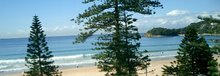
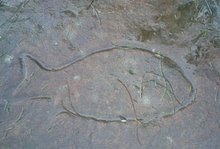
Events in Manly are announced via a BIG CO2 footprint. At the beach front/Corso plastic banners are hung into the pines to announce an event. The banners and plastic strings weighing a few grams are being put up and taken down with a maximum of petrol usage and noise pollution.
Also a huge section of the public pedestrian space is taken up by parking a suv, a trailer and a crane in it. With the machinery running, the worker extracts the bit of plastic.
It is especia lly ironic that 'green events' are being advertised in this emission rich manner. Digital channels do exist. It seems incompatible with the council's 'Sustainability Strategy for Future Generations'.
The 'green family fun' event at Manly Lagoon also degraded the sound scape for the waterbirds/wildlife and adjoining residents. Amplified noise or anthropogenic noise pollution are not beneficial for wildlife. A high impact event.
NB In image 2 note the plane trails of high emission in the blue sky celebrating the aerial combustion engine as well. Families were fascinated with the pollution and the disappearing atmosphere for their off spring.
24 August 2009
Emission Intensive Events at Manly Beach

19 September 2008
Little Penguins, Electrocuted Birds, Mauling Dogs, Bogong Moths, Spilled Oil and Artistic Inspiration
 A visit to the the Manly Art Gallery, where the current exhibition is by Bruce Goold. The designer/printmaker displays woodcuts/linocuts of iconic Australian objects. Nautical themes and Aussie flora and fauna get mingled with sub-urban culture jamming. The fragipani, banana and (unfortunately) bamboo convey that coastal holiday feeling.
Some thoughts on the following themes seen there, which are relevant for the northern beaches:
'Telegraph crows' 1995 depicts Australian Crows getting electrocuted in power lines. Think about it every time you flick on that convenient switch, how many birds and other fauna get killed and crippled by this underdeveloped landscape feature bringing power to you.
The design with Bogong moths was very timely as they will start their annual migration next month. This gets too messy for tidy-town then.

The few remaining little penguins in Manly get regularly mauled by off-the-leash dogs. One of their 'habitats' at the Manly Cove is a busy human infrastructure with fireworks, bands and other mass events. The little bird needs to live in a partial marine and partial terrestial territory. This is the space where human impact in Manly is most noticeable.
 Habitat for Manly's endangered Little Penguin population (pdf) , Manly Cove. More than a webcam needed here.
'Pasha Bulka' 2008 visualises the stranding of a huge cargo ship beached on a Newcastle surfing beach in 2007. 'Heavy fuel oil ' ran into the Pacific Ocean. Such scenarios are not unthinkable for the Manly region. For now, we get the sulphur particle emission from ships that are near Manly.
Outside the Art Gallery there were numerous very large motor bikes parked on the “pedestrian and bicycle path only”. Aerial garbage is a new thing here: Plastic kites in Manly Beach pines, a very long nylon fishing line dangling from a tall palm in front of the gallery, waiting for that next bird to entangle. Aqua-parking as far as the eye could see in Manly Cove, right along the penguin's feeding grouds. Wharf construction set the acoustic ambience.
See also Bogong migration incompatible with humans
Links:
- Endangered Population of Little Penguins (Eudyptula minor) at Manly, NP, pdf
- Caution: Electrocution! Suggested Practices for Bird Protection on Power Lines, BUND, pdf
Update: 0709 The slaughter of 11 Little Penguins by a dog/s in their last mainland habitat on mainland NSW.
17 September 2008
Wobbegong Dreaming at Shelly Beach Aquatic Reserve
 The Spotted Wobbegong (Orectolobus maculatus) is a shark that lives in temperate to tropical rocky reefs. It likes to rest in caves during the day and at night it inhabits the bottom of the shores. Occasionally it ventures offshore. Sea grass beds are the preferred nursery. It has nice spots and a substantial 'beard'. If all is well, it can become 100 years old and measure up to three metres.
But there is a hitch, which is that the majority of Australians live along this very coast-line. The interface of shark habitat and the human field of activities has led to the near eradication of this species.
Extractive practices are seeking to plunder or commericalise every bit of the creature:
Commercial fishing with a high rate of by-kill extracted many, sometimes chucking them if there was no market for them. “Recreational”, sports-fishing competitions and spearfishing do the rest.
 All is well, now that the remaining wobbegongs in the 'wild' are tagged with radio transmitters and seven were bred in captivity, then also tagged and released into Shelly Beach Reserve. ”...Acoustic study and tracking devices will ensure that we can find much more about it.” Fitting electronic devices onto or into juvenile creatures usually employs invasive methods, as the gear is glued on with epoxy resin or suction pads. The ethics of this practice is questionable. Data-gathering from the dry comfort of the screen and DNA mapping might just reveal that the object turned into flake or by-kill yet again. Managing the mind-sets and practices of their own kind might ensure a sustainable habitat and an effective biodiversity management.
Large boats throw their heavy anchors into this delicate aquatic reserve. The noise and chemical pollution they cause is not compatible with a reserve for 'wildlife'. Suburbs drain their effluent into the shores and at night keen divers disturb creatures in their habitats with bright torches.
Just yesterday there were, yet again people line fishing IN the Cabbage Tree Bay Aquatic Reserve. Spearfishing in it has also been reported.
Links:
Spotted Wobbegong, IUCN Programme
Cabbage Tree Bay Aquatic Reserve, Shelly Beach, Manly
NSW AMSA Position Statement on Marine Protected Areas and No-take Marine Sanctuaries, 2008, pdf
Australian shark fishing out of control ,The Nature Conservation Council?
The cost of Recreational Fishing and Boating on the Moreton Bay Marine Park, Bay Journal
Marine, National Parks Association of NSW, advocating the establishment of marine sanctuaries in NSW, only 6.5 % of NSW marine habitat is protected.
08 August 2007
Motormania Manly style
 Inefficient two stroke motors are ubiquitous in Manly (and all over Australia). High-powered and mostly handheld or mobile they are used on land and water 24/7:
- Lawnmowers, whipper snippers, debris (leaf) blowers , chainsaws and sit-on-mowers are in use for 'land-scaping'.
- Motorcycles, mopeds, scooters, diy thingos and model airplanes buzz around roads, pathways and green reserves.
- “One jet-ski driven for one 8 hour period emits the same amount of pollution as a car driven for 100,000 miles”. There are many on the beaches blowing their fumes in the face of swimmers.
- Boat motors are not just revved on waterways, but are 'blown out' in the suburban streets and gutters.
Developing countries tackle two-stroke engines to make them more efficient. In Australia one just wants to 'get things done' – climate and all.