The Royal Botanic Garden is only 15 (nautical) minutes away from Manly. Pedestrians are the main obstacle to the flow of motorised traffic IN the park. A huge building site WITHIN the garden is very noisy. The industrial site-ambiance drives one to the sunny lawn areas (no plants).
It is a pity, how such a mid-city green gem could just turn into an extension of the noisy, dangerous city. It is not easy finding Australian flora, but maybe it is all locked up in the commercialised constructions. Plants seem secondary to the event spectacles that are drawing the paying crowds to the theme park.
The bats are running out of trees and the native Ibis, robbed of their wetlands are declared another "nuisance species". The chicks are just suffocated in a 'cheap' way.
And the restaurant!- better not go into detail.
The image via Google might show how the garden is eaten up in time, not from the outside, but from within.
Update: A decline in visitor numbers - what a surprise. abc 190509
11 October 2007
Sydney Botanical Gardens

04 April 2006
On gardening the mind

"…Most gardens reject the local environment."
The Old Country, Australian Landscapes, Plants and People, George Seddon, Cambridge University Press 2005, p.83 (Manly Library, 581.994 SED)
13 December 2005
Lawn obsession II
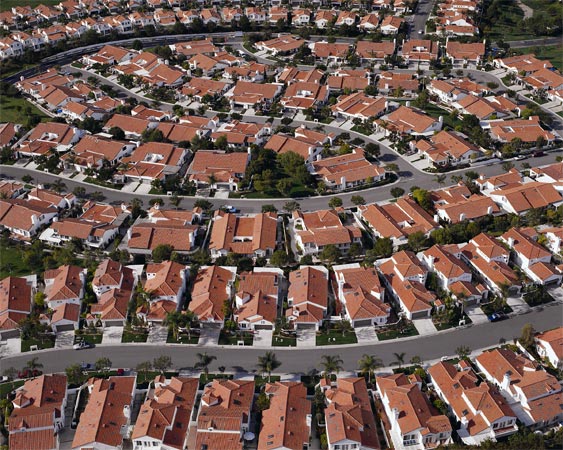
 Mnly reported on the lawn obsession in Australia. An article by Sarah Rich in World Changing recaps the situation for Los Angeles. Two references mentioned there, Archinects and CCA especially provides a very elaborate cultural history of the lawn in sub-urbia. A must-read! Also no shortages of good ideas how to turn these lawns into fruit.
"North America now has more than 32 million acres of lawn under cultivation, occupying more land than any single crop, including wheat, corn, or tobacco. Americans spend $750 million a year on grass seed alone and more than $25 billion on do-it-yourself lawn and garden care, making the lawn and landscape industry a booming sector of the economy." (CCA)
Image:'toxic uniformity'
01 November 2005
Stop killing Lorikeets
Rainbow Lorikeets are brightly coloured parrots that travel in flocks emitting piercing calls in mid-air. Travelling from one pollen source (native trees & shrubs) to another in swift motions. Because of their beauty people are seeking to get close to this protected species. As mentioned before here and here, this form of luring them with inappropriate sugar-based substances cripples them, breeds diseases and shortens their life-span.
Large numbers die from poor hygiene + artificial diets:
necrotizing enteritisIf you would like to admire these fantastic birds, leave them some habitat,
(Artificial unsanitary conditions of containers where many birds aggregate, like in a poultry factory, food and faecies of many are mixed, immunity is lowered)
Psittacine beak and feather disease is an AIDS-like condition, beaks and feathers are deformed, a long agony to death.
or even better make some:
Plant flowering banksias, bottlebrushes, grevillias etc. in your garden or on your balcony.
Unfortunately the responsible authorities are not able to effectively protect the native flora and fauna. Mere recommendations and appeals from tooth-less tigers and ignorant 'kindness' could see this species disappear.
11 September 2005
Native conifers or expensive, toxic weeds?
Despite the down-turn of the horticultural industry the push factor for atrocious weeds continues. The latest seems to be Thuja in all varieties as hedges or feature plants. Most Thuja are so poisonous, that the mere touch causes irritation. Here we go with the new Australian weed, mass planted as hedges, in containers everywhere. The long term costs are already on the cards.
The most beautiful native conifers grow right here in Sydney. Callitris rhomboidea (Port Jackson Cypress) and many others are suitable for the local conditions and provide food and shelter for endemic fauna.
"Callitris species have outstanding qualities which place them far above the exotic Cupressus . . . whether for utility or for ornament there is a Native Cypress suitable for almost every purpose. They are of very great beauty, fast growing, remarkably free from disease, very hardy and mostly very drought and cold resistant." William de Beuzeville
More on Native Australian Cypress Pines (Callitris) and Port Jackson pine
05 September 2005
Feeding flying canetoads and starving native birds
 All over Manly people feed birds. Most try to attract the beautiful native birds to their balconies with sugar water or other inappropriate or dangerous offerings. Some even actively feed known flying pests, such as Indian Mynas with dog food, bread and bought seed mixes. In public places, people feed fast food to gulls and pigeons. These areas are caked in avian faeces. People eat in them, sit there or park right in it.
A search on 'attracting birds' offers all the commodities that make the pet industry thrive, but leads to malnutrition, sickness and finally death to the endemic birds. Mice and rats are also attracted.
Where is the pleasure in creating dependent relationships? Is there no knowledge in the act of 'giving', that starves the bird of necessary nutrients and social behaviour?
It takes a lot to allow the 'bush' to co-exist in which birds can thrive even close to human habitats. Earnest devotion, care and resources are required to bird-scape a yard/garden. This is no longer cheap thrill, but a setting aside of one's urban footprint to further the existence of native flora and fauna. It means not having that BBQ-temple, the 4th car space or the white fluffy thing etc.