2010 8 killed, May 2011 7 known bandicoots killed
Vehicles rush in 'to get a view' on North Head 'Scenic Drive'. They park for free or take their dogs for walks. Pet rabbits are also being 'freed' and mingle with the giant rabbit population denuding the National Park. Free range pets, motor vehicles and urban intensification contribute to the declining populations of this endangered species.
Showing posts with label cars. Show all posts
Showing posts with label cars. Show all posts
11 May 2011
Long-nosed Bandicoots of North Head Manly

22 June 2009
Manly Beach Spirit
 SUV driver aiming to plough their way across pedestrian strip, despite the pram, three adults and dog. All non-motorised beings had to dodge to survive. Pedestrian crossing, Sth Steyne/Victoria Parade.
Marine Corps style female fitness runner banging into walkers (obstacles) on 'their' gym track and injuring them. 'Fitness Boot Camp': I, me & myself, get out of my track. Shelly Beach Walkway.
Black suv racing , endangering others. Sydney Road, along Ivanhoe Park.
Families mistake the severe beach erosion as an adventure playground: Small children are playing amongst the dislodged rocks, cement chunks, crevasses, debris, fibrous mats, dunes and backwash. The 'stormwater' run off pipes (eutrophication) draining the suburbs, seem to be the highlight of small toddlers. Manly Beach
20 May 2009
Roadkill at Ivanhoe Park, Manly
 Parks or public green spaces are under constant pressure as they are seen as Terra nullius to be 'developed'. Ivanhoe Park is squeezed by two large roads (Sydney/Raglan), giant sports arenas, a large pub and other commercial facilities. The squeeze continues on this little island of flora and fauna.
We have stopped counting the road kill on both roads of native birds and marsupials. Today another Ringtail possum was smeared by racing drivers across Sydney Road. There seems to be a kill every day now... going unnoticed.
Image: Google Maps
27 September 2008
Manly Beach Bike Week - Sustainable Mobility
 Manly Council is hosting the NSW Bike Week, (pdf) (RTA) on Sunday, 280908 from 10 am to 4 pm at North Steyne.
The key objectives are to
" Raise the profile of the use of bicycles for short local trips.
Promote safe cycling and the use of shared bicycle/ pedestrian facilities."
The Road and Transport Authorities main aim is to improve safety on the roads.
Once one has "dusted off" one's push bike and obtained safety gadgets it is off to a high risk territory of armoured and petrol-powered vehicles.
The motorised community's behaviour hits the attention-economy daily with news of road rage, bullying, 'hit and run' and ploughing into pedestrians or their houses. "Accidents", speeding and intoxicated vehicular manslaughter are the norm. Bodily harm is also caused by  the noise and chemical pollution that is being inflicted on all. Pedestrians and cyclists wishing to share this space seem to be perceived as a lower species with less rights, as they are not obtaining power derived from fossil fuels. Not contributing to Australia's record emissions they are treated as being 'in the way'.
Awareness needs to be raised not in the community that is achieving sustainable mobility, but in the petrol vulnerable car-dependent nation and its mind-sets. Structural change needs to to facilitate safe and emission free transportation.
Many bikes in Manly still arrive on/in cars. The 'leisure bikes' get unpacked with idling motors at t he beach/car-park. Variations range from plastic uniformed racing bikes, to large family groups, with children often on dysfunctional cheap 'throw-away' bikes and mounting-bikes looking for municipality tree-edges to crack. Of course, there are some real-life cyclists arriving on bikes as well. But all are seeking to join in on the heel-to heel packed 2.4 kilometre (1.5-mile) Pacific beach path. The cycle/walkway proper is situated along the beach car park with many cars having hard or sharp protrusions right over the cycle path. At night the beach walkway has racing bikes endangering pedestrians. Off the beach drag, the fragmented bike paths are often parked on. Without the provision of physically-separated bicycle paths the life of a bare body on a wire frame is taking a higher risk. Arriving for ones "short local trip" there are insufficient bike racks to do the shopping. The odd bicycle bar is often taken up by motor-bikes, conquering the pedestrian paths increasingly. Resorting to tie the bike to trees/palms further degrades the neglected trees.
Leaving the bike and attempting to cross any marked pedestrian  path is a struggle, and one had better run. The designated 'pedestrian zones' are most of the time filled with delivery trucks and trades vehicles. Idling is the norm. Car design regulations in Australia are lagging behind causing injury and death to walking people and cyclists. Fatal injuries could be avoided by spending a bit on reducing harm to the 'collided objects'.
"About 300 pedestrians and cyclists are killed in vehicle-related accidents on Australian roads each year and another 3000 sustain serious injuries.Cycling is a wonderful form of mobility, but the mind set of the car addicted community and their practices has to be targeted and structural urban changes have to be realised and enforced.
The most common injuries are serious head injuries, broken legs and ribs and fractures to the pelvis."
Images:
1. Corso 'bike path'
2. Beach bike path with dangerous protrusion in ya face
3. Beach bike path with knife-like instrument at head level
4. Manly Cove pedestrians & push bikes only!, 3 large motorbikes, one idling bus.
Links:
- Video, Physically seperated bike lanes, US
- Fatality Analysis Reporting System with Google Maps, US
- Shocking the suburbs: urban location, housing debt and oil vulnerability in the Australian city , Jago Dodson and Neil Sipe / Urban Research Program
- Pedestrians at risk as car safety rules slip behind, SMH 270908
- Risk for cyclists 'increasing' on Beach Rd, SMH 270908
- Bicycle Paths, Manly Council
- Bikely Maps and Routes
- Sydney Cyclist
- Pedal Mobility
- They complain about birds swooping cyclists in their breeding season as they run out of habitat. Pity, there are no corresponding articles about the deadly dangers posed to pedestrians and push-bike riders by urban tanks steared by aggro drivers at pedestrians, push-bike riders and birds. (Manly Daily 021008, the dead-tree version is most reliable!)
13 September 2007
The world as a car park - hot and oozing toxins running into our water streams
 A growing amount of the Earth is sealed with non-absorbent surfaces to ease the flow of automobiles. The result is warmer urban temperatures and polluted water ways.
Bryan Pijanowski found that in a mid-size shire “...parking spaces outnumbered resident drivers 3-to-1 and outnumbered resident families 11-to-1”. Car parking spaces were “...larger than 1,000 football fields, or covering more than two square miles.” Car parks “... turn out about 1,000 pounds of heavy metal runoff annually ”. Leaking car batteries and airborne fumes all found their way to the impervious surface and then to the next water body.
The temperature in these areas is raised by '2 to 3 degrees Celsius'. The researcher reminds us that 'land is not unlimited ' and we should “ seek a lifestyle that requires less automobile use”.
 Australian research has looked in detail at what is running down these hard surfaces to the beach and other waterways. “Roads make up about one-fifth of the urban land area”. They claim that the run-off is a cocktail of toxic waste. Rain or any other liquids then wash these poisons into the water bodies. “ The dust then enters the waterways, silting up creeks, ponds and wetlands.”
They found 20 chemicals on Sydney's road surfaces, such as:
- Environmentally persistent chemicals
- Polycyclic aromatic hydrocarbons (PAHs) from “ vehicle exhausts, asphalt roads and fires”
- “ Nicotine, most likely from tossed away cigarette butts, is an alkaloid with a half-life in the environment of 30 days and can be toxic to aquatic organisms”
- “ Trace amounts of heavy metals such as lead and zinc from tyres, petrol and bearings; chromium from wear and tear on car bodies, and copper from brake linings”
- Plasticisers
- “ Phosphorous that leads to algal blooms”
Links:
Convention on POPs
07 September 2007
On crossing roads in Manly and surviving it
For most of our centuries, walking was our primary means of locomotion. With the advent of motorised transport our known planet became restructured to suit the flow of these auto-mobile devices. People underwent a century of reprogramming their central nervous system in tune with the flow/jam of the 'traffic'. Children (video) and adults (video) were being instructed to fit in to motorised society.
In the meantime, the-to-be-negotiated-space is more akin to a war-zone. Armoured urban tanks ram places, plough into people and houses, mount curbs and pin pedestrians to the wall. Raised, with metal roo-bars they conquer every cm of the urban territory. Council attempts to stud pedestrian zones with iron posts. On the roads "The pedestrian remains the largest single obstacle to free traffic movement."
So it you do wish to cross a road with traffic lights in Manly, here is an instruction that might increase your chances of survival:
- Wait till the traffic lights turn green for pedestrians, not breathing too much
- Do not cross!
- Check for cars, 4WDs, (especially the black ones with tinted black windows), because they might just want to go in spite of any lights.
- Remember, they just throw in their weight.
- If all seems clear and the lights haven't changed to red.
- Run – looking right/left simulaneously.
Perils for Pedestrians, videos
The End of Suburbia
Video via Endofsuburbia, "We're literally stuck up a cul-de-sac in a cement SUV without a fill-up" - James Howard Kunstler
Update 110907 Urban planner concludes:
"..Sydney's roads, footpaths and traffic light configurations all conspired to favour the car... They were a product of traffic engineering that was refined in the 1960s and '70s but never reviewed. Sydney pedestrians can spend as much time waiting to cross the street as they do on the move because the car has ruled the city unnecessarily for 30 years. Measures to alter the balance between drivers and walkers range from the radical - doubling tax on fuel - to the subtle - altering the configuration for turning left and right off thoroughfares."
21 June 2007
Attracting more motorised vehicles to Manly beach
 Some cities aiming for sustainability introduce 'pay as you drive' schemes. Transportation in Sydney is 'going nowhere', killing many, endangering health and hotting up the Earth for all to come.
But Manly is going the other way, parking out the beach will become even cheaper. Beachfront parking already increases traffic and the associated noise and air pollution. Foul smells and deafening noises enter the eateries and cafes at the beach and the CBD. Hot bombs fly along unrestricted. Even on the beach promenade the negative impacts can be heard and smelled. Sometimes even there are motorised vehicles on the pedestrian path. The stated goal of 'maximise (car) parking' seems contrary to any proclaimed goals of sustainability.
Just one look at the many parked bikes and walkers and one can see that residents and visitors want bikeability and walkability in a unique place. Yes they do shop too and spend money in restaurants. But in the absence of 'a chambre of non-motorised residents and visitors', no one seems to consult these stakeholders. Lets not consume the uniqueness of Manly beach in one gulp.
Consider a car-free beach, even a walkable, cyclable town.
A world for cars
16 June 2007
Unique wildlife - can Sydney afford it?
 In most sub-urban space people are unwilling to share with native wildlife, especially because of habitat destruction. Their individualised transport modes fragment animal habitat even more and make it deadly for all. Just like many human beings are killed and maimed on these motorised mobility arteries, so are the local Australian animals.
In only one of Sydney's suburbs on the North Shore (map) a study has found the following:
"One possum per day is dying on a single 40-kilometre stretch of road”.
The researcher collected
600 dead possums,
dozens of local birds and
10 dead bandicoots in a 2 year period.
Elsewhere, in Tasmania 1,700 Tasmanian Devils get killed on the roads every year.
People living in the remaining iconic Australian bush report the following on their walks:
“In six months I’ve counted
eight dead wallabies,
today’s possum,
plus several pigeons,
a kookaburra,
a noisy mynah...,
a couple of young magpies,
a galah,
plus countless lizards and snakes.
They’re just what I’ve seen walking one or two days a week, on a road without much traffic. “
In local National Parks I have seen irresponsible cars racing, deliberately knocking down wallabies. Many of these killing incidents are not accidents, bad and neglectful infrastructural planning is a cause, but willful racing, or even 'possum busting' seems to be a national sport.
Reported acts of individuals eradicating wildlife in their habitats:
- Shooting at dolphins in the Adelaide Dolphin Sanctuary
- The brutal massacre of kangaroos in Murramarang National Park
- The “...indiscriminate shooting of native animals and vandalism in reserves north-east of Bombala.”
- Updates: Severed heads of five kangaroos found on beach, handy bait?
- Torture, killing kangaroos
- Running over collaborative Echidnas in migration
- Shooting a Koala at Breeza, 'shotgun pellets were found throughout its body'
- Suspected poisoning of four possums in a beach suburb of Mackay
- A body of koala was found in a garbage bin in Brisbane, another koala with her joey had sticks and rocks thrown at it by teenagers.
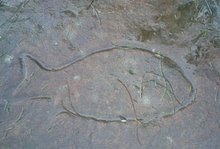
Images: Ringtail sculpture & Eora 'graffiti', rock-painting.

Subscribe to:
Posts (Atom)