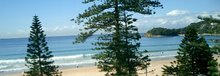
Manly Beach currently has 3 time zones - South Steyne, North Steyne and Queenscliff. Please adjust your watches as you proceed along the beach. The most reliable chronometer is at the North Steyne pavillion. It tells the correct time twice a day. To set your watch/mobile, please check the time there at 10.20 am or pm on any day. If you are not sure if it is 10.20, just ask someone at the beach. For summer time add one hour.
It is recommended that you pay careful attention to the time zones as beaches are only patrolled at certain exactly defined times. Note that Queenscliff time is usually one hour later than South Steyne time and North Steyne time is identical to South Steyne time and Queenscliff time twice a day respectively at 10.20 am or pm.
If you are unsure which time zone you are in, check for the lines on the sand or ask a local official or resident.
“Manly Beach 1000 miles from care, 3 time zones.”
Does Anybody Really Know What Time It Is? Chicago
05 November 2010
Manly Beach Time Zones

17 July 2009
Beach Sand, Fecal Contamination and Salmonella
 Salmonella has been found in sand of playgrounds in Mona Vale, Winnererremy Bay, Warriewood, Palm Beach and North Avalon. One year on and the bacteria (Salmonella paratyphi bio var java) have resurfaced in the sand. In Dunbar Park, which is now closed the sand will be replaced with 'treated bark'. Both in May 08 and November 08 Mnly wrote about the connections between(exotic) pets, fecal contamination and aggregation of minors in beach sand.
New research has also found that people digging in beach sand or building sandcastles risk gastrointestinal diseases and diarrhea. The epidemiological study looked into sand contact activities and illnesses.
"Researchers found evidence of gastrointestinal illnesses, upper respiratory illnesses, rash, eye ailments, earache and infected cuts. Diarrhea and other gastrointestinal illnesses were more common in about 13 percent of people who reported digging in sand, and in about 23 percent of those who reported being buried in sand...We have known for some time that swimming in waters polluted by fecal contamination can result in illness, but few previous studies have focused on sand."
Beach users should use a hand sanitizer or wash their hands/body after contacting beach sand.
The runoff from urinating and defecating dogs at the beach promenade/wall, draining through the pvc pipes/stairs onto the beach sand does not seem to make the beach sand less risky.
 Questions remain:
Where was the sand sourced from that covered the playgrounds?
Where can information be obtained regarding fecal contamination of beach sand at Manly Beach?
Links
Sand, salmonella, e-coli and that cute pet, May 08
More salmonella mysteries on the Northern Beaches, November 08
University of North Carolina at Chapel Hill (2009, July 10). Digging In Beach Sand Increases Risk Of Gastrointestinal Illness. Via ScienceDaily
Christopher D. Heaney et al., Contact With Beach Sand Among Beachgoers and Risk of Illness, American Journal of Epidemiology Advance Access published on June 18, 2009, Am. J. Epidemiol. 2009 170: 164-172; doi:10.1093/aje/kwp152
30 June 2009
28 June 2009

22 June 2009
Manly Beach Spirit
 SUV driver aiming to plough their way across pedestrian strip, despite the pram, three adults and dog. All non-motorised beings had to dodge to survive. Pedestrian crossing, Sth Steyne/Victoria Parade.
Marine Corps style female fitness runner banging into walkers (obstacles) on 'their' gym track and injuring them. 'Fitness Boot Camp': I, me & myself, get out of my track. Shelly Beach Walkway.
Black suv racing , endangering others. Sydney Road, along Ivanhoe Park.
Families mistake the severe beach erosion as an adventure playground: Small children are playing amongst the dislodged rocks, cement chunks, crevasses, debris, fibrous mats, dunes and backwash. The 'stormwater' run off pipes (eutrophication) draining the suburbs, seem to be the highlight of small toddlers. Manly Beach
25 May 2009
Plastic Pellets and Erosion at Manly Beach
 Wild weather events have brought forth two unusual phenomena at Manly Beach: erosion and plastic pellet pollution.
Erosion: At the south end , especially near the Life Saving Club the sand has dropped by 110 cm. Large chunks of cement, rusty iron pipes and sandstone are exposed. The stairs' foundations and the old infrastructural stumps have been exposed.
Plastic Pellets: Nurdle (pre-production plastic pellet or plastic resin pellet) are approximately 5mm in diameter, white or discoloured. All of it 'gets lost' in the industrial production and transportation of plastic products. Once in the ocean they become 'mermaid tears'. Many animals at the ocean become sick or die from them. In the end they enter the entire food chain. Additionally they leach plasticizers. They are also a transport medium of toxic chemicals (PCBs, DDE) in the marine environment. In the Great Pacific Garbage Patch giant amounts are in a vortex till the next  gyre hurls them in any direction.
The plastic pellets have in the memory of Manly blog never been seen on the beach. There is also a lot of general plastic debris as well all along the beach.
Is there a marine science body responsible to monitor such occurences, or is it all up to the expertise of life savers? Links:
International Pellet Watch, Global Monitoring of Persistent Organic Pollutants (POPs) using Beached Plastic Resin Pellets.
Plastic Debris, Manly Beach
Coasts eroding, tag, abc
07 May 2009
Manly Beach Video with 'Announcements'
Manly Beach video made with a mobile, mashing up some of the audio-scape of the life guards' announcements and the sounds of the Pacific ocean. More ocean animations full screen...
Via DotAtelier
02 December 2008
Manly Beach Drift "wood" - December
 A monthly summary of what has washed onto the shore or beach through the winds, tides, waves or human action. Marine debris, flora and fauna, dead or alive:
30+ dead Leatherjackets again, possibly Meuschenia flavolineata, (10-20 cm long). Kids p laying 'ball' with them. Millions of mostly still alive Ladybirds at the water's edge, struggling. There appeared to be no 'white collar', probably a native. Many aphids, scale insects, mealybugs, and mites will not be eaten this season by this 'gardener's friend'. As with the mass occurrence of dead crickets (021108) it is unknown how they ended up in this environment.
The usual 'fast food' wrappers and many 'gift-wrapping strings' with balloons, ready to entangle. Beach worm 'harvesting' and fishing 'classes' now at the waters' edge. High speed kite surfing poses a serious danger to swimmers/surfers and beach users.
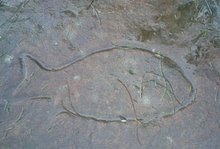
Image: sandsculpture, kelp and pine needles 021208
A seagull had both feet tightly entangled by a fishing string. It could hardly walk or balance. Do we really need 'recreational taking' on busy urban beaches? Container ships hovering on the horizon. 031208 Thousands of Ladybirds struggling at the water's edge again. Seagulls gorging on the live ones. No one seems to notice, as strangers are usually recognised, by exhibiting curiousity and looking at objects at the beach. For the locals it is just a tabula rasa to do stuff on. Giant sand castles with deep trenches, possibly to trap joggers in the dark?. Various container ships cluttering up the horizon, possibly heavy in junk for the coming exchange festivities. At the North Steyne cliff end a White-faced Heron (Egretta novaehollandiae) was stalking insects and amphibians in the urban run off. Rock engravings of the Eora people depict this coastal bird doing its thing for thousands of years. An off leash dog did not allow the bird to continue feeding. 041208
 A 2 m long log covered densly in living Crustaceans. The Goose barnacles were of white/blue colour. The life raft was returned to the sea. A pelican was gliding north, looking like a flying ancient lizard.
A double rainbow again, nicely offset against the plump white clouds. A few blue bottles , many dog paw prints in the sand and black dog feces plastic bags sloshing in the water. 051208
Post Care Day and after rain. A huge soggy pond at the pipe. Leaf litter plus sub-urban run off, hanging around the surf. A large amount of garbage, mainly plastics: wrappers, bottles and an unusual amout of 'party ballons' with long 'fancy' wrapping ribbon of all colours- ideal to entangle. Inflated baloons blowing around. Again, full nappies, a syringe and chemical loo cleaner.
A near-death shearwater, an unusual number of seagulls with only one leg. Many blue bottles, nice kelp of all different shapes. Painted driftwood and building materials. The daily dog on the beach, hopping about on the prize winning North Steyne beach. A person flying his surf kite over the heads of swimmers/walkers ('obstacles') at very high speeds. Above the water, control of the medium seems to be beyond the guy stearing it. One day a beach user will be injured by these speeding installations. Council probably is liable for such eventualities. 081208 A few small Abalone shells (Haliotis coccoradiata), rarely larger than 3 cm. A nice audio-scape coming from the rows of pines: Sulphur-crested Cockatoos (Cacatua galerita), Red Wattlebirds, (Anthochaera carunculata) and Ravens (Corvus coronoides). Black faced Cormorants flying north. 091208
Powerful fast clouds stroke the beach. Welcome Swallows (Hirundo neoxena) surfing the dunes at high speed, mopping up insects. Ravens eye the dead fish. Rich leaf litter, blown down the hills from endless noisy debris blowers which move the sub-urban debris into the public gutter and down to the beaches. Civilised places have given up the polluting of air and water a long time ago. 101208
> Drift "wood", November 2008
26 November 2008
Managing Busy Beach Environments
 Benidorm in Spain went from a small fishing village "formed by two crescents of fine golden sand" to a 2.6 million tourists a year high-rise beach - "the Dubai of Europe". Intensifying alcohol- fuelled festivities in a mass tourism location distracted visitors that might have sought the uniqueness of a place.
Benidorm now wants to turn around and secure just this one-off status by seeking to protect and promote its world cultural and natural heritage. To become a Unesco World Heritage Site one has to clean up their act, so they drafted a 73-article code of conduct for beach users:
€1,000 ( 2,011.50 AUD) Bathing under "red flag" conditions
€750 Fishing (€1,100 with a harpoon)
€1,100 For Bonfires
€250 Bringing glass containers on the beach (€750 if that container breaks)
€250 Taking animals on the beach
€300 Drinking alcohol, selling merchandise (conducting outdoor businesses)
€150 Urinating or defecating in sea or sand
€120 (£102) Playing ball and paddle games outside authorised areas
€150 Early staking-out of a prime spot on the beach for later use
€750 Using the beach (for a party, sex, stroll) from midnight to 7am
Source: The Independent
02 November 2008
Manly Beach Drift "wood" - November
 A summary of what has washed onto the shore or beach through the winds, tides, waves or human action. Marine debris, flora and fauna, dead or alive:
Dead crickets (Gryllidae), along the entire beach, a thick layer 1 to 2 m wide of dead insects. Seagulls were feasting on some of them. There was talk of aerial spraying locust in Sth NSW/North Victoria. Bees in Victoria were protected from the pesticides. Any connection? A dead Petrel. Thick clumps of kelp. Some blue bottles 021108
Rabbit poisoning (sodium monofluoroacetate?) is taking place in the Mona Vale Beach area. An unusual amount of dead birds, fish and insects were observed there. (Manly Daily, 041108, p2) Just a reminder, there were unusual numbers of dead fish (moray eel) at Manly Beach (081008), a dead albatross (021008). There seems to be no monitoring body of these mass ecological occurrences or possible eutrophication. It will be a different 'silent night' without the chirping of the many crickets.
Today, many translucent jellyfish, (10-15 cm round), a nice large shark egg case, maturing kelp and sea gulls and their young all along the beach. 0411108
Many glass-like translucent jelly-blobs, one had rusty/ red tentacles. 5 dead black seabirds, more kelp, fresh large blue bottles. Many plastic lighters. At the rocks off Queenscliff Rockpool, one rock had been cleared of all the oysters. Right in the run off from all the houses and toxic Manly lagoon. Yum! 051108Post weekend frenzy: 8 dead shearwaters, possibly short-tailed shearwaters. No, it was not starvation and exhaustion' which kills them but 'fishing'. One had been trapped by a fishing hook of a human being, it had a long nylon string tangling out of it's beak. Is there any monitoring body for the eradication of wildlife in this biome? A marine wildlife annual database?
Fishing took place just there at Queenscliff Rockpools and at the weekend the ocean was full of boats in full take-mode. The multiple fishing rods on the busy beach are a hazard to people and wildlife. Busy urban coastal areas must be free of 'recreational taking' and sharing of their dangerous debris.
One dead Weedy Seadragon (Phyllopteryx taeniolatus), a lot of kelp, many sepia hulls and very large bluebottles. Full "disposable" nappies were generously left behind. The usual plastic 'convenience' food, drink and toys. Giant sand castles, are being built by large optimistic families, simulating rapid and extreme climate change. 101108 Image: Bird hanging by long nylon string out of its beak.
Polystyrene, the white crumbly plastic that does not biodegrade in various chunks and pebbles. Many plastic dummies and the usual plastic bottles and plastic tops galore. A lot of 'gift wrapping', long enough to entangle any marine creature. A lot of dead winged insects and lost mole crickets.
A lot of grey round pumice again and brownish foam that sits on the sand for a long time. The surf is lapping at the cement stairs.
There is light pollution emanating from new street lights, starting at North Steyne and continuing along half of the beach. One of the mega-lights even stays on all day. Turning the dark sky and the Pacific into an overpowering glare. So much spare energy, blasting emissions like there is no tomorrow. For beach/promenade users it is unpleasant, for birds and insects deadly. Residents living in this 'sport-light' ambiance must be blinded. 141108
A few Crested Terns (Sterna bergii) mingling amongst the Silver Gulls (Larus novaehollandiae), a sure sign for hotter days to come. A fluffy thing, called dog walked along the beach illegally in bright daylight.
The disappearance of the horizon - hardly a day goes by where there is an absence of toxic diesel spewing container ships hovering until they can enter the jammed harbour to spill their o.s. commodities on to hungry consumers. More frequent ships increase the risk of oil or chemical spills, as well as exotic marine pests. They are not just clutter on the horizon of a beautiful beach, but a health hazard to all coastal and harbour residents and wildlife. 171108
Another dead moray eel, large blue bottles and many dead bees and other winged insects. 181108
Large amounts of leaf litter, mostly Brush Box (Lophostemon confertus). Either the rain washed them in to the ocean or some considerate person blew them against the wind with their debis blower. A Magpie checked the litter out. Stunning rainbows. 201108
A cold and rainy day. Sub-urbia washed its load onto the beach, the run-off looked like a mix of dark dust, gum leaves, speckled with jacaranda and bougainvillea flowers. Contractors and residents blow the debris of the 'nature strip' into the common gutter. The unwanted of blandburbia is transported via a million noisy petrol powered machines into Manly Beach, the Pacific. There were also many cigarette butts. A chucked unwanted lobster head, full nappies again. A racing beach buggy did not improve the air.Floating in the water a bright plastic buoy, with a couple of long strong ropes and a heavy lead/metal weight attached to one of the ropes. The inscriptions read:'MANLY JLSC 'Nippers''. Turning the beach into an event zone and leaving potentially deadly junk floating for marine mammals to get entangled in can't be kid's fun or delight any sponsors. Floating plastic debris and the possiblility of entanglement does not seem to be in the spirit of "Ocean Care" or good PR for Manly beach. 231108
A fresh smell today of salt, fresh fish and kelp. Huge waves and golden sand. 241108
Many plastic bags, full nappies and a not so fresh smell 251108Grass stars (inflorescences of Spinifex sericeus) rolling along the beach looking for suitable real estate to bind the sand, stabilising against coming turbulences. Human stampedes limit this colonizing grass in its dune-binding function. A large variety of different kelps today.
Many non-biodegradable balloons sloshing along the beach. Balloons have become a popular way of advertising one's business, as well as staging events and parties. There they are - in all colours, maybe ending up in the intestines of a whale. Later to be found stranded and more than three square feet of plastic would have to be removed from it's bowl.
Many sharp and dangerous pieces of glass of all colours along the beach. Each bottle taking one million years to break down. The disposable diapers were still there - in 450 years they might be gone. The mono filament fishing line tangled around Queenscliff Rock Pool grids will take 600 years to disappear. Many plastic bags. There is a lot of polystyrene and garbage trapped in between the rocks at that location. So much for ocean dumping for one day 261108
> Drift "wood" December 2008


10 August 2007
Dolphins passing by Manly Beach
 A minimum of 10 dolphins swam in tight formation along Manly Beach today around 5pm. They seemed to come from Queenscliff, going straight to Shelly Beach breaching occasionally. Not many people seem to notice.
22 July 2007
Pines and birds at Manly Beach
 Manly Beach once had sand dunes and heath vegetation on it, but now it has rows of pines. These giant conifers (Araucaria) are living fossils originating from the Mesozoic (251 to 65 million years ago). The Norfolk Island Pine, (Araucaria heterophylla) endemic to that island has been planted along the beach promenade. For 40 years they appear symmetrical in form, then the 50-70m tall giants arrange their shape according to the environmental conditions. There are other tall gymnosperms growing throughout Manly, Bunya, Hoop, Kaurie and many more.
At dusk these 'trees of life' at the beach start to become alive with the screeching of the local Rainbow Lorikeets. The giant remaining figs sound with fig birds. Lorikeets fly in large swarms over Manly screeching as they go, which is unusual for bird swarms. Suburbia is still intent to feed these creatures to death. > Black Cockatoos calling the rain
The video captures some of the 'beach corridors', where Lorikeets, Wattlebirds, White Cockatoos can still mingle.
Thanks to DotAtelier for the video
20 October 2005
Manly beach mix

effluent, sewer, discharge
stormwater pollution, marine pollution
cost-effective waste disposal, but unsustainable.
'externalities'!