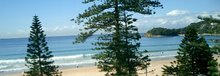
'Mystery' has struck again. Sand contaminated with Samonella paratyphi B var java was found again on the Northern Beaches playgrounds. "Hitchcock Park at Avalon and Winnererremy Bay at Mona Vale on the Northern Beaches have been fenced off for the second time this year, while a third South Avalon playground has not re-opened since May". Replacing (some) of the sand did not work. The bug, linked to exotic fish/pets can cause serious illness.
In pet-fanatic Manly off leash dogs mingle in playgrounds and on the beaches with toddlers. Apart from community hygiene standards and enforcements, it does not instill confidence that possible bio hazards could also turn out to be 'mysteries' for half a year or more...
More:
Salmonella paratyphi bio var java contaminated grounds May 2008
19 November 2008
More Salmonella 'mysteries' on the Northern Beaches

23 October 2008
Halloween - Spoooky for Australian Children
 WOOHOO! - It's Halloween again. Let's see what spine-chilling, scary and weird spook lurks in the closet this season.
It has been found that educated and mature parents, capable of long-term thinking/planning produce healthier and smarter kids "Children with highly educated parents, and from families with two working parents, display higher cognitive ability and appear to have fewer behaviour problems." Depressed and immature parents are probably not ideal carers.
The 'One minute a day-dad' is probably steering his attention towards electronic interactivity, just as the mother/carers are not investing in interaction with the child.
Not learning to focus in a social setting could lead to 'Attention-Deficit Hyperactivity Disorder' (ADHD). “Drugging unruly children is a method of social control “ in Australia and the U.S. especially. Being under six years old for 'the pharmacological solution' seems no barrier. Later, cognition can be chemically enhanced and psychotropic medication usage becomes prevalent for young adults.
“ Drinking as a means of self-medication” is usually adopted in the parental milieu and might be advanced into "binge drinking" or a “Culture of Extreme Drinking” and self-abuse.
The 'home' environment is a dangerous place: No, not spooky bats, but family dogs maul helpless children to death (here, here, here & etc) or transfer their diseases (image). Nothing is done.  Alone in deep water (pools) is also a high risk environment(2 yo, 15 mo, 2 yo). Just mower injuries are considerable.The media is awash daily of violent crimes committed by the 'hand of the carer' against helpless infants, toddlers and children. In 2003 "almost 3,500 children under the age of 15 die from maltreatment (physical abuse and neglect) every year in the industrialized world." (UNICEF 2003, pdf) Nothing much seems to change.
Scaffolding society does not seem to lend much support either, in fact the human balance sheet is sliding into that of a 'developing' country: Australia "continues to accept mediocrity for our young people" at a time when we top the rankings of some global prosperity indices....I'm disappointed in the way Australia has become smug about being top of the pops in wealth and sport, but for the most important element for the future of the country, our children, we're way behind the eight ball," says Professor Stanley.
- Dying very early: "Australia ranks 20th out of 27 nations for infant mortality.""The infant mortality rate for Indigenous Australians is more than double the non-Indigenous rate - we rank in the bottom third of the OECD nations for infant mortality."
- Violence: "There are too many "deaths from injuries and non-accidental deaths...These are children who are killed - neglected so much that they die."
- Children getting children: "Teenage pregnancy rates are much higher than the OECD average, and rates for Indigenous young Australians are the highest in the OECD"
- Lack of sustainable public mobility: Youth road deaths are 12 times higher than Portugal. Chuck mum's SUV. "We need to get kids walking to school, so they can get both exercise and get to know other children.”
- Choking on Pollution: "Australia's asthma mortality rates are one of the highest in the world" pdf
- Mental health: - Australia ranks "13th out of 23 OECD countries on childhood mental health".
- Food/Socialising: Australia ranks "21st out of 27 for children eating meals with their parents."
- Communicating: "We have half the rate of parents just hanging out and just talking to their children than Hungary does for example - Hungary is the best in the OECD," Professor Stanley
A crowded, hot, water-less and polluted world, without all the other species will be very unhealthy.
The environmental heritage left behind is far from inter generational equity according to this report:
All will have to deal with bio-accumulation:
- Groundwater and surface water contamination,
- PCBs, Radioactive waste and uranium mining, mining activities generally
- new emergent chemicals/toxins
- Urban air quality
- Untreated sewage
 In Manly businesses are eager that all immerse themselves in plastic gadgets and costumes, which will soon end up in the tip, or worse the ocean. Trick or treat for advanced children ends up nasty and violent and only keeps the authorities busy.
The best green 'party' (celebration) people could offer the little ones would be to face up to their actions, access their values and act responsibly towards themselves, their offspring, the other species and the remaining biomes and give the Earth a chance. Quality interaction and doing things from scraps can be a lot of fun .
See also: "Manly- It's kinda spooky 2007"
Images: All public art works by young people o.s. Known here as 'graffiti', as it often just is the initials of the scribbler in Manly.
Links
- The Australian Research Alliance for Children and Youth -ARACY Report Card on the Wellbeing of Young Australians,
- Never better - or getting worse?The health and well being of young Australians, Australia 21, Richard Eckersley, pdf, 369KB
- John Pilger, Under cover of racist myth, a new land grab in Australia, Claims of child abuse are proving a fertile pretext to menace the Aboriginal communities lying in the way of uranium mining. The Guardian, 241008
- A conversation with Professor Fiona Stanley, (Professor in the school of paediatrics and child health at the University of Western Australia, and UNICEF’s Australian Ambassador for Early Childhood Development. NHMRC, 0708, podcast
- Garnaut, Climate Change Review
- Intergenerational Justice, 2008, Stanford, Philosophy
- Top ten World's worst pollution problems 2008, Green Cross & Blacksmith Institute
- Australia’s health 2008, Australian Institute of Health and Welfare, Canberra, pdf
- Costume suggestion for 2008 : Plastic choked mermaid at Manly Beach
08 August 2008
Hindering the physical and neurological development of children
 As reported before: Extended time, flat on the back, lacking sensual interaction is a form of deprivation for developing human beings. The average child might now spend extended time in a 'convenient' capsule. “Parents are not picking up their infants when the infants are awake... you get a stroller and car seat combo. And because the car seat snaps in and out of the stroller and the vehicle, often the baby simply stays put after reaching a destination.” These “mobility” gadgets might appear as a convenient “life saver” for parents in their 4x4s/cars.
For the capsule-bound and interaction-deprived infant it often means:
- motor delays
- “.. developmental, cognitive, and organizational skills delays, eye-tracking problems, and behavioral issues”
- the flattening of the baby's skull, occurs “in infants who spend too much time on their backs while awake.”
- This syndrome is also termed 'Flat-head syndrome' or plagiocephaly.
 “In recent years, craniofacial centers and primary care providers reported a dramatic increase of up to 600 percent in referrals for misshapen heads.” Various service industries and products (eg cranial helmets) have sprung up, promising 'corrections' of the unintentional cranial modification. The hindered development of the neurological network will most likely be a life-long handicap.
 Experts are urging “parents and caregivers to ensure that babies get enough "tummy time" throughout the day while they are awake and supervised”. Quality interaction is needed to produce a human being through interactive behaviour. "Increasing the amount of time your baby lies on his or her tummy promotes muscle development in the neck and shoulders; helps prevent tight neck muscles and the development of flat areas on the back of the baby's head; and helps build the muscles baby needs to roll, sit and crawl" "It's important to get our infants out of devices that constrain mobility and onto their tummies so they can focus on neck muscle balance as they interact with their caregivers," “We're going to have to be more actively involved with them” - beyond a 'rotate daily'.
 Have a look at the Manly poodle & pram parade, check out the adults' active interaction with their mobile or the dog/s. In the eateries, do the kids stare at the wall, while the grown-ups are interacting with each other and the environment?
Some cafes/eateries in Europe have introduced pram parking at the front door, fold it up and into a slot. The baby/or multiples are then carried or walked to the area where the group wishes to engage with one another.
Experts urge parents/caregivers to facilitate mobility for their infants and not constrain mobility. Craniofacial deformities and a deficient neurological network can be prevented. 'Activities to Help You Position, Carry, Hold and Play with Your Baby' advises on basic interaction.
Images:
1. Heinrich Zille, Children practicing handstand via Zeno
2 Edward James Muggeridge, Healthy child crawling via Zeno.
3 Edward James Muggeridge, Healthy child crawling via Zeno
4 Heinrich Zille, Children practicing handstand via Zeno
Links:
-Child Development: Lack Of Time On Tummy Shown To Hinder Achievement, American Physical -Therapy Association (070808)
-Intentional head molding, head flattening or headshaping and other body hacks
- More on the child's development guided by interpersonal communication (language development and though) and culture via Lev Vygotsky
Update:
New study possibly links cognitive and motor delays with 'flat head syndrome' in young babies 15022010
18 May 2008
Sand - Salmonella, E. coli and that cute pet
 With reported salmonella infections surging in NSW and gastroenteritis reaching epidemic proportions again, it is time to look at the local 'mystery' disease.
The latest outbreak has hit the Northern Beaches' sandy playgrounds. 23 children are suffering from Salmonella paratyphi bio var java, a bug associated with exotics in aquariums.Suburbs cleansed of Australian 'wildlife' only allow interaction-starved young humans to relate to animals as pets, held in captivity. Under the guise of education & child-care living creatures become the objects to form the attention skills of little ones.
After dogs & cats, exotic pets fuel rampant animal traffic and pet shops. Lifted out of their habitats, and/or raised in unsanitary crowded conditions, these exotic beings are then brought (mostly illegally) into the child's space. The exotic bugs come gratis. Reptiles and amphibians became fashionable recently due to their perceived low maintenance and cost effectiveness. ” During 2001--2006, the number of turtles kept as pets in the United States increased 86% to nearly 2 million turtles.” Both turtles and other reptiles are a cause of human Salmonella infection. In the US children in 33 states have become infected with this new emerging disease. “...Salmonella carried by small pet turtles has sickened more than 100 people and hospitalized at least 24 nationwide in the largest recorded outbreak of its kind...” Salmonella Paratyphi B var. Java has been found in most of the cases, “an exposure to turtles, other reptiles, or aquariums containing tropical fish.” was prevalent. In some instances the children were even sharing the unchlorinated pool with the turtle, for some it resulted in renal failure.
The Red-eared Slider (Trachemys scripta elegans) is one such popular pet turtle from the wet-lands of the United States. Popular with the animal trafficking industry, later as another costly invasive pest they are finding their way illegally into Australia, from Brisbane, Canberra, Gold Coast, Hobart and Melbourne. “The CDC has found that potentially fatal diseases such as monkeypox, salmonellosis, tularemia, and plague have been transmitted to people via imported animals such as squirrels, mice, lizards, snakes, and turtles.”
It would be sustainable to learn to share the world with the Australian animals,that still exist and interact by providing a long-term habitat for them and healthy young human beings, learning about ecology and interacting with peers in an intact environment. No invasive pests and no hurled alien bugsAnd more on beach sand...and E. coli
It has been found that bacteria from sewage ( Escherichia coli, fecal coliforms,  and enterococci) accumulates in the golden beach sand of Florida's shores. ” Results showed that wet sand (in the intertidal zone) and dry sand above the intertidal zone had significantly more fecal bacteria than near-shore seawater ”. Feces-derived bacteria actually continue to reproduce on the beach sand, wave action washes some back into the blue surf. Rolling on beach sand could harbour health risks.
Let's not think about the untreated mess illegal dog-walkers leave behind on unsupervised beaches. Lucky, that Manly is girth by a vigilant water quality management.
More:
On Salmonella, CDC
Turtle-Associated Salmonellosis in Humans—United States, 2006–2007, CDC
Stop kissing that turtle, Barf 0908
Update:
280709 Beach sand fecal contamination and salmonella
260212 Salmonella in Sydney playgrounds, Mona Vale, Winnererremy Bay, S. Paratyphi B biovar Java exotic pets reptiles aquarium hygiene Multidrug-resistant Salmonella Java
06012015 Finally, the 'feel good solution' of blaming Australian native animals is here. Blame the last endemic bandicoots and turn a blind eye to pet feces and contaminated sand in which minors aggregate in large numbers (with their pets).