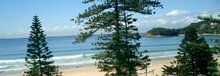
North Head, Lady Fairfax walk today. Toilet litter all over on the ground from mass-tourism (without the facilities). The National Parks sign is a sure indicator for what is to be expected: dogs, bikes, litter. The rare Banksia vegetation had been damaged on the 'walkway' by cars. Although there were no black plumes (soot) visible from ocean-going vessels, the entire air around the walk seemed saturated in diesel fumes. And then there it was again - another giant infrastructure development IN the national park, placed on the main 'tourist-attracting' look-out, directly on the cliff of North Head.
Diesel-belching clutter IN the wildlife refuge (NP)
A huge diesel-belching, humming demountable, with a large spinning radar antenna had been placed in the middle of the Sydney Harbour National Park's territory. Seeking to “add value to all aspects of Sydneys port operations... (and) protect the environment and have regard to the interests of the community “, the Sydney Ports Corporation planted this air-conditioned, video and radar surveillance object into a wildlife refuge. This 'state-of-the art' technology (pdf) is to aid in the intensification of trade and logistics from Botany Bay to Sydney Harbour (North Head). Intensify - more for more, 'exploit & open up NPs'
The “Vessel Traffic Service (VTS) provides active monitoring and navigational advice for vessels in particularly confined and busy waterways with complex traffic movements...Sydney’s ports alone handle over $50 billion of international and domestic trade annually. Total trade through Sydney’s ports was 29.2 million mass tonnes, 5.0 per cent higher than last year.” Obtaining ROI in a harbour full of tinnies is not easy. Infrastructure is likely to be erected in various harbour sites and widening the bays (dredging) is already starting in Botany Bay and elsewhere.
Deadly trade
As in colonial times, the growing population (pdf) is still dependent on the boats coming in, bringing the essentials. Only this time, the huge diesel-powered vessels (container ships, tankers, bunk carriers, tugboats and cruise ships) are costing lives and health. Most diesel powered ocean-going vessels are significant contributers to air pollution in the heads, the harbour, ports and cities. Ports, handling the bulk of imports, are among the biggest sources of air pollution and greenhouse gas emission. “Each step of the goods movement process is powered by diesel fuel, which releases greenhouse gases and toxic, smog-forming air contaminants...ports pose "grave health risks" to millions of people living in metropolitan coastal areas, especially those living nearest the ports." In 2002 "60,000 people living in coastal communities along major shipping routes died from lung and heart complaints as a result of high sulfate emissions from ships". Particulate matter from ocean-going ship causes asthma, heart attacks, hospital admissions, and premature mortality. “Particle pollution from shipping to tens of thousands of premature deaths each year, most of them along coastlines in Europe, East Asia, and South Asia." This dirty trade is causing harm to public health and to the environment. The ocean, its life and the atmosphere becoming degraded
"Ships use the tar-like, sulfur-concentrated remains of petroleum left once the gasoline, oil and all other products have been extracted. This high-sulfur fuel is responsible for the significant environmental impacts of ship sulfur emissions. Regionally, sulfur emissions contribute to acid rain, which can pollute freshwater lakes and rivers, and damage vegetation." Even cloud formation over the Pacific is influenced by trade-carrying cargo ships powered by diesel engines."The annual costs of sea traffic’s contribution to air pollution, climate change and marine pollution are estimated to amount to 260 billion euro for the world fleet and 57 billion euro for the EU fleet." These 'externalities' are probably not lower for the Asian/Pacific region.
Intensifying diesel-powered traffic that 'costs the Earth' and has negative impacts on the marine foreshore and protected wildlife refuges is unsustainable.
Links:
- International Maritime Organization
- "In accordance with the Australian Government's responsibilities and policies, Australia's obligations under IMO Conventions and AMSA's functions specified in Section 6(1)(a) of the Australian Maritime Safety Authority Act 1990, AMSA coordinates a national pollution prevention and response strategy to protect Australia's marine environment from pollution caused by shipping and related activities. This document lists the prevention components of this strategy, based largely on several IMO Conventions given effect by domestic legislation, implemented and enforced by Commonwealth and State/NT Governments." Protection of the Sea - Conventions and Legislation in Australia, AMSA, Australian Government
- Protection of the Sea (Prevention of Pollution from Ships) Act 1983, NSW
- The National Parks and Wildlife Service, DECC
- National Parks & Wildlife Act 1974
- NCC/NPA Submission to Taskforce on Tourism and National Parks, Submission of The Nature Conservation Council of NSW and the National Parks Association of NSW and the Blue Mountains Conservation Society. 0808, pdf 1,2MB
Update 111008
"The International Maritime Organization on Thursday adopted stringent new controls on airborne pollution from the world’s 300,000 oceangoing vessels. Emissions from ships steaming into ports from Rotterdam to Shanghai to Long Beach, are blamed for about 60,000 premature deaths around the world annually. Sulfur emissions are a major source of airborne fine particulates, which have been associated with pulmonary and cardiovascular disease. In some ports in Europe and in the United States, environmental groups, using the courts, and local governmental bodies have required ships to shut off their engines and plug in to the local electrical grid to keep ship operations functioning while in port." NYT 101008
24 September 2008
North Head NP Occupied - More Toxic Diesel in Wildlife Habitat

22 September 2008
Manly Beach 2048

 “Pungent brown sewage spews into the Pacific ocean. In the background, cranes put up hotels and beachfront apartments."
So runs an intro to another Pacific tourist spot where uncontrolled coastal tourism development kills the 'golden goose' for investors, residents and visitors. Pressures to intensify and commercialise the protected 'green and blue' leads to the degradation of all. Squeezing the proverbial 'goose' to death means a loss of human health, life quality and economic gain. Even more of the Australian species, plants and animals would lose their habitat, that is their right to life.
Imagine!
Manly in the 21st Century could be consumed in the same way, if there is no refraining from grabbing 'what's left'. Developing the trends would give the following constellation:
The pressure is already on (pdf) to convert 'nature' (Sydney Harbour National Park, North Head, Quarantine, Dobroyd, and Garigal National Park) into more of the same, a tide of 'accomodation' and sprawling sub-urban McMansions with their associated infrastructure.
Manly 'town' could become 24/7 neonlit buyosphere which customers could immerse themselves in. Alcohol merchants and casinos high-rise, Las Vegas style could frame the beach. Experiences and bodies could be organised via animators from the entertainment industry. Roofed domes would lessen the deadly uv radiation from scrambling the DNA. Organised 're-creation' is conducted on flood-light filled arenas. All are of course attending in respective plastic uniforms. Sports ovals, swimming pools and golf courses are also day & night air-conditioned and lit. Plastic lawns have long replaced water gobbling/toxic lawn transplants. Every inch of the Earth is paved over with coastal real estate: tourism development (hotels, resorts, restaurants, etc.), and the infrastructure supporting coastal development (e.g. marinas, beaches, recreational fishing facilities.) Breakneck developments turn the area into ear-piercing noise waves on every corner.
The sky is also filled with constant noise: Jumbo planes are seen 'spinning' over the beach, belching poisonous gases and consuming non-renewable energy while delivering more 'customers'. Helicopters and small plane 'joy-rides' are now so numerous that they are on a clear collision course with each other and the many UAVs. Brand names are 'written' into the clouds for all to see, that are not in-dome. Blimps urge all to accelerate the buying of anything now!
The ocean:
Surfing and swimming has long being abandoned, as the nutrient over-enriched coastal waters have turned into a permanent red tide. This anoxic "dead zone," is devoid of fish, but still very rich in stinging jelly blooms. The entire coastal marine ecosystems has been consumed. The sand is so e coli laden, that it is not to be touched. The 'ocean spray', full of HABs, is a health hazard. An industrialised ocean horizon:
Private boating also ceased, due to oil shortages and the unavailability of territory to give these motor-boats 'a good spin'. A dense network of aquaculture infrastructure clutters up the coastal waters. Further out, the ocean horizon is studded with chains of giant artifacts: Desalination factories (pdf), gas- and oil drilling and extraction structures and huge data platforms. No whale has been seen for years that could navigate this dense human ocean clutter.
More frequent violent storms, tornadoes, hurricanes and giant waves mince up the entire set-up due to human-caused climate change. The thick layer of human debris and waste floating on top of the Pacific also gets washed onto the shores. Various chemical spills and scrambled infrastructure do not make 'clean-up' operations easy.
Due to the many desalination factories, the water guzzling life style could be kept up. Visitors on the whole are consuming double the amounts of water via hotels, swimming pools, golf courses and personal use etc. But locals also all have their personal lap pool by the 'beach'. The exotic plants still are watered with petrol pumps as before.
The demand on energy leads from time to time to a crash into 'a candle economy'. Many suffer in their air-conditioning dependent dwellings in the long black-out periods. The nuclear option seems to keep this power-ful life-style alive.
Sewage, another plentiful anti-product which is a slight challenge to the aesthetic and olfactory appeal, could also pose a possible loss in revenue for tourism. The dead zone of the coastal waters is fueled by this waste-water contaminated with toxins and pharmaceuticals.
But all is not without life, people now have their dearest darlings cloned in multiples. One can see them, as before in cafes with up to 6 harnessed dogs.
Huge cats, as well as packs of dogs have gone 'feral' roaming gated estates. The only surviving bird is the Indian myna, seen in millions coating all with its feces. Many black rats are seen living on the garbage. Large swarms of flies, mosquito and ticks are still posing a challenge.
Australian animals can now be admired (for a fee of course) in an event space, previously known as a museum. There they are, the bandicoot, the little penguin and so many more - all stuffed, just like in the 19th Century. Most Australian plants are gone. Some invasive plants and pests are still about, despite the increased toxicity of the weapons used in aerial helicopter spraying.
Uncontrollable fires shroud the area in suffocating smog. Even though there are only weeds left to 'back-burn', the scarcity of water, threatens the 'real estate'.
Many argue that tourists were not drawn by all that 'environmental stuff', they didn't give a hoot about the unique ecology of Manly. They were seeking to spin their body around, often with the aid of petrol or ingestid toxins . This constituted 'fun' and sold well. Human generated 'attractions' have to be erected to offer a peep here or a spin there. Once contained, money could be collected in this Disney-like hybrid simulacra world. Neither locals nor visitors are remembering or missing that 'biodiversity and landscape attractiveness'. The problem is though, that the place has become indistinguishable from so many other (coastal) places in the world and that is a challenge. Like malls and airports, one doesn't know anymore where one is. Looking after the Country in the future:
Myopic objectives could gamble away 'nature' and 'uniqueness' that has no substitute. Unchecked developments and mobile destruction (mass tourism) degrade a place and its resources. 60 % of Australia already has been degraded by relative few people in a short time. 'Customers' flee the degraded tourist traps, locals desert the uninhabitable places seeking refuge in the remaining 40% 'new-found-land'.
Returning North Head, Sydney Harbour National Park, Quarantine Station, Dobroyd, and Garigal National Park to their owners might guarantee a halt to the tidal wave of destruction.The National Parks and reserves are an essential refuge for endemic plants and animals. They also are of great ecological and economic value in framing Manly as a desirable and unique place on the Earth.
Images:
1 North Head, Manly and the Northern Beaches, Google Earth
2 North Head, Dobroyd and part of Sydney Harbour National Park, Google Maps
3 Dobroyd, SHNP viewed from Manly Cove
4 The Pacific ( uncluttered) viewed from North Head
5 North Head cliffs and the Pacific Ocean
Links:
Manly Council Submission to Taskforce on Tourism in National Parks, PDF
Players:
The NSW Government
The Environmental Trust, The Department of Environment and Climate Change (DECC)
Manly Council
NSWALC, NSW Aboriginal Land Council, Land Rights Act
National Parks & Wildlife Act 1974
NCC/NPA Submission to Taskforce on Tourism and National Parks, Submission of The Nature Conservation Council of NSW and the National Parks Association of NSW and the Blue Mountains Conservation Society. 0808, pdf 1,2MB
Areas to 'exploit' and 'open up':
Sydney Harbour National Park (SHNP) North Head, Quarantine Station, Dobroyd, and Garigal National Park.
Coastal Recreation and Tourism:
- UN Atlas of the Oceans
- United Nations University (2008, June 4). Coastal Management Cooperation, Enforcement Key To Avoid Pending Crisis For Millions, UN Experts Report. Retrieved September 22, 2008, via Science Daily
- Mike Davis , House of Cards, Las Vegas: Too many people in the wrong place, celebrating waste as a way of life, Sierra Club
Footprint:
-"You can't have one species growing indefinitely on a planet that is finite." Prof. Bill Rees
Update:
" The vast majority of the Australian population is clinging to the east coast, running out of land and running out of water...2043, when 43 per cent of the Gold Coast has been abandoned to ever-rising sea levels. Australia's swelling population could be accommodated in desert cities." SMH 201209
03 October 2007
Sydney Harbour National Park - a Casino?
 A walk at North Head NATIONAL PARK today, Lady Fairfax walk. Despite the annual ticket to the N.P., access was very restricted and hazardous. Numerous large trucks and trades vehicles were driving/parking on the WALK-WAY. At the cliff look-out, within the NATIONAL PARK a huge structure was being erected, dangling 90 m off the North Head Cliff. How could such a monstrosity serve to conserve the flora and fauna of Sydney Harbour National Park? " Sydney Harbour National Park protects various islands and foreshore areas around one of the world's most famous harbours."
 Yes,the spectacle Las Vegas-style poker will be staged there. Gambling IN the N.P.? The refuge for animals and birds turned into an over-run CASINO?
Where will the visitors go, that came for the 'nature', the uniqueness Manly has to offer.What will be the impact of such an event(traffic) on the wild-life.  Six endangered Bandicoots have been recorded killed on the road so far. What will happen to the trampled vegetation and the generous garbage left behind? How was the community consulted? Is this a further privatisation and commercialisation of spaces in Manly?
29 August 2007
On the Annexation of National Parks
 A walk through Sydney Harbour National Park at Grotto Point Reserve. A beautiful place, bursting in Phebalium dentatum, Eriostemons, Caladenias and Lomandras at the moment. Black Cockatoos singing for more rain.
The new way of utilising National Parks as one's backyards revealed itself as the relative short walk progressed:
- At dusk dog owners regularly bring their dogs there, off the leash of course. Today, one hunting dog was allowed to race freely though the bush at the time when wildlife starts its day. The other dog bathed at Castle Rock Beach and was then walked back through the National Park. I assume the 'user pays' principle is applied, if one does have to pay a small fine, maybe once a year, then it is like a cheap annual dog-pass to a beautiful dog loo.
- Many of the beautiful old Angophora costata were vandalised by deep cuts from knives.
- Somewhere, off the track 2 people were collecting many 'things' (under rocks?) and shoved them into plastic bags. Sad to see the N.P. so abused and native flora and fauna only being protected pro forma.
29 July 2007
National Parks for bushwalkers or vehicles?
 Off to the favourite National Park, Ku-ring-ai Chase N.P. to enjoy the flora & fauna. The Salvation Walking track features wet heath lands and hanging swamps. All in yellow and pink at the moment. While the entry fee is being charged, mainly birds provide the acoustic ambiance. After that, West Head Road turns into a free roaring racing track with wildlife smeared across the road.
For the sake or re-creation it is one of those rare places that one can move their body in Sydney without inhaling toxins or having one's attention totally focused on other people's hazardous motor-cars. Our relaxed walk was interrupted by 'hell riders'. Four mature adults insulating their bodies with plastics against the environment came hurling along on huge 'mountain bikes' from behind. As it was illegal to make a racing track out of a WALKING track we did not move aside. After various verbal bullying they crashed through the delicate heath, breaking vegetation as they went and raced off. The entire track was mushed up by mountain bike tracks for any park management to see. I especially object to the riding of these vehicles on the delicate sculptured sandstone platforms which chip easily. The indigenous artifacts are lost forever this way. Another space in 'nature' converted into a free gym where the 'I, me, myself' can hurl their body around.
Hell riders " attention is fixated onto the object of your arousal and you quite easily miss things like road signs or someone stepping off from the pavement, because your attention is absolutely locked onto the competitors"
Bush walkers tread lightly and give names to all flora, fauna and land-formations.
Update: 050807 The entire Salvation Loop full of speeding 'bicycle' riders harassing walkers. The wet track ploughed up by the many bikes daily.
Result of broad daylight car-racing: Two dead wallabies on the side of West Head Road.
See also NP going to the dogs
Bikes and damage to sandstone engravings
Images: Ku-ringai Chase N.P. tessellations, bleached,drosea and tea tree-swamp (Salvation loop) mushed by heavy vehicle use. Usually frogs breed in these puddles.
20 November 2005
National Parks going to the dogs.

A walk in Ku-ring-gai Chase National Park:
Road kill: The road into the Lambert Peninsula had a dead Euro, Lizard and Possum along the curb. The meaning of the unique roo-bar was apparent. Once fee collection knocks off, the road becomes a racing track in earnest.
Dogs in NP: Then there are the dogs, with or without owner/s. Hunting native wildlife and polluting the habitat. NP are aware, but their action is confined to only 'urge' local residents. Personally I find it unpleasant having to confront /follow up dog-owners in NPs.
Their line of 'arguments' always follow the same pattern:
"He's no dog/ he's a dingo"
"I live here/this is my place"
"I am a rate payer/Are you?"
'my back-yard' annexation
Then there are the physical threats. Bringing it to the notice of NPs seems a waste of live-time and ineffective.
Horses in NP: As if slaughtered wildlife by cars and dogs is not enough, horse owners demand to trample all over the delicate soil of the NP.
"Harvesting": Families with arms full of flannel flowers.
Annexation, privatisation & commercialisation: The mental and political annexation of habitat set aside for the conservation of Australian flora and fauna pushes to "properly handle" public assets, e.g. privatise and commercialise them.
Still, the Hyacinth Orchids (Dipodium Punctatum) looked stunning...
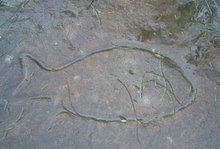
(Image: Petroglyph by the Eora people depicting an Euro?)