Imagine a baby and its carer get separated at a busy freeway node – impossible to find each other again, the weakened child mistakes a parked SUV for its mother and attempts, in vain, to get nourishment. Helpful creatures manoeuvre it out into the 'wide and open spaces' where it might be hopefully reunited with its mother.
Humpback calf lost in Pittwater
Such is the story (sad video) of a very young humpback calf found in isolation from its mother in busy Pittwater bay, north of Sydney. These slow-moving marine mammals, with their offspring in tow are on age-old journeys across the globe. For eons they have traversed their same marine territories. First, they were massacred by Australian whalers, now the whale watching industry has to lure the tourist dollar. Their habitat has also changed rapidly: The sheltered bays and the open ocean are more like the terrestial world's car-parks, oozing repair workshops, endless wider roads to shoot private mobility capsules along. The largest obstacle to their efficient flow are soft-bodied, slow-moving organisms, known as pedestrians and wildlife.
Boating Habitat
Aqua motoring in the Pittwater region (or anywhere else) operates according to t he same mind-set. One look at Google Maps reveals the area is criss-crossed with boats racing and most of the shores are more akin to "car-parks". Industrialising and commercialising the water-bodies and the marine habitat brings about many "externalities" for the environment. Eutrophication from combustion powered boats, from sprawling sub-urbs and the associated 'shared debris' turns the beautiful Pacific and its bays progressively into dead zones. Not just for seasonal visiting whales - but for all living creatures. If they do not get entangled by anthropogenic debris or get infected, human business also robs them of their habitat, the open ocean.
Mega fauna is in the way
The intensification is a take-over by the terrestial mammals of the habitat of the whales, that do not have any other habitat to survive in. On the open oceans, whales are simply in the way of busy shipping lanes and other boats.. "In places where marine traffic is heavy, vessels fast and whale numbers expanding, violent encounters are increasingly common.” As on our roads - many cetacean and other marine animals are being maimed or killed by the 'collisions'. The wildlife of the oceans is becoming a "a hazard to sea craft" in their own habitat. In some areas the International Maritime Organization has designated an "Area to Be Avoided" for container ships to avoid killing them.
Noise
Even when not assaulted by aqua motoring the noise and vibration caused by the  human racket will diminish their life or even kill them: "The throb of mighty engines and the thrash of propellers as 60,000 huge vessels plough the world’s sea lanes; the hammer of diesels and scream of outboards as 4 million fishing boats and more than 10 million ferries and pleasure craft surge to and fro; the thump and ping of military and fishing sonars; the deafening crash of seismic ships seeking oil and gas; the blare of acoustic harassment devices; the grinding of drills and dredges; the low-frequency growl of scientific experiments designed to monitor global warming."
Could it be, that in such a hostile habitat the whale and its calf became seperated though a degraded habitat and many missiles interjecting their journey?
> > Part II, Whale calf rescue, Sydney Basin
See also:
Desalination, Drilling rigs Sth of Sydney & Whale migration
More on Whales
MSM Updates:
- 'Out with the sharks', abc news, 190808
- Three weeks old calf "abandoned" and "doomed to die" speculations, SMH, 190808
- "The baby has further injured himself from its attempts to rub up on boats, with clearly visible sores on its back. In a last-ditch effort they convinced the whale to follow their boat out to sea, and it disappeared from view about 1km off Barrenjoey headland. It wasn't in good condition." Manly Daily, 190808
Images:
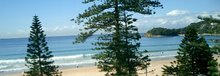
1. Part of Warren Langley's, Manly Visions, glass art at Manly Library
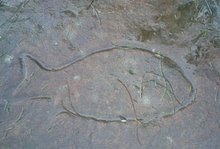
2. & 3. dotAtelier, inspired by Eora Rockengravings of the Pittwater region.
19 August 2008
Humpback whale calf lost in Sydney's buzz

29 August 2007
Air pollution caused by cars in Manly - consequences
 Most carers of small children in Manly seem to drive 4x4s. The town and the suburbs are pedestrian-hostile environments. The 'pedestrian zone' and bike paths are usually parked on.
A study found that 4x4s pollute the air we breathe more than other cars, in carparks and in our shared urban environment. “Pedestrian exposure to high levels of these air toxics within parking garages is of concern because of the proximity and intensity of the vehicle activity within the semi-closed environment...These pollutants (carbon monoxide (CO), particle-bound polycyclic aromatic hydrocarbons (pPAH) and several volatile organic compounds (VOCs)) include known and suspected carcinogens” (Science Daily)
Another project by Dr.B.Ritz found “Women who lived in regions with high carbon monoxide or fine-particle levels — pollution caused mainly by vehicle traffic — were approximately 10 to 25 percent more likely to have a preterm baby than women who lived in less polluted areas."
Update 300907 Elsewhere they outsource safety and emission tests together with pink slips to private garages.Where there is a will...
01 June 2007
Sydney smog
 Winter is here, time to light up the romantic fire-place burning off all the rubbish. The Sydney sky turns into an orange-brown smog dome. “For the six months to March this year the number of days with pollution above acceptable levels was 25 per cent higher than 2005/06." (Daily Telegraph) The economy is doing well, the number of motorised vehicles has “increased by 60 per cent in 20 years.” (SMH)
- 1 in every 6 Australian children have asthma.
- 1600 people are dying every year “from air pollution related illness.” (DailyTelegraph)
- The government has stopped the monitoring of “cancer causing 'air toxics' – particles from cars and industry which can lodge in the lungs.” (DailyTelegraph)
Is it a matter of institutional responsibility for the decision makers of sustainable transportation?
Is it a matter of sheer probability in a risk society requiring 'sacrifice'?
Is it systemic and our personal responsibility due to all our actions?
Update: 240607 We are inhaling "...four times the recommended concentration of air pollution."