Showing posts with label motors. Show all posts

01 July 2009

Manly Beach Drift 'wood' - July

A monthly summary of what has washed onto the shore or beach through the winds, tides, waves or human action. Marine debris, flora and fauna, dead or alive:
010709Plovers reclaiming the beach.
Glass, as every day.
Erosion: The southern end of the beach is a building site. Two earth-moving machines and some 11 workers sifting through the rubble. Sandstone, basalt, cement garbage, iron bars, plastic/fibrous mats, that have been dumped there and now have to be hand-picked. Lines of vehicles parked on walking parade.

020709
Erosion: Southern end of the beach manufacturing: fencing down, rubble largely removed. Diesel machines still pumping on the beach and pedestrian parade.

An unusual amounts of shells along the northern end of the beach. Ocean acidification thinning shells? One look along the beach, it is 4x4s crawling, with the odd rocket pumping CO2.
A large tanker hovering on the horizon. A motorboat racing just meters from the surfies' lineup towards the Cabbage Tree Aquatic Reserve to 'park'.Glass, splinters, broken bottles, as every day. Image displays the average daily crop of sharp health hazards on a beach.

A flock of Sulphur-crested Cockatoos (Cacatua galerita) feeding on the ground seeds of the Norfolk Island pines (Araucaria heterophylla). Two dogs have just been emptied on the same bit of lawn. Usually people: toddlers, bootcamp training clients etc roll on this turf.

Illegal dogs at the Queenscliff end daily. Dogs & motors in summary.

03709
Erosion: 'Nature' and many labourers hand raked the beach for the last debris/rocks at the southern end.
Daily illegal dog on the beach
A lot of glass collected. All forms of styropore at the northern end of the beach.

The daily ocean-going ship hovering on the horizon. Elsewhere they now have " regulation mandating that all ocean-going vessels within 24 miles of the state's coast must use cleaner burning low-sulfur diesel fuel". Less premature deaths from air pollution/smog. Less acidification of the oceans.
Manly will probably soon give up "choking on noise and fumes of the international combustion engine" and be declared car-free. Breathing at Manly Beach and 'immersive Manly village' will be possible.

Fisheries without fishes, tourism without reefs, beaches and wildlife is not unthinkable. The collapse of the ecosystems would turn the present economic crisis into a hiccup.

060709
Highlight was a pod of dolphins upstaging the surfies by leaping high out of the surf.

For some 3 million years they were at home in their coastal habitat. Now this aquatic sphere is claimed by our species. 'Flipper' becomes bait, 'bycatch' or it has its habitat degraded by us. Marine infrastructure clutter up the coast, anthropogenic noise pollution from motor boats, toxins, waste and (fishing) garbage degrade the ocean even further. Eating 'our' tuna and squid the 'competitors' are often turned into bait. Many die from entanglement and ingestion of fishing gear which is so often found at Manly beach.

There are many Eora depictions of Bottlenose dolphins engraved into Sydney sandstone. Let's continue to share the ocean with these smart marine mammals!Image: Google Maps: Manly Beach, pipe, North Steyne/Raglan St.

Five Great Cormorants (Phalacrocorax carbo) flying north, leaving bird-unfriendly Manly behind.
A flock of Sulphur-Crested Cockatoos feeding on the lawn under the pines on cones. Only the dogs posed a danger to them.
Two large dead fish at the beach. One a Porcupinefish as so often.

The appearance of the beach seems to be normalising.

070709
Crested Terns, Crows and Sulphur-crested Cockatoos
Divine cloud formations, sun and rain. Permanent tropics in Sydney?
Again a new lot of plastic junk: Drink bottles, tops and a lot of polystyrene in the shape of orecchiette pasta. At the sandstone wall a small 'run-off' pipe exuded small polystyrene balls with a black discharge on to the beach.

At the horizon, two navy ships hovering. Scary to think that in an event of an oil spill, the 'clean-up' costs could not be recovered as it might "hurt Australia's reputation."

A large noisy (navy) helicopter swooped a couple of times along the beach /surfers. The 'manned scarecrow' chased all birds away. No marine mammals were in sight with that noise. Time to switch to 'unmanned' air vehicles in a regulated airspace.

080709
Manly Beach going to the dogs...A dog owner took their dog in bright daylight illegally for a walk all along the shoreline of Manly Beach. Black plastic dog feces bags blowing on the dunes. On the walking parade a dog defecated in a puddle. The rain drained all untreated excrement down a pipe onto the beach. One would think, that with an explosion of the dog population, corresponding enforcement services are being made available. There is supposed to be a 'litter guard', where is the canine/feces guard? What is public health?The usual amount of glass on the beach. Maybe there will be less in the future, as premises of alcohol merchants will be regulated. Drinkers will no longer be trusted to handle glass after midnight in some places.

Re the daily ocean-going vessels at the horizon: Elsewhere a Clean Air Act will set standards for engine and fuel to improve the air quality, save lives and the environment.

090709
Manly Beach is a unique parrot beach: White cockatoos during the day, lorikeets in the afternoon and black cockatoos occasionally. Echos of some 55 million years of a bio-diverse heritage. Locals facilitate captive non-Australian animals.

Junkspace: Plastic in the form of a lot of drink bottles, toys, lighters, caps/lids and 'party balloons'. Differently shaped polystyrene packaging bits today.
The usual crop of freshly cracked glass.
The 'run-off' pipe around Raglan St. has a distinct odour of miasma.

Tourist buses with idling motors spill their customers on to the beach. Photo, litter, off.
Yet again, another motorboat racing along the lineup and then, as they all usually do straight to the Cabbage Tree Bay Aquatic Reserve to 'park'.

Erosion: The southern end of Manly Beach is still fenced off. Rocks and black plastic mats are scattered over the beach.

100709
Junkspace: An unusual large amount of packaging from a wasteful 'throw away' society. Plastic bottles, styrofoam cups and a very large number of 'disposable' domed plastic lids and foam cups. A large array of 'one-mouthful edibles wrappings'. Carry-out trays are the latest to be dumped at the beach. Maybe the cafes/crèche are too unbearable? If the sale of these wasteful items can not be prohibited or regulated, then it could at least be taxed.
Litter in the sky: A large clump of 'party balloons' released and stuck in + 25 m high pines. The entangled strings pose a hazardous environment for birds/wildlife. What form of 'waste management' will remove the plastic junk: kites, balloons etc out of the 'littered' giant pines?

Sulphur-crested Cockatoos
are boldy grazing the pine promenade for seeds, hoping, that all dogs are on a leash.
Daily dog illegally on Manly beach.


130709
Diesel ploughing at the Queenscliff end. More diesel fumes belching from train-like trucks and vehicles 'moving' along road-side Steyne cafes. Other than deadly diesel fumes, the ocean did not smell of kelp and salt.Erosion: Rocks, cement junk and black plastic mats still jumbled up on the Sth.Steyne end of the beach. The $3,000,000 building site 'stabilising the sea wall' all along Manly beach is supposed to be completed by 2010. Holding back the sea level rise for the "the long-term viability of the local economy".
A walled off rising ocean
, caused by anthropogenic CO2 emissions, might be a quick fix instead of an Integrated Coastal Zone Management that is interdisciplinary. Taking the needs of the coastal ecology into account and reducing CO2 emissions might be a sustainable prevention of a rapid retreat.
Image: Katsushika Hokusai , The Great Wave off Kanagawa , Tsunami via Zeno

140709
Large waves, calling plovers and sunshine.

The dumped rubble of cement, plastic mats and sandstone is still exposed from the erosion from the Corso to the southern end of the beach.
The rubble and steep sandcliffs provide a welcome family entertainment in the school holidays. There are attractions like throwing the rocks around. Digging up the metal beach sign and converting it into a funfair guillotine is all part of recreation. Digging diarrhea sandcastles has branding potential as a theme park. If the kids are bored with chasing seagulls, then there are attention-grabbing helicopters hovering over the beach or the many planes overhead going to desirable locations.A last look at the historic sandstone wall, studded with life and remnant dune vegetation before the disaster preparedness wall will be errected. Will it equally be studded with an abundance of pvc pipes draining dog feces, lawn chemicals etc onto the beach? Will the sandstone stay? Will they get rid of the Asthma Weed?

The daily dog ON the beach of course. A procession of packs of dogs on the esplanade. Mostly driven in suvs to Manly Beach to be emptied. A minimum of three harnessed dogs, or at least one each on display. The white fluffy thing is so 'yesterday' and serious hunting animals are 'in' this season: Doberman, Great Danes etc. Fashion dictates and the old models get churned into a dog pound to get pulped or released into 'freedom'.

Most walkways are parked out with service trucks/utes from uncountable building sites. The noisy 'green machine' seems to go for peoples' toes sitting on benches at 10.40 am.

Broken glass of all colours, shapes and sizes.

170709
Small to fist-size rocks along the southern end of the beach have emerged since the erosion. Ideal for toe-stubbing or family target practice.

The butt littering was overwhelming. A lot might have washed down from the roads with the rain. A couple of plastic lighters thrown in.
Styropore disintegrating into bubble-sized pieces. Broken glass

At the beach wall, dogs urinated on the wall/steps and the rain washed all down on to the beach sand.

Sulphur-Crested Cockatoos picking seeds from under the cars and are in danger of being run over by speeding cars.

190709
The beach stairs at Victoria Pde/ Sth. Steyne are hollowed out from underneath. Deep water and surf hits the stairs.200709
Severe erosion of the beach stairs at Victoria Pde/Sth Styne. Waves continue to undermine the stairs' foundations, distributing rubble and fibrous mats along the beach. Deep surf is pounding this area. Up to fist-size rocks have been dislodged and cover the previously sandy beach from the Manly Surf Live Saving Club to Raglan St.

An unusual amount of freshly cracked glass, a post weekend crop?
Some unusual shells at the northern end of the beach.

230709

T h r e e dogs on Manly Beach illegally. A regular male dog owner walks along the entire esplande throwing a ball ONTO Manly Beach which his brown Australian Kelpie is fetching. A Doberman tied to the bottom of the stairs preventing access to the public. The daily dog at Queenscliff. No enforcement.

An angler set up multiple rods and clutter at the beach. Joggers got entangled in the 'loine'. Beach rage over disputed legitimate activities on a crowded beach. A health hazard! Time to make it a NO-TAKE area.Plastic 'take away' junk is increasing at a rapid rate. Plastic lighters and glass.

A lot of cut garden refuse. Endless leaves which are blown by petrol-powered 'leaf' blowers into the the gutter. Seen all over Manly the owner/ contractor blows the debris from the private proverty onto the public pathway/ road and finally into the gutter. Council workers do it too. All privatise the soundscape. The collected works are then flushed down the pipes onto Manly Beach and get sloshed back up onto the sand. It takes a lot of petrol and noise to achieve this state of 'tidyness'.

In the sky three light aircraft affording their paying clientele swooping views of Manly surfies. From the road (Steyne) roaring building noise as the road is cut open.

240709
Two speeding jet skis (tautology) racing along Manly Beach. This could be life-threatening for the frequent long distance swimmers. Little Penguins feeding on the upper layers of the ocean and other marine mammals are also endangered by this petrol-fuelled activity.

Manly Beach as cheap garden tip? Rich in debris and garden refuse after a night's rain. Most large pieces are cuts from an iconic sub-urban palm: The Cocos palms (Arecastrum romanzoffianum), a weed. The rest is flushed or blown down to the beach with the air of petrol from the streets of suburbia. (see 230709 above)

The one-mouth plastic wrappers are rapidly increasing. Silencing devices to not get ones hands dirty? The odd plastic lighter.

The horizon looked uncluttered with an occasional 'bump' like a migrating Humpback whale. But then to allow jet skis and motorboats to speed is not very inviting for a large marine mammal mother and her infant. The time she needs to lift her breathing infant out of the water is often not granted in the motor-boat infested oceans. Many young have to die, or are 'put down' by 'benevolent' human beings after the freshly born and mother have been separated by noisy, speeding objects that criss-cross their migratory routes. Encroaching 'peep industries' also pose a danger.

A dead Rainbow Lorikeet on the beach. Either fed to death on sub-urban balconies and gardens. Or maybe a fox got it out of a pine?The daily illegal dog ON Queenscliff Beach. A lot of dog/fox turds left on the Esplanade lawn, awaiting rain to flush it down onto the beach sand.

290709
A dolphin pod swimming up and down Manly Beach today. The group consisted of ten dark individuals that swam in a tight formation to occasionally form a vivid hunting? circle. The access of these marine mammals to the surfline was only possible, because of an absence of hooning motorboats or jetskis.

Shells all along the beach.
A lot of freshly cracked glass and styropore bits.

Along the Esplanade:
A noisy building frenzy all along the beach.
Event advertising (small pieces of cloth) being hung into the pines with the aid of a suv and crane idling and parked on the footpath, as most 'service' vehicles do. An absurd idea of communicating events with an high emission footprint. The daily green machine, just sitting there idling and adding to the noise pollution.A lot of dog feces was left on the walkway by irresponsible dog owners, despite the machine cleaning. Many people stepped into it and smeared it along. The rest just runs down the stairs/ through the many pvc pipes onto Manly Beach. Just on the other side of the beach wall people rolled in the 'sand'.

But then it is 'just' a hygiene and enforcement issue compared to the large scale ecological vandalism being committed by Australia, depriving other species of a right to existence and leaving a degraded 'quality of life' for the ones to come.

See also Driftwood of:
June,
May, April, March, February, January, 2009

15 January 2009

Manly Beach Drift 'wood' - January

A monthly summary of what has washed onto the shore or beach through the winds, tides, waves or human action. Marine debris, flora and fauna, dead or alive:

Each day washes another type of jelly fish up, today bluebottles, yesterday a mysterious 2 cm 'button' with a dark blue short fringe. The entire beach filled with them. The day before, transluscent blobs. Heating up the ocean, turning it into an acid brew and eradicating the predators of jellyfish (Sunfish, turtle etc) will produce an ever denser 'bloom' of more or less stinging jellies to wade and 'swim' in.

Many different types of kelp in beautiful shapes. A living hermit crab (Pagurus sinuatus) walking about in a big shell. One cuttlefish whole and the other with arms and tentacles cut off, cooking on the sand. 'Cheap bait'? Desperate fishing people swish nets of stinking fishheads on the sand, maybe to attract sharks? An abundance of fishing junk all along, reels, nylon etc.

At the pipes of sub-urban eutrophication lingers a mysterious smell. Intertidal critters do their best to coat the pipe. Terns love the safety of the tall signs. Real driftwood, washed in by the king tide.

The human contribution: Smoking all over the beach, toxic butts in the surf. Large groups of young people all with unprotected heads in the water and on the beach. Their coaches and carers are well covered from uv radiation.
On the sand and in the surf, the smell and sound of petrol racing. Roaring, smelly boats in 'operational areas', getting close to bodies in the surf. Buggies racing along the sand, without an apparent urgency for speed. One day it will be termed an 'accident'.
Commercial speed boats spin right into the Cabbage Tree Bay Aquatic Reserve, depriving the marine fauna of a safe habitat. Swimmers and divers are in great danger form aquatic 'wheelies'. The airspace also has more frequent hovering of helicopters, private and commercial 'joy flights'.

On the litter front, the usual 'one mouthful' wrappers and containers, many balloons, gift wrapping and other marine debris on the shore line.

Denise Ellis Kelly pointed out how a speeding motor had killed a Little Penguin. She also mentioned how the shark net tangled and drowned a dolphin at xmas. (Manly Daily, 140109, p. 22) This is probably just the visible 'tip of an iceberg'. The motor boat and living body interface is as deadly and polluting as terestial traffic. Ban, reduce and lower speed. Motorised lifesavers' high speed is only warranted if life is in danger.

Aerial plastic tangle in the form of kites, string and balloons are left in the tall pines for animals to get entangled in.

The extreme light pollution along the beach from North Steyne Club to Queenscliff pool is an “ecological trap” for wildlife and a blinding nuisance for people. One light bellows out CO2 pollution during the day as well. What a waste.


150109 Image 2 & 4 :Penguin art exhibition by children in the Manly Library. "Boats can hurt penguins. Slow down!"

A moray eel washed up, strangled by fishing line right behind the neck. Another inhabitat of the Cabbage Bay Marine Reserve reef became victim of fishing by-kill.
More Crested Terns (Sterna bergii) indicating heat to come.

The daily junkspace: unwanted flimsy plastic sun tents, generously left behind when broken down after a low usage rate. Large sheets of plastic tarp and the usual unwanted plastic bits.

On the beach walkway - many cars, unloading their commercial loads for the day. The council “green machine” billowing black smoke, repelling people from using the beach parade. The noise and pollution impact on beach users from driving on pedestrian paths is considerable. Operators stop for long periods to engage in long 'ride on conversations' – all with running motors of course, as it is customary in CO2 belching hot Australia. The accumulated fumes from the diesel-intensive mechanical sweeping and the decibel pollution drives people from the public space which is apparently being 'cleaned' for them. 220109Another large dead moray eel with a tumor/growth? on the side of its body. A dead frog and many blue bottles. A hot ocean and the feeling of desertification racing. Despite it all, SUVs and airconditioners are pumping up the Hot Planet. 300109

08 October 2008

Dead Fish and Noisy Motors at Manly Beach

Dropping anchors onto the aquatic reserve
In the Marine Reserve today 'leisure crafts' were throwing their heavy anchors into the low reef today to pop some champagne.Motorising the beach, air and land
Helicopters hovered over Manly beach and sub-urbs, giving it that VN ambiance. Are there any restrictions on people perving from above, destroying the space with their noise? How many noisy aircraft routes can Manly Beach handle, in addition to the diesel-spewing coaches, running their air-conditioners hot?
Beach findings
On the shore of Manly Beach an unusual number of ocean/leather/mosaic jackets. We mentioned that an unusual amout of puffer fish and moray eel were also washed up onto Manly Beach. They all seem to have been dislodged from the safety of the reef caves of Cabbage Tree Aquatic Reserve. Maybe they are all just ploughed into the industrial beach sweeper and disappear with the tonnes of garbage into the tip? Does anyone record why there were so many dead reef fish last week?

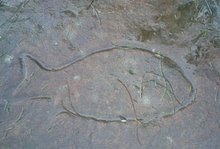
Images: Some of the dead fish (ocean leatherjacket, pdf & Eubalichthys mosaicus) washed up on Manly Beach 071008 and possibly an Eora engraving from the Pittwater region.

02 October 2007

Jellyfish wading and Noise pollution at Manly Beach

Jellies in a Hot Ocean
Manly Beach swim today was like wading in sago. Tiny translucent jellyfish filled up the surf and the beach. No they were not Bluebottles.

How to repel visitors to Manly
Council did its best to chase visitors away by blowing the sand off the many stairs with a very loud debris blower. Just months ago this work was done with a broom. Additionally, the 'green machine' stood on the walkway for ages with the loud motor running and not cleaning. Again - people fled the space. Both machines were causing pollution right on the beach promenade. In other places blowers are banned as a noise nuisance, some places restrict these inefficient gadgets
.The industrialisation of the beach is degrading a potentially beautiful and unique environment.

30 September 2007

Aqua-motoring in Manly - an Accident Waiting to Happen

The aquatic space is used the same way as the terrestial space – just a space to rev motors along. Just as the asphalted Earth is becoming too congested to get anywhere, the little bays, coves and even beaches become race-courses to blow the abundance of fossil fuel away. Problem is, there are these pedestrians and wildlife 'cluttering up my road'. In the blue waterbodies and oceans, swimmers take the fun out of 'having a good spin'.

Whatever takes place on the roads, is taking place on the water. Out of control, under the influence of alcohol these motors are being steered into bodies. Here a child is being hit by a jet ski on their rubber duckie, there another gets their face shaved off by boat propellers. Another gets 'mangled' by a speedboat while swimming. Speeding jet skis on Narrabeen Lagoon endanger the life of people, as well as eliminating swans and pelicans. They even insist to race The Big Dry Murray.


In Manly the season for mixing water & petrol is truly open. At Manly Beach the fumes of the speeding 'life-saving' boats are breathtaking. The proximity to swimmers of all boats is a great danger to people in the water, at Shelly Beach and Manly Beach.

Robbing the public of walkways and green space


The land-grabs of foreshore Sydney is on everywhere. The small strip of green along East Esplande, Manly Cove is being conquered with the help of 4 WDRs and a lot of semi-commercial boating gear. Both the green strip and the pedestrian strip are being regularly squatted and people are excluded from using it. No one there to enforce the right of people walking (in the very few spaces set aside for them) and enjoying the Cove.
What would happen if one of these SUVs ran over a person on the 10 km/h
walkway-only?
Why is the public excluded from using the green strip and their walk-way?
Watch them make an aqua-car park out of Manly Cove and the jetties swallow up the blue harbour. Count the boats...
Image: Manly Cove aerial shot via Google Images, 0807

08 August 2007

Motormania Manly style

Inefficient two stroke motors are ubiquitous in Manly (and all over Australia). High-powered and mostly handheld or mobile they are used on land and water 24/7:

“People pollution” via "the old 2 cycle motors have been said to cause more pollution in two hours than a car running for an entire year.” These machines are a health hazard and an inefficient way of utilising energy. “Because fuel leaks through the exhaust port each time a new charge of air/fuel is loaded into the combustion chamber, oil pollution is a problem” on the water or the land.

Developing countries tackle two-stroke engines to make them more efficient. In Australia one just wants to 'get things done' – climate and all.

04 August 2007

Powerboat racing in Manly or whales, dolphins and penguins?

Some of the natural assets of Manly are that Sydney Harbour is framed by two National Parks. Aquatic wildlife such as whales, dolphins, penguins and many others often show themselves to residents and visitors there.

These assets are under constant threat to be privatised or destroyed. This time the idea is to race “the world's fastest boats” (220 km/h) from Manly to the Harbour Bridge next March. “Exclusion zones”, or “ f r e e vantage points for spectators” will lock others out of the common ground. The National Park, alienated from its purpose, will have its vegetation massively trampled down.

Manly Mayor Peter Macdonald “ said the combination of an aquatic reserve, an environmentally sensitive area and a fairy penguin habitat “doesn't lend itself to large engines roaring through it''.

”
Similar events ran aground because of “the possible ecological damage.” “The noise from the engines would not be inconsequential for fish and marine mammals in the harbour'' ... "In fact, it would be quite dangerous for them, especially for marine mammals like dolphins and whales that would be disoriented by it.''

Increasingly less Harbour is visible as private motor boats appropriate it as parking. Fast roaring boats already hurl (mainly?) tourists across the Harbour, which is the habitat of the (often) surface floating Little Penguins. Authorities attempt to combat anti-social-behaviour of motorists in terms of noise and pollution. Injury and death are the hallmark of asphalt OR acquatic racing.

  • Do not turn Sydney Harbour into a (privatised) racing track
  • Do not turn National Parks into free 'show-grounds'
  • Do protect the unique terrestial and aquatic wildlife of Manly
  • Do consider sustainable options.
Via Manly Daily, Chelsea White and John Morecombe, Power struggle,sighted 04Aug07

31 May 2007

Whales visiting Manly - still

Whales are passing again on their long journey. Wednesday two Humpbacks were sighted. Today at around 5 pm two were sighted from North Head. As it was already dusk, it was too hard to distinguish if it was a Humpback or a Pilot Whale. Many of the motorised speeding boats did not seem to notice anything. At least there was no marina developer 'buzzing a humpback whale in a speedboat'.
These mammals have been doing their routes for 15-36 million years of their evolution and can become some 200 years old and have a language/dialect. Like a lot of other species they are being forced out of their habitat by us.This giant megafauna 'cloggs up' the shipping routes. Good news for human beings is, it is cheap meat with low production costs and 'advances science'. Additionally they can also be monetarised 'as a resource for tourism'. Paying audiences can have a good commercialised look from a noisy motorboat.

Just like in our motorised traffic it becomes near impossible to communicate to each other over motor noise. So with the whales, the noisy motors shred the syntax and block any of their cool remix mating songs. "A blue whale, which lives 100 years, that was born in 1940, today has had his acoustic bubble shrunken from 1,000 miles to 100 miles because of noise pollution".
Sonar military communication...”Causes hemorrhaging in their brains and lungs. They've found them bleeding from their ears, bleeding from their eyes...It kills them." Planned oil and gas mining in the ocean “Would expose whales to noise pollution, oil spills, chemical pollution, vessel collisions and entanglement with or ingestion of marine debris “

About whalewatching, NSW
Leaving some personal space for them if you have to go near them
Learn more about marine mammals
Greenpeace
Video: Destruction of 3000 whales p.a.
Whalesong
Update: 010607, 11:30 am Humpbacks of different sizes passing North Head/Manly.

19 April 2006

Petrol or penguins in an aquatic reserve?

Jet Skis and other motorised watercraft will be banned from the Cape Byron Marine Park. No more aquatic motorbikes fuming out the air, endangering swimmers and surfers around Brunswick Heads and Lennox Head.
Manly Cabbage Tree Bay Aquatic Reserve often has Jet Skis, Yachts and other motorised watercraft parking there and speeding through. This is a danger especially for the Little penguins. One day they'll ban these petrol powered crafts on Manly's shores too. Does anyone know if motoring on top of an aquatic reserve is legal?

04 January 2006

Turn on the motors while Australia burns

As the temperature reached 44.2C in Sydney, experts claim that the heat-wave cannot be linked to global warming: "Just one of those sorts of things we have".

The CSIRO expects it to become the norm:"… We can expect a doubling or trebling of the number of scorchers in the next 30 to 40 years"

Meanwhile "Australia's green think tank… has accused the Federal Government of fiddling on climate change while Australia burns." "The Government's own estimates show that Australia's greenhouse gas emissions will increase by around 45 per cent in the two decades to 2010 and will actually accelerate thereafter".

The World Meteorological Organisation claims, that "This year is currently the second warmest and likely to be among the warmest four years in the temperature record since 1861."

As the Inuit file a legal petition against the US government for it's emission of greenhouse gases, the insurance industry views the world's changing climate as uninsurable.

In Manly for example the reaction is to overcome the effects of The Great Warming by turning their dwellings and auto-mobiles into fridges. Giant noisy compressor motors buzz away (illegally) 24/7 in the hood, attempting to turn entire un-insulated houses into freezer-bunkers. Cars, especially 4WDs, are usually left running. The creation of this kW- intensive artificial habitat is unsustainable und socially irresponsible.
More:
Kyoto or the big Australian Party
Climate Justice
Have a Hot, Dry, Stormy Life, Kid

15 December 2005

Automobile apartheid & sacrifice

In a world resembling a giant car-park with a mash-up of roads, personal freedom to mobility, especially of the young, the not so young, specific groups and any non automobile users is severely limited.
As David Roberts from Grist puts it:

"Automobile apartheid means anyone who wants mobility through walking, cycling, or public transportation suffers discrimination in a built environment designed for automobiles."
"First-class citizens drive motor vehicles, second-class Americans walk, cycle, or ride public transit."
The human sacrifices of ancient civilisations are condemned, the human sacrifices to the auto-mobile 'god' becomes a mere risk calculation individually and systemically.The 'road toll' and 'road kill' fill the 2cm margins of the tabloids.
"In the past 25 years some 175,000 pedestrians have been killed on America's roadways." (grist)
Children and over 70's suffer the highest fatalities. Specific ethnic groups are also over represented in these stats.
Trees are pet-hates of road authorities: Make a 'clear zone' to improve 'roadsafety' and fell 20 km of them.

Compulsive passive driving for all who need to breathe further reduces life quality and life expectancy for all.
previous:
Motorised transport and its regulation
4 WDs

09 December 2005

Lawns and pesticides

Most sub-urban homes and public green spaces in Sydney consist of lawns. Petrol-powered equipment creates a noise nuisance (long abolished elsewhere) for most of the day. But apart from the internal combustion engines, the whippersnippers and leaf blowers it is the toxic lawn chemicals that are of serious concern.

Stan Cox reports about the situation in the U.S., but the scene in Australia is probably not much different:

"Profits from agricultural pesticides have been low for years," sending agrochemical manufacturers in search of new markets. Today, "their most reliable customers" are the makers of lawn-care products, who, in turn, are working to "increase the ranks of chemical-using lawn managers."

"…50 percent of households treat their lawns or gardens with pesticides, applying active ingredients at average annual rates of 2 pounds per acre for herbicides and 0.4 pounds for insecticides. Professional applicators apply an average 193 pounds of fertilizer per acre per year, while do-it-yourself homeowners use 139 pounds."

Beyond Pesticide quantifies the problem in the following way:

"Annually, over 100 million pounds of pesticides are used in and around homes and gardens. Alarmingly, suburban lawns and gardens receive far heavier pesticide applications per acre than most other land areas in the U.S., including agricultural areas."

The health effects of these cocktails on humans:
"Such widespread use and exposure is alarming considering that of 30 commonly used lawn pesticides, 13 are probable or possible carcinogens, 14 are linked with birth defects, 18 with reproductive effects, 20 with liver or kidney damage, 18 with neurotoxicity, and 28 are sensitizers and/or irritants." (See also their pdf for more details)

Why have a monoculture of lawns?
Cox cites a study that suggests that "property values are clearly associated with high-input green-lawn maintenance and use," and that "moreover, lawn-chemical users typically associated moral character and social responsibility with the condition of the lawn."
Apart form the 'tidy town' symptom it is also a stated part of Oz DIY culture and of course a good way to 'kill time.' The lawn care industry has an interest to substitute labour with petrol and chemicals to roll out that 'instant turf'.

What are the alternatives?
Cox cites that "Any truly sustainable alternative is, put simply, bad for business." For gardeners conversion to organic lawn management is desirable. No noise, petrol fumes & artificial toxic sustance dependence and dangers to health.

Better still would be to rip out the lawn and create a low water, low maintenance native garden. It will take some time, but you will be able to spend your time productively, lessen the environmental burden and encourage wildlife to your dwelling.
Links:
DB of common names of pesticides
NSW EPA, compulsory training info for people who work with pesticides.
Pesticide gardening info,UK, esp. the stuff most gardeners use.
Signs and Symptoms of pesticide poisoning
Effects of organophosphate poisoning
Using native grasses in your sustainable garden
Make an 'edible estate'
Picture: Defend your Turf!
Beyond Pesticide resources
Previous article in Mnly on the topic:
On petrol gardening

28 September 2005

'Why do people like the sound of cars more than koels?'

The Koels (Eudynamys scolopacea) are back in their breeding place. After the long journey from New Guinea, the strong "coo-ee" or "ko-el" can be heard at night especially. Up to 46 cm they are a stately and beautiful bird. They will put their eggs into the nest of the local birds. (Red Wattlebird, Figbirds etc).
The depicted image is on exhibition at the Manly Library at the moment. Wonderful to see, that kids are raised with an awaress of their local habitat. Still switched on to ask questions like: "Why do people like the sound of cars more than koels? " Meanwhile adults complain about the sounds of frogs and birds, but not traffic, 'air-conditioners', building noises etc etc
I did not get the name of the budding artist, but promise I'll look it up next time....
Update: The name of the artist of the above picture is: Helena Todd. She is 10 years old. Also forgot to mention that there are many more nice pictures in the 'Art and Nature' Competition.

27 September 2005

4WD user profile

"A typical 'city' four-wheel drive owner" is:

  • in their 40s to 50s
  • obese
  • conservative, intolerant
  • homophobic
  • in full employment, well remunerated
  • not keen on Indigenous culture
  • allergic to public & good causes
  • has a low regard for disadvantaged people

they view themselves:
  • as rugged individualists 'lovin a bit of sport'
  • 'it's ok to use force to get my way' (also on & off road)
  • proud 'Mr. Fixit'
  • ok to be digitally illiterate
via ABC news online