There is a lot of circus and warm recommendations about 'sustainabiltiy' in Manly. The council itself is modelling via their actions that polluting petrol-gardening is ok. Putting in 'pansies' and other exotics that require petrol-powered watering is also ok. Apparently in charge of noise (annoys) management, it regularly bestowes a noisy hurricane of petrol-powered equipment 'when the council does the 'nature' strip'. It is hard to believe these machines have 'noise labels' and conform to the prescibed noise level of 80 dB(A). In other places the debris-blowers are already illegal.
Who controls and enforces this health endangering noise?
Who controls private providers when one wakes up on a Saturday in 'Timbertown'?
There is talk of 'tougher restrictions on neighbourhood noise' but are the 'managers of noise pollution' exempt?
When will council show the way and rip up the lawns of suburbia, plant self-sustaining native tufts of grass, that do not need, petrol, water, pesticides or high staff-intensity?
How does council ensure that pesticides on suburban lawns and constant beach turf transplants are not endangering life?
Where is the guarantee to toddlers/people that the lawns/turf are not saturated with poisons?
That their immune system will not be affected by 'mystery diseases'? In many cities of the world people have taken sustainability seriously, they eliminate their carpets of conformity and put in sustainable plants that do not cost the Earth or inflict noise and toxic pollution onto the environment.
Visitors and tourists would also know that they are not in the Europe of the pansy or the Sth. Africa of exotica, but could see what unique flora Manly has to offer. Additionally it could become a quiet beach-resort and not another interchangable Anywhere-place.
More on lawns and pesticide
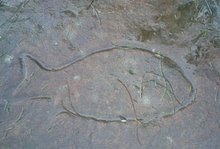
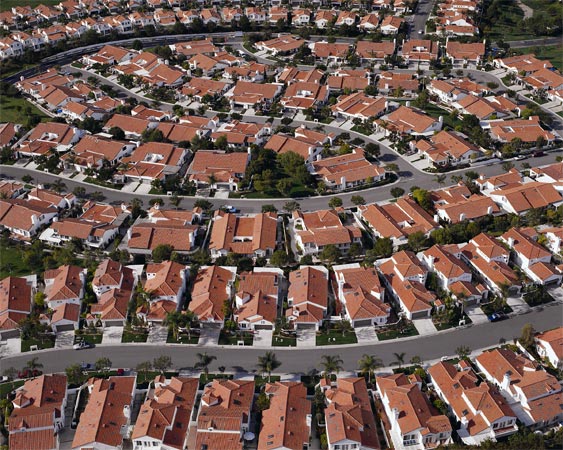
Images: Monoculture lawn of anywhere and local native grass tuft
20 June 2007
Unsustainable noisy petrol - 'gardening' Manly style

13 December 2005
Lawn obsession II
 Mnly reported on the lawn obsession in Australia. An article by Sarah Rich in World Changing recaps the situation for Los Angeles. Two references mentioned there, Archinects and CCA especially provides a very elaborate cultural history of the lawn in sub-urbia. A must-read! Also no shortages of good ideas how to turn these lawns into fruit.
"North America now has more than 32 million acres of lawn under cultivation, occupying more land than any single crop, including wheat, corn, or tobacco. Americans spend $750 million a year on grass seed alone and more than $25 billion on do-it-yourself lawn and garden care, making the lawn and landscape industry a booming sector of the economy." (CCA)
Image:'toxic uniformity'
09 December 2005
Lawns and pesticides
Most sub-urban homes and public green spaces in Sydney consist of lawns. Petrol-powered equipment creates a noise nuisance (long abolished elsewhere) for most of the day. But apart from the internal combustion engines, the whippersnippers and leaf blowers it is the toxic lawn chemicals that are of serious concern.
Stan Cox reports about the situation in the U.S., but the scene in Australia is probably not much different:
"Profits from agricultural pesticides have been low for years," sending agrochemical manufacturers in search of new markets. Today, "their most reliable customers" are the makers of lawn-care products, who, in turn, are working to "increase the ranks of chemical-using lawn managers."
"…50 percent of households treat their lawns or gardens with pesticides, applying active ingredients at average annual rates of 2 pounds per acre for herbicides and 0.4 pounds for insecticides. Professional applicators apply an average 193 pounds of fertilizer per acre per year, while do-it-yourself homeowners use 139 pounds."
Beyond Pesticide quantifies the problem in the following way:
"Annually, over 100 million pounds of pesticides are used in and around homes and gardens. Alarmingly, suburban lawns and gardens receive far heavier pesticide applications per acre than most other land areas in the U.S., including agricultural areas."
The health effects of these cocktails on humans:
"Such widespread use and exposure is alarming considering that of 30 commonly used lawn pesticides, 13 are probable or possible carcinogens, 14 are linked with birth defects, 18 with reproductive effects, 20 with liver or kidney damage, 18 with neurotoxicity, and 28 are sensitizers and/or irritants." (See also their pdf for more details)
Why have a monoculture of lawns?
Cox cites a study that suggests that "property values are clearly associated with high-input green-lawn maintenance and use," and that "moreover, lawn-chemical users typically associated moral character and social responsibility with the condition of the lawn."
Apart form the 'tidy town' symptom it is also a stated part of Oz DIY culture and of course a good way to 'kill time.' The lawn care industry has an interest to substitute labour with petrol and chemicals to roll out that 'instant turf'.
What are the alternatives?
Cox cites that "Any truly sustainable alternative is, put simply, bad for business." For gardeners conversion to organic lawn management is desirable. No noise, petrol fumes & artificial toxic sustance dependence and dangers to health.
Better still would be to rip out the lawn and create a low water, low maintenance native garden. It will take some time, but you will be able to spend your time productively, lessen the environmental burden and encourage wildlife to your dwelling.
Links:
DB of common names of pesticides
NSW EPA, compulsory training info for people who work with pesticides.
Pesticide gardening info,UK, esp. the stuff most gardeners use.
Signs and Symptoms of pesticide poisoning
Effects of organophosphate poisoning
Using native grasses in your sustainable garden
Make an 'edible estate'
Picture: Defend your Turf!
Beyond Pesticide resources
Previous article in Mnly on the topic:
On petrol gardening
04 August 2005
Hello golfer!
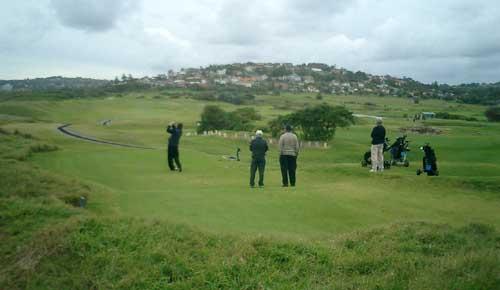 The Northern Beaches are studded with golf courses. Headlands have been cleared, lagoons and water-ways provide handy elimination of undesirable substances. The club houses are manicured to not get those white shoes soiled. The consumers of these services do not ask themselves what the negative impact is on the environment or their future generations. The need for hundreds of large cars to park, the industrial and chemical treatment of the large area. The noise scape created by industrial machinery. The ecological and economic impacts on the direct neighbourhoods. Responsible people would ask their 'recreational club' for a sustainability accounts. Make an informed consumer choices that does not negatively impact on people, fauna and flora.
- It takes some 2.5 billion gallons per day to irrigate the world's golf courses, the same amount could be used to provide 4.7 billion people with the UN minimum of fresh water required.
- There are 18.0 pounds of pesticides used per acre annually in golf courses.
- Agriculture uses 2.7 pounds of pesticide per acre.