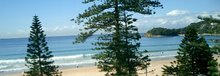
Each year there are fewer Crested Terns visiting Manly Beach.
 More and more fishermen line up along the urban beach. Booze-free zone. Stinking garbage, dead fish, dangerous hooks and plastic junk are left behind.
 A Crested Tern mother had a chick which she hid amongst the Seagulls. Returning from her feeding trip, she was in distress, trying unsuccessfully to regurgitate - a fishing hook and nylon string. Various phone calls were made to volunteer organisations with long waiting loops. Had it been a precious dog, there would have been a swift service. It is unknown if the dependent chick or the mother survived. But then it's all about beach as a tidy and profitable playground for humans. Wildlife, especially shorebirds, are not granted a habitat.
More birds killed by fishing hooks and fishing lines at Manly Beach
Ban fishing on urban beaches. Make Manly beach and the Northern beaches a marine park.
08 January 2011
Ban Fishing on Crowded Urban Beaches - Marine Reserves

16 October 2010
Water on MNLY Blog
 A compilation of posts on water. Ways of utilising water. As a tip: a cost-effective dump, as 'unintentional' 'run off' or as general human-caused eutrophication of water bodies. Taking risks with public health by polluting the elixir of wet for all life.
Water & public health:
On the use of water and on the creation of dead zones 28082007
The water bodies of the Earth are being used as a cost-effective way to dump the unwanted.
Drinking water and healthy water bodies Pt II 04090207
Sydney's drinking water, we are being told 'is no public health risk'. Some areas of Australian coasts are so polluted, that it “can cause selective inhibition of phytoplankton species”
Drinking water security sewage and emerging bugs Pt III 10092007
"Growing population centres and the inefficient use of water is “the greatest threat to waterways”. Urbanisation, norovirus, disease history
Drinking water, food & health:
Drinking water security, Sydney belly: Cryptosporidiosis, Giardia 17102007
Reducing risks when eating out 21092007
More on Sydney water, Health and Pollution 27092007
Manly restaurants and eateries - a wishlist 13112008
Draining Sub-urbia, 'run off' Eutrophication:
Water chemical mashup over suburbia 23082007
Shelly Beach palm gully creek 20102007
Impervious surfaces, spaces for cars and running toxins in urban heat islands:
The world as a car park - hot and oozing toxins running into our water streams 13092007
Lawns - water guzzling & toxic
Lawn transplants costing the Earth - Manly style 09082007
A mono-culture of petrol and water intensive regime of foreign grasses (lawn), noise, air and soil pollution.
Coastal lawns golf and pesticides 04082005
'Run-off' to Manly Beach, dog feces and chemical cocktails:
Water quality at the beach 09082007
Careless urban sprawl in coastal areas is devouring wetlands and other natural buffers such as dunes and beach grass that would otherwise help filter out dangerous pollution.“ Local beaches are ranked here for both faecal coliforms and enterococci. Some of the waterborne illnesses like gastroenteritis, dysentery, hepatitis, respiratory ailments etc. probably hit people 'out of the blue'. Toxic waste such as heavy metals etc also show their effects only after some time.
Suburbs draining toxins into Manly Beach and Lagoon 16012006  Suburbs drain toxins and feces to Manly beach and Manly lagoon as a way of disposing of these unwanted substances cheaply. All the everyday actions of the everyday people are then drained into the non 'my space'. Socialise externalities" Mr Galloway found that concentrations of nitrogen, phosphorus, copper, lead and zinc in Manly's stormwater exceed ANZECC guidelines for pollutant concentrations in waterways by between two and 168 times."
Draining Manly suburbs pipe at the beach 20102005
Can Manly afford not to share North Head with Penguins? 19102008
Red Tides in the making...
Preventing red tides at Shelly beach, Manly 06102008
Proud to waste water
Wasting water as a life-style 25032007
Desalination mega projects - Water as a commodity
Water and Desalination Factories by M. Barlow 08102008
Privatising water, offshore factories sludge in the ocean
Desalination - A mega project or water conservation and whales 13082008
Mnly tag: water
Blog Action Day 2010 Water, Twitter: blogactionday, #BAD2010
Images: 1. Water sculpture for gathering clouds by the Eora people of the Sydney sandstone region. 2. Ancient drinking trough (for horses ?) in a town square, Lake Constance
24 August 2009
Emission Intensive Events at Manly Beach
 Events in Manly are announced via a BIG CO2 footprint. At the beach front/Corso plastic banners are hung into the pines to announce an event. The banners and plastic strings weighing a few grams are being put up and taken down with a maximum of petrol usage and noise pollution.
Also a huge section of the public pedestrian space is taken up by parking a suv, a trailer and a crane in it. With the machinery running, the worker extracts the bit of plastic.
It is especia lly ironic that 'green events' are being advertised in this emission rich manner. Digital channels do exist. It seems incompatible with the council's 'Sustainability Strategy for Future Generations'.
The 'green family fun' event at Manly Lagoon also degraded the sound scape for the waterbirds/wildlife and adjoining residents. Amplified noise or anthropogenic noise pollution are not beneficial for wildlife. A high impact event.
NB In image 2 note the plane trails of high emission in the blue sky celebrating the aerial combustion engine as well. Families were fascinated with the pollution and the disappearing atmosphere for their off spring.
17 July 2009
Beach Sand, Fecal Contamination and Salmonella
 Salmonella has been found in sand of playgrounds in Mona Vale, Winnererremy Bay, Warriewood, Palm Beach and North Avalon. One year on and the bacteria (Salmonella paratyphi bio var java) have resurfaced in the sand. In Dunbar Park, which is now closed the sand will be replaced with 'treated bark'. Both in May 08 and November 08 Mnly wrote about the connections between(exotic) pets, fecal contamination and aggregation of minors in beach sand.
New research has also found that people digging in beach sand or building sandcastles risk gastrointestinal diseases and diarrhea. The epidemiological study looked into sand contact activities and illnesses.
"Researchers found evidence of gastrointestinal illnesses, upper respiratory illnesses, rash, eye ailments, earache and infected cuts. Diarrhea and other gastrointestinal illnesses were more common in about 13 percent of people who reported digging in sand, and in about 23 percent of those who reported being buried in sand...We have known for some time that swimming in waters polluted by fecal contamination can result in illness, but few previous studies have focused on sand."
Beach users should use a hand sanitizer or wash their hands/body after contacting beach sand.
The runoff from urinating and defecating dogs at the beach promenade/wall, draining through the pvc pipes/stairs onto the beach sand does not seem to make the beach sand less risky.
 Questions remain:
Where was the sand sourced from that covered the playgrounds?
Where can information be obtained regarding fecal contamination of beach sand at Manly Beach?
Links
Sand, salmonella, e-coli and that cute pet, May 08
More salmonella mysteries on the Northern Beaches, November 08
University of North Carolina at Chapel Hill (2009, July 10). Digging In Beach Sand Increases Risk Of Gastrointestinal Illness. Via ScienceDaily
Christopher D. Heaney et al., Contact With Beach Sand Among Beachgoers and Risk of Illness, American Journal of Epidemiology Advance Access published on June 18, 2009, Am. J. Epidemiol. 2009 170: 164-172; doi:10.1093/aje/kwp152
21 June 2009
Pathogen Ecology at Manly Beach
 People pass on superbugs to seagulls. "...Wild birds pick up E. coli of human origin, and with human resistance traits, and may accordingly also act as an environmental reservoir and melting pot of bacterial resistance with a potential to re-infect human populations."
Both aggregate at beaches and like to share take-away food. Humans leave the 'throw away wrappings', gulls leave their feces on the beach promenade.
Waste management on the Manly Beach front (images) takes the form of high-pressure hosing, and debris blowers. All are petrol powered, polluting and very noisy. The waste, which as we now know has the potential to contain antibiotics-resistant bacteria is 'dispersed' by the air or water/aerosol pressure. The waste is blown, wet or dry, either in the direction of the beach or towards South Steyne and its outdoor eateries. Beach users, parade walkers and customers of the eateries need assurance that risk factors are being kept to a minimum.
- Silver Gulls (Larus novaehollandiae) are a native and protected species. Enforcing the 'no feeding' rules would limit their spread.
- Eradicate invasive species (Indian Mynahs) and their feces, dog feces on public footpaths. Enforce the law.
- Adopt sustainable waste management not based on petrol and that does not constitute noise pollution.
Via > > Bonnedahl et al. Dissemination of Escherichia coli with CTX-M Type ESBL between Humans and Yellow-Legged Gulls in the South of France. PLoS ONE, 2009; 4 (6): e5958 DOI: 10.1371/journal.pone.0005958
Escherichia coli , antibiotic resistance
Reverse zoonosis
Image: Google Maps, Manly Beach front, parade with eating facilities, South Styne and the eateries opposite.
20 May 2009
Fishing (hooks) and Albatrosses - Manly Beach
 Another dead Shy Albatross found at the beach. This time it was an obvious victim of 'fishing-by-kill'. The fishing hook was lodged in its eye and the nylon string entangled especially the young bird's legs.
Create more Marine Reserves, eradicate the ineffective and wasteful fishing industry and ban ' recreational' wasting of biodiversity.
More 'recretional fishing' victims at Manly Beach here
01 May 2009
Manly Beach Drift 'wood' - May
 A monthly summary of what has washed onto the shore or beach through the winds, tides, waves or human action. Marine debris, flora and fauna, dead or alive:
Glassing - unintentional/intentional
A stunning lot of freshly cracked G L A S S on the beach. It can be mapped as a post-event phenomena.
On the cemented turf violence with glass, 'glassing' seems to be a popular, mostly alcohol-fuelled activity. There were a lot of bare-footed people on the beach. Which 'stakeholder' is responsible for this potentially dangerous 'externality'?
Airborne Bird Feces and Public Health
At prime visitor time the main cement stairs along the Corso beachfront were sprayed with a high pressure hose. The stairs tend to get caked in bird feces and 'fast food'. The odd butt and wrapping thrown in too. The worker wore no protective mask/ respirator while blowing the nutrient-rich accumulations of bird droppings, feathers and debris in the beach direction. Nearby visitors seated on the stairs received a good dose of of the moist, pulverised, and airborne mix. If OHS is an alien term, then at least the health hazards associated with bird feces and food wastes should be taken into consideration not just in times of pandemics.
Stingers An unusual jelly, a squarish transluscent bell and short, pink tentacles.(Purple Stinger, Pelagica noctiluca?) Never seen before. It seemed the only medusa on the beach.
An almost hot day with dense white clouds. The horizon uncluttered. 010509
Herbicide in runoff
Various plants around Manly suburbs seem to have been sprayed with herbicide. That classical plant around the pole that petrol-fuelled 'gardening' could not eradicate.
 Crested Tern Habitat: Eutrophication Pipes
 At the Manly Life Saving Club, developments race on. Extreme pollution around that premise: a cacophony of debris blowers and diesel-fuelled deliveries of 'fast food' - all blowing into the building. A place to avoid. 040509
More than 24 Crested Terns with offspring. White Cockatoos grazing on conifer seeds. Styropore flakes seem to have come down the hill, washed out of the pipe and got flushed back in. A lot of them. The "Green" machines are disturbing the peace and quite. Fecal matter on the stairs being moistned and dispersed as aerosol by a high pressure hose again. 050509
Unusual mushroom-shaped sponges. Many leg-less seagulls. Why? Large Bluebottles.
All streetlights along North Steyne are on in the daylight. Too much money? Not enough CO2? Pollution from smokers, diesel vehicles and rancid restaurant oils mingling at the beach.
Elsewhere they are flying a blue flag at the beaches to assure users/visitors that the water is clean and the shore-line free of anthropogenic debris. 110509
 Dense schools of different sized fish in the surf. Gannets diving for them (video) Seagulls chasing Crested Terns and Gannets for their rich catch. At places the ocean looked like it was 'boiling' with life. A few Willy Wagtails (Rhipidura leucophrys) checking out the dunes and a few Butcherbirds calling (audio) from the pines. 130509
A very large variety of shells today. Many Crested Terns still fishing. The surf had very large fish nosing around our legs. The usual plastic junk, fishing/diving garbage and chunky glass.
All streetlights blasting energy during the day from Queenscliff to North Steyne Surf Club. This has been going on for ages now, they must have money to burn! Their offspring might ask them one day why this planet has become so uninhabitable. (PDF) 150509
Diesel and noise pollution at the Queenscliff end: The smell of 'kelp' or the substance that flows out of Manly Lagoon has been exchanged for industrialising the beach and lagoon mouth with noisy and stinking machinery. 180509
The last oysters scratched off by very hungry and needy people at the Queenscliff rocks end. Street lights still blasting in the day as if there is no tomorrow. Dead fish and a lot of garden refuse washed down to the beach from the subs. 'Throw-away' lighters and very large,
 sharp pieces of glass. Boat-parking on the Cabbage Tree Bay Aquatic Reserve. Who needs biodiversity when in need of parking that petrol-guzzling 'recreational' aquatic vehicle? 190509
A second Shy Albatross found with a fishing hook in its eye and the fishing string tighly wrapped around its legs. Many dead fish and many sepia. The usual 'event' glass and one-mouthful wrappings.
People that look at things at the beach seem to be either small children or foreigners. For the rest it is a (free) gym or a path to the surf. 200509
Wild weather conditions pound the coast. The row of pines in full seed seem to emit a castanets' sound before the lorikeet frenzy starts. Two Pelicans glide over the beach without a movement.
The sand was covered in small pieces of volcanic rock that have blown in. Large Cuttlefish sepia bones.
 Along the sandstone wall some native vegetation is re-establishing itself, holding the sand in place: Knotted Club Rush (Isolepis nodosa), Pigface (Carpbrotus glaucescens), NZ Spinach (Tetragonia tetragonioides) and Scaevola sp.
At the southern end the surf is lapping at the stairs, signs of erosion become visible.
The heavy rain washed suburbia clean again. Down the hill it all goes, all the unwanted externalities.
The plastic Junkspace contained fishing and surfing paraphernalia. Fast food 'throw-away' cutlery and dishes, a lot of balloons with fancy long strings, dummies, spray cans, furniture and crates.
An adult man flying plastic kite in the air, endangering others. Usually the plastic debris gets tangled in the tall pines and stays there for the birds.
A lot of fruit rolled around the shore: apples, figs, grapefruit, oranges, tropical mysteries. The gulls prefer apple.
The usual daytime light pollution and energy waste from Pine Street to the north all along North Steyne.
Around Pacific St. the dunes are reclaiming lawn territory from the underground.
An army plane flying low over the Pacific horizon. 210509
Wild weather still pounding the shoreline.
Audio: Pounding surf, White Cockatoos screeching.
 Fauna: An abundance of Nudibranch (Glaucilla marginata). Crested Terns are still blending in with the Seagulls.
Jellyfish: Many Velella, the unusual Bluebottles mingling.
Vegetation matter: Most vegetation matter seems anthropogenic, cut branches, weeded grass tufts, weeds etc. Possibly washed down 'externalities' from sub-urbia.
Plastic: Many bags, 'party balloons' and extra long strings and fancy ribbons ready to entangle wildlife.
Glass: Only one extra large, sharp piece today.
Dogs: Black plastic bags, full (of feces) and empty blowing around the shoreline. Illegal dog packs ON the beach.
On the parade: the same pine vegetation as if the council's idling 'green' machine has never been there. 220509
Wild ocean, even the gulls are uncomfortabe at the beach. The volleyball infrastructure on the beach eroded and scrambled like toothpicks. That bit of 'real estate' on the beach won't be 'monetizing' for a while. The stairs are challenged by the pounding waves, the large sharp rocks from under the sand/ beach are exposed by the erosion. 230509
The erosion and plastic pellets have their own post. There was an unusual amount of anthropogenic debris on the beach. Mostly plastic, a lot of it minced. Giant rope knots, plastic cables etc, ideal to entangle. Most crested terns have disappeared. The smell was not the best and it was not kelp! 250509
Erosion, especially at the south end of the beach. Large rocks, cement lumps, iron bars and mysterious fibrous mats surfacing. The last upright volley poles are going.
Plastic junk and plastic ropes and fishing lines, knotted in thick entanglement balls. The "litter free" North Steyne beach was like the rest of the beach full of plastic garabage and plastic resin pellets.
 Kelp is arriving to replenish the (northern end of) beach and grasp the sand. Sea tulips and live marine creatures are also amongst it, so the human community will scream 'stinky weed' again and deprive the beach of what it needs. Strange insensitivity towards the other most overwhelming smells...
Jellyfish, large red/burgundy with a huge bell.
Motorised: Wheelies on the ocean, idling green machines on the parade and tractors at the beach stemming the tide of human junkspace. 260509
Kelp: At the north end of the beach: 150+ cm high kelp covering the pool's edge, the beach and surf. Sea Tulips are also mingling. Swarms of Swallows chasing thick swarms of 'kelpflies' in their habitat.
Sponges: A great variety, many still in their colour.
Jellyfish: a couple of the huge bell in red/burgundy.
Junkspace: Minced plastic junk all along the beach.
In front of the childrens' hospital the pines now even become a tip for long and thick fishing strings, high up in the trees, ready to entangle Lorikeets or any other bird. Junkspace making has many dimensions.
Horizon: Thick brown haze pollution. Romatic fireplaces, pollution from a car-dependent nation? 270509
 Kelp: + 150 cm high especially at the northern end, sloshing in the surf and reaching into the lagoon and pool. All along the beach as well. As it is mixed with Sea tulips and Cunjevoi it will smell of decomposing animals. That is aside from the Manly lagoon smell, the many eutrophication pipes leading into it and the ocean, funneling the 'externalities' of Sub-urbia into the Pacific.
Sponges in great variety, Shark eggcases and Sea Urchins.
Swallow cleaning up the kelp and marine life 'flies'.
Plastic Junkspace: The old finely minced plastic with the plastic resin pellets from days ago, distributed along the dunes. A fresh lot in the thick kelp of mainly plastic bottles and fast food, eat & chuck debris. And all that on a 'litterfree beach'.
Dogs and more dogs illegally at the Queenscliff end of the beach.
Queenscliff cliff edge: Most woody vegetation (trees) rolling down the cliff 'sponatenously'. Even the endemic wetland reed (Phragmites australis) looks as if it is sick and tired of stabilising the cliff edge. Another habitat going for Herons and Ringtail possums. Only a bare and eroding cliff face/headland would be recognisable as iconically 'Australian'. 280509
See also Driftwood of:
April, March, February, January, 2009
17 December 2008

06 October 2008
Preventing 'Red Tides' at Shelly Beach, Manly
 Shelly Beach is a small sheltered beach, facing Manly Beach. A coastal walkway, leads along the Cabbage Tree Bay Tree Aquatic Reserve to Shelly, which has one of the few small unbuilt headlands with native vegetation on it. Some of original cabbage tree palms were replanted as they once fringed the watercourses leading to the beach. The headland leading back to Manly beach has been undergoing intense development for years. The beach facilities are also under intense demand.
Dead Fish, how come?
Last week (02 & 03.1008) many dead puffer fish and a moray eel were washed up on Manly beach. We assume, these 'cave dwellers' were from the 'Aquatic Reserve'. On the 051008 the first blooms of an apparent red tide was visible at Shelly Beach. On the 021008 "a mysterious red sludge", believed to be red algae bloom was found on a beach in the Manly area, at Clontarf.(Image)
Nice Beach as a drain, growing harmful bacteria?
The walkway from Manly beach to Shelly beach along the aquatic reserve is studded with old, often decayed pipes of all sizes, draining the dense sub-urban  development on top of the headland, down into the little bay/'reserve'. The mossy green rocks are the sure-sign for 'rich run-off'. The little creek behind the restaurant, has spaghetti-like pipes all leading into it and straight into the beach. Most of the properties, strain to grow water and nutrient intensive foreign vegetation. A large paved car park on top of Shelly, is increasingly denuded, leading to even more run off. Numerous dogs on the beach and unleashed along the walkway help to contribute their untreated feces into the adjacent cabbage bay aquatic reserve. Sydney on the whole “dumps a billion liters of sewage into the ocean every day...” (Maude Barlow, Blue Covenant, 08 p28.) Habitat degradation, generous run off and extreme warming of the atmosphere and the ocean is a guaranteed recipe for 'red tides', then harmful algea (HABs), then hypoxic or 'dead zones'. The beaches become at first unusable, smelly and might irritate the skin and eyes. Later, even just breathing the 'mist' can cause health problems and fish suffocate in the o
 xygen-deprived sludge, “fish-kill” (video). Marine species have their central nervous systems attacked by the poisons generated by the bacteria and also seek to 'leave the ocean' gasping for oxygen. Marine mammals, such as humpbacks are also poisoned and 'beached'. 'Food-species' can become deadly to fish, shellfish and people. Sea and shorebirds fall out of the sky(pdf). The stench would repel any visitor, closing beaches becomes very costly for the human economy. Rehabilitating the ecology of a 'dead zone' is usually left for the next generations.
Beyond denial - Doing something against the red tide
Elsewhere environmental groups are enforcing measurable standards to prevent the fouling of their beaches."..To set numeric limits on the excess nutrients which trigger harmful blooms of blue-green algae...Blue-green algae - also known as cyanobacteria - produce "dermatoxins" that can create severe dermatitis and are known tumor promoters; "neurotoxins" which interfere with nerve cell function; and "hepatotoxins" which attack the liver. Exposure to blue-green algae toxins through ingestion, skin contact or inhalation can cause rashes, skin and eye irritation, allergic reactions, gastrointestinal upset, serious illness, and even death..."
Their drinking water" is now subject to almost year-round blue-green algae blooms as a result of nutrient pollution"
It is too dear to not act
The red tide algae, Karenia brevis, "costs approximately $20 million per bloom in  economic damage off the coast of Florida alone." The beauty of a beach is lost forever.
Ocean Care includes the acknowledgement of eutrophication, it seeks to alter the behaviour of individuals and the authorities bestowed with the stewardship of an biome and urban planning.
Images:
1. Shelly Beach, Google Maps, 2008
2. The walkway from Manly Beach to Shelly beach along the Cabbage Tree Bay Tree Aquatic Reserve on the one hand and the suburb on the other, Google Maps, 2008
3. Shelly Beach looking back onto the walkway with thick streakes of 'red slime' 051008
4. Shelly Beach with 'red slime'', with view to Manly Beach opposite
Update:
Red Tide 11.2010: North Head images, 1 & 2,
13 August 2008
Desalination - a Megaproject ! or Water Conservation and Whales
 Today's news of the construction of a 16-storey drilling platform off Kurnell, Cape Solander assured us that "The six-month operation will..not have any impact on migrating whales. I have every confidence the whales will swim around it..There will be no impact on the residents of Kurnell"
Will the whales still make it past Manly?
Could Manly become another 'Kurnell'?
Once water conservation is off the agenda, the high cost and high energy option of desalination plants appears to be the only way to continue unsustainable practices on the driest continent. The environmental costs, apart from turning the sea/shore into an industrial zone (image) are carried by the wildlife and its biome.
The following reading list is highly recommended on topics that will not disappear in our life-time:
Desalination projects & transparency:
Phil Dickie of melaleuca media investigatives the options of desalination plants in "Making Water - Desalination option or distraction for a thirsty word" 0707 for WWF’s Global Freshwater Programme. "The first global survey of desalination from a non-industry perspective" (pdf) Regarding Australia:"All of the areas where seawater desalination is rapidly assuming a more prominent water supply role had more cost effective and less potentially environmentally damaging alternatives available. This is particularly true of demand management, water conservation and water efficiency measures, where many of even the more advanced economies such as Australia do not uniformly require easily achievable water and energy efficiency standards in new buildings."
Megaprojects & Transparency:
Bent Flyvbjerg, on megaprojects, Chapter 1 of his book Megaprojects and Risk: An anatomy of Ambition, by Bent Flyvbjerg, Nils Bruzelius, and Werner Rothengatter (Cambridge University Press, 2003). Some of his interests are transparency in policy planning and strategic misrepresentation wrt megaprojects.
Links:
- Towra Point Nature Reserve, Kurnell
- Botany Bay National Park
- NSW Fisheries - Towra Point Aquatic Nature Reserve
- Amid Water Shortage, Australia Looks to the Sea, Patrick Barta, The Wall Street Journal, 110308
- Ecotoxicological marine impacts from seawater desalination plants, Rachid Miriaand Abdelwahab Chouikhib, Desalination and the Environment Volume 182, Issues 1-3, 1 November 2005, Pages 403-410
- Environmental impacts of water desalination along the coastal region of Israel and the Palestinian Authority (pdf) (environmental impacts and noise pollution)
- Sydney Water, Desalination Factsheet
- Riverkeepers fighting to not mush up the "small aquatic organisms into the cooling mechanism; the resulting impingement and entrainment from these operations kill or injure billions of aquatic organisms every year." (pdf)
- Protests against desalination in Victoria, abc 140708
- Scorched Earth for water plant we might not need, SMH, 0807 (Great image of the 'scorched earth' near Towra Point Nature Reserve!)
Image: GoogleMaps, Cape Solander , Kurnell, (NB note the ocean colour, approx. 2007)
Update 210808
- Plans to dredge Botany Bay as part of a $1 billion port expansion, taking 60 hectares of land to construct five new shipping berths. abc 190808
Update 300808
- "Australia could be using 400 per cent more energy to supply its drinking water by 2030 if the policy trend towards seawater desalination were to continue...seawater desalination was likened to a petrol-guzzling "six cylinder" family car by one of Australia's top water bureaucrats at a major summit in Melbourne." The Age 290808
- On offshore drilling platforms in the coastal path of hurricanes, the ecological and economic damage. Science Daily 290808
- What's the Deal With Offshore Drilling? Will it do any good at all? Jacob Leibenluft, Slate, 120808 (A good overview of the environmental impacts of offshore industrial activities)
Update 091008
- Peak Energy also was concerned about the impact on the sea dragons at Kurnell.
- Water and Desalination Factories by M. Barlow, Environmental Folly
- Climate-caused acidity of oceans, creates a noisier environment for whales, apart from the construction and operation noise of such a large infrastructure (click graphic!)
20 October 2007
Shelly Beach Palm Gully Creek
 Walking along Marine Parade (Manly Beach to Shelly Beach) today. Wondering why most of the large figs are so sparse and losing their leaves. Herbicide? Better views? Dogs, off leashes chasing the few Eastern Water Dragons trying to rest on the hot sandstones. Bulging black (leaking) plastic bags of untreated! feces hanging around picnic-lawns, near the walkway and beach. Weeds spilling down the nice sand stonewalls from the properties above.
 On the Ocean side, at the Cabbage Tree Bay Aquatic Reserve huge boats parked right in the little bay, stirring up the bottom of the delicate “reserve”. Swimmers and divers risk their lives swimming near these motorised McMasions.
Finally at busy Shelly Beach, all seem to be unaware of the high pollution at the beach, mixing fecal bacteria with blue Pacific water. It is a mystery why Shelly Headland is not part of the National Park or a Reserve. Just handed over to car parking and as a dog loo. Middens and Stone tools mashed up as cement to bang in access for easy fishing. Cunningham's Skinks (pdf) are deserting the area and Bandicoots are living dangerously there at night with dogs hunting.
A state of shame in water management
The stairs near the Kiosk lead up to a remnant of a creek that used to flow into the Palm cove of Shelly Beach in the old days. Today a walkway leads to Bower Street and the water management is a disgrace. Years ago a beautiful rainforest has been planted alog this creek, which has its origin on North Head. Most properties have weeds spilling into the (name-less?) 'reserve'. But the biggest shame are the many blatant PVC pipes directing their point source pollution INTO that water which flows into Shelly Beach. The point at the bridge, where most pipes discharge their private waste looked like oily smelly yuck.  Surface runoff from building sites also just flows into the little gully. How can such a waterway and bushland be treated so carelessly?
But then there are many pipes flowing all along Marine Parade into the Aquatic Reserve. The thick green 'fur' on the rock testifies to this eutrophication which in turn causes harmful algae to grow.
Images: 1.Swimmers having to swim around a yacht on Cabbage Tree Bay Aquatic RESERVE, 2 & 3 Creek Gully, stairs to Bower St. from Shelly Beach, re-vegetated wit run-off at many points.
Update:
Preventing red tides at Shelly Beach, 061008
Links:
Streamwatch
Managing Wastewater in Coastal Urban Areas
16 October 2007
Halloween – it's kinda spooky
 Manly Council is attempting to facilitate 'community' top down. The chosen event this time is Halloween. “Make your Street Spookier” goes the postcard-blurb. We should engage in a “creepy” orgy of consuming and line the streets with debris (plastics): “fake cobwebs, bats" etc., streamers and sugar/coloured lollies and spend big on costumes. Strange ideas for a council that purports minimising waste and has a sustainability statement. The promise is that the road will be closed, but no mention is made where the many spectators will park and what the increased traffic hazard means for wildlife and adjoining streets capes.
Halloween has its origin in the agricultural rites of death and renewal for a new sustainable year. Part of the produce had to be sacrificed to the land spirits and shared within the community. Dark forces had to be soothed with gifts and bonfires held darkness and death at bay. This renewal festival has long been co-opted and commercialised to flog off (mainly plastic) merchandise. Australia has just recently hopped on to this bandwagon.  The are a lot of spooky skeletons in the Australian closet. The plastic bats, spiders, owls, crows, skeletons, the cats, werewolves, haunted houses and zombies might be contemporary props to ward off the the inevitable hot dry future created by mischief-making adults. The horror is ususally projected onto the living native spiders and bats etc - till the ritual spray or habitat destruction puts an end to the spook. The defense mechanism must lay the blame on a sacrificial being, to heal the denial, the anxious state of being. Halloween is a welcomed purging as well as an economic healer now.
Children are very anxious about the future. A world without water and food , but permanent engulfing “bonfires” does not fuel much optimism. Responsible elders not looking after our only common home make the decisions to heat it up unbearable for all, make the sea rise and melt the ice. Daily, many members of this common household have to go forever. The land, waterways and air are used as rubbish tips and all loose their health. Degraded land and toxic landscapes are part of the inheritance. This 'house of horrors' might well be less inhabitable than what their parents inherited and squandered. The disruptive nature of economic and ecological inter generational equity is creepy.  Apart from these many “natural disasters” of a turbulent future, children go through horror scenarios of neglect and child abuse in Australia. Irresponsible use of cars, guns and dogs also sacrifices many young lives. Haunted human relationships propagate in a spooky Zombie culture. It is bewitched how young people are denied independence and maybe a future too.
Till then, put on the big magical denial party and celebrate...
Images: 1. Children at Manly Beach, 2 & 3 Street art Berlin