Showing posts with label Shelly. Show all posts

08 October 2008

Plundering the Cabbage Tree Bay Marine Reserve again


Again, the "no take" Cabbage Tree Bay Aquatic Reserve has been vandalised in broad daylight with many people present. 'Protected' fish such as the Blue Gropers and many more were speared. It is sad, that apparently only one person stood up to these people carrying potentially deadly weapons on a busy beach. Regularly, MNLY confronts people taking buckets full, spearfishing, filling big nets of colourful 'protected' fish. Some carers just let their kids collect as much shellfish as they wish. Most of the plunderers know about the illegality of their actions and become very aggressive. It is sad, that the enforcement of a "no take" zone is left up to the arbitrary citizen willing to risk their life.
A phone call to the relevant authorities on weekends and after hours, when most of the 'harvesting' and 'sport' takes place, is usually diverted to an answering machine. Rangers are off duty. MNLY has been documenting some of the vandalising of an aquatic reserve since 2005 and made numerous phone calls. It would be a positive step to hear that vandals, that "could be prosecuted" are actually fined. Effective protection of the marine reserve should be 24/7.

Via Manly Daily 'How can anyone be so bone-headed?' 071008 (Maybe it is has not fallen out of the archives, as the 'red tide' 021008 has.
Images:

Portrait of a male Eastern Blue Groper (Achoerodus viridis) with escorts. Shelly Beach, Manly, NSW, Flickr
Eastern Blue Groper (Achoerodus viridis). Fairy Bower, Manly, NSW, Flickr

Report all illegal taking and vandalising in protected aquatic habitats: Ph: 1800 043 536
- Manly Council Rangers Ph.:9976 1630
- Sydney North Fisheries Office Ph.: 8437 4983

Update:
The 'Spearoz' community is also discussing the matter here

17 September 2008

Wobbegong Dreaming at Shelly Beach Aquatic Reserve

The Spotted Wobbegong (Orectolobus maculatus) is a shark that lives in temperate to tropical rocky reefs. It likes to rest in caves during the day and at night it inhabits the bottom of the shores. Occasionally it ventures offshore. Sea grass beds are the preferred nursery. It has nice spots and a substantial 'beard'. If all is well, it can become 100 years old and measure up to three metres.

But there is a hitch, which is that the majority of Australians live along this very coast-line. The interface of shark habitat and the human field of activities has led to the near eradication of this species.

In the last 20 years the Spotted Wobbegong declined by 60 %, more in NSW

The coastal habitat has human infrastructure sprawling all over, sea grass beds are becoming rare.

Extractive practices are seeking to plunder or commericalise every bit of the creature:
  • Flesh for flake
  • Skin for hide
  • Poaching for aquaria trade
  • Peep & pay industries
Commercial fishing with a high rate of by-kill extracted many, sometimes chucking them if there was no market for them. “Recreational”, sports-fishing competitions and spearfishing do the rest.

All is well, now that the remaining wobbegongs in the 'wild' are tagged with radio transmitters and seven were bred in captivity, then also tagged and released into Shelly Beach Reserve. ”...Acoustic study and tracking devices will ensure that we can find much more about it.” Fitting electronic devices onto or into juvenile creatures usually employs invasive methods, as the gear is glued on with epoxy resin or suction pads. The ethics of this practice is questionable. Data-gathering from the dry comfort of the screen and DNA mapping might just reveal that the object turned into flake or by-kill yet again. Managing the mind-sets and practices of their own kind might ensure a sustainable habitat and an effective biodiversity management.

Large boats throw their heavy anchors into this delicate aquatic reserve. The noise and chemical pollution they cause is not compatible with a reserve for 'wildlife'. Suburbs drain their effluent into the shores and at night keen divers disturb creatures in their habitats with bright torches.
Just yesterday there were, yet again people line fishing IN the Cabbage Tree Bay Aquatic Reserve. Spearfishing in it has also been reported.

Links:
Spotted Wobbegong
, IUCN Programme
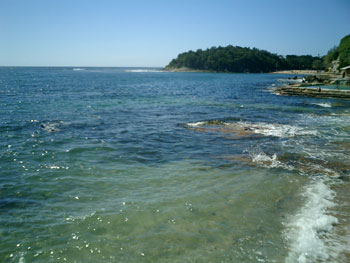
Cabbage Tree Bay Aquatic Reserve, Shelly Beach, Manly
NSW AMSA Position Statement on Marine Protected Areas and No-take Marine Sanctuaries, 2008, pdf
Australian shark fishing out of control
,The Nature Conservation Council?
The cost of Recreational Fishing and Boating on the Moreton Bay Marine Park, Bay Journal
Marine, National Parks Association of NSW, advocating the establishment of marine sanctuaries in NSW, only 6.5 % of NSW marine habitat is protected.

20 October 2007

Shelly Beach Palm Gully Creek

Walking along Marine Parade (Manly Beach to Shelly Beach) today. Wondering why most of the large figs are so sparse and losing their leaves. Herbicide? Better views? Dogs, off leashes chasing the few Eastern Water Dragons trying to rest on the hot sandstones. Bulging black (leaking) plastic bags of untreated! feces hanging around picnic-lawns, near the walkway and beach. Weeds spilling down the nice sand stonewalls from the properties above. On the Ocean side, at the Cabbage Tree Bay Aquatic Reserve huge boats parked right in the little bay, stirring up the bottom of the delicate “reserve”. Swimmers and divers risk their lives swimming near these motorised McMasions.

Finally at busy Shelly Beach, all seem to be unaware of the high pollution at the beach, mixing fecal bacteria with blue Pacific water. It is a mystery why Shelly Headland is not part of the National Park or a Reserve. Just handed over to car parking and as a dog loo. Middens and Stone tools mashed up as cement to bang in access for easy fishing. Cunningham's Skinks (pdf) are deserting the area and Bandicoots are living dangerously there at night with dogs hunting.

A state of shame in water management
The stairs
near the Kiosk lead up to a remnant of a creek that used to flow into the Palm cove of Shelly Beach in the old days. Today a walkway leads to Bower Street and the water management is a disgrace. Years ago a beautiful rainforest has been planted alog this creek, which has its origin on North Head. Most properties have weeds spilling into the (name-less?) 'reserve'. But the biggest shame are the many blatant PVC pipes directing their point source pollution INTO that water which flows into Shelly Beach. The point at the bridge, where most pipes discharge their private waste looked like oily smelly yuck. Surface runoff from building sites also just flows into the little gully. How can such a waterway and bushland be treated so carelessly?

But then there are many pipes flowing all along Marine Parade into the Aquatic Reserve. The thick green 'fur' on the rock testifies to this eutrophication which in turn causes harmful algae to grow.

Images: 1.Swimmers having to swim around a yacht on Cabbage Tree Bay Aquatic RESERVE, 2 & 3 Creek Gully, stairs to Bower St. from Shelly Beach, re-vegetated wit run-off at many points.
Update:
Preventing red tides at Shelly Beach, 061008
Links:
Streamwatch
Managing Wastewater in Coastal Urban Areas

10 October 2007

Immersing in Manly's smells, sounds and...

Olfactory ambience: sewage stench, at Shelley Beach, at Manly Beach and North Head. Dense plumes of nicotine at every doorway and corner.

Auditory ambience: A frenzy of buildings noises overpowering the surf all along the beach and walkway. Have a nice holiday!

Walkability: All “pedestrian zones” were parked out with numerous vehicles all over. Air-pollution in your face when they throw the motors on to “warm er up”.

Bathing: Shelly Beach is a shit and water mash-up. What a waste for such a nice beach. Too poor to keep up infrastructure with population growth?

Garbage and Plastics pollution: Convenience food and drinks encouraged and the anti-products socialised.Image 2: Surfers against sewage
Previous:
On the use of water and the creation of dead zones
Drinking water, sewage and emerging bugs
Daily beach reports

22 August 2007

Dogs of Manly allowed to savage wildlife

A late walk at Marine Parade, ending at Shelly Beach Park usually ends up disappointing. The majority of dog owners display very anti-social behaviour. Despite signs all over to keep dogs on leashes, they are off the leash and even deliberately chased on to the beach or into the small fragments of bush. Today a dog chased a very small Bandicoot and 2 Possums. When asked to restrain the dog, the owner defended all and nearly assaulted the person pointing out the matter. This is not the exception, but the rule.

Let's have a wildlife day in Manly. People who live here because of its natural assets would like to see the native animals and plants protected - instead of 'going to the dogs'. Any industries to sponsor such an event ?

07 May 2006

Spraying flammable solvents over beach and bush

Twirling and splattering flammable solvents on the white beach sand and near Shelley Head bushland is a regular activity in Manly now. Today there were various people (a class?) at Shelley beach fuming out the entire headland with a stenching smell from their fuel ( metho, (formaldehyde) kerosene, naptha, petroleum etc). Sparks fly close to the dried out bush, the high winds this evening made it all fly well over the headland. But there they twirled, hurling these toxic chemical solvents and drenching with it the white sand of the beach. An amazing tolerance of the Kiosk. The car park above was also shrouded with this foul smell. So much for 'fresh air in Manly'.
But then it is part of the culture to chuck a bit of metho on the BBQ and the absence of any enforcement will probably soon ignite the bush and all the bunkers encroaching upon it.
Pyromaniac

19 April 2006

Petrol or penguins in an aquatic reserve?

Jet Skis and other motorised watercraft will be banned from the Cape Byron Marine Park. No more aquatic motorbikes fuming out the air, endangering swimmers and surfers around Brunswick Heads and Lennox Head.
Manly Cabbage Tree Bay Aquatic Reserve often has Jet Skis, Yachts and other motorised watercraft parking there and speeding through. This is a danger especially for the Little penguins. One day they'll ban these petrol powered crafts on Manly's shores too. Does anyone know if motoring on top of an aquatic reserve is legal?

07 August 2005

Cabbage Tree Bay


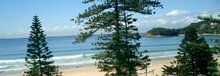
Cabbage Tree Bay is one of Manly's nicest beaches. It is part of a marine reserve and is right next to Shelley Headland, an area of regenerated bushland. It is unusual for headlands in the city near beaches not to have houses packed onto them. This is the only west-facing beach in Sydney.
The bay was named after the cabbage tree palms which grew around the beach and up the creek. When Sydney was first colonised, the edible hearts of these beautiful palms were used for pig food and all the palms were cleared. All that remained of them was the name of the bay, and most people did not know why it had that name.
For the last several years, the Manly Council has been replanting cabbage tree palms at the beach and around the waterfront. Once again Cabbage Tree Bay has cabbage trees growing on it. Again there are palms on the beach where they belong.
Unfortunately, large motor boats have started using this bay as a parking lot on weekends, spoiling the visual unity of the bright blue water and the green headland and pumping petrol fumes into the fresh air where people are swimming.

04 August 2005

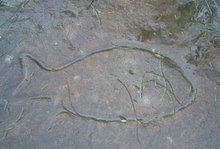
Cuttle 'fish' all over Shelley beach

A walk on Shelley beach (03.08) at night exposed a beach littered in cephalopoda, you might know it as the "stuffed with…thing". Approximately 13 white cuttle 'fish' each 30- 40 cm long were lying all over the beach. 'Natural stranding?' They have been around for some 542 million years now and are still performing their rituals in the protected Cabbage Tree Bay area. Many large boats came right in in the last days and went about their 'business'. These strandings go unreported. Bait?,boat chemicals or just tangled in nets?
Some more
images and information is here. Detailled scientific illustrations of anatomy and morphology of Sepia officinalis are here.