“Pungent brown sewage spews into the Pacific ocean. In the background, cranes put up hotels and beachfront apartments."
So runs an intro to another Pacific tourist spot where uncontrolled coastal tourism development kills the 'golden goose' for investors, residents and visitors. Pressures to intensify and commercialise the protected 'green and blue' leads to the degradation of all. Squeezing the proverbial 'goose' to death means a loss of human health, life quality and economic gain. Even more of the Australian species, plants and animals would lose their habitat, that is their right to life.
Imagine!
Manly in the 21st Century could be consumed in the same way, if there is no refraining from grabbing 'what's left'. Developing the trends would give the following constellation:
The pressure is already on (pdf) to convert 'nature' (Sydney Harbour National Park, North Head, Quarantine, Dobroyd, and Garigal National Park) into more of the same, a tide of 'accomodation' and sprawling sub-urban McMansions with their associated infrastructure.
Manly 'town' could become 24/7 neonlit buyosphere which customers could immerse themselves in. Alcohol merchants and casinos high-rise, Las Vegas style could frame the beach. Experiences and bodies could be organised via animators from the entertainment industry. Roofed domes would lessen the deadly uv radiation from scrambling the DNA. Organised 're-creation' is conducted on flood-light filled arenas. All are of course attending in respective plastic uniforms. Sports ovals, swimming pools and golf courses are also day & night air-conditioned and lit. Plastic lawns have long replaced water gobbling/toxic lawn transplants. Every inch of the Earth is paved over with coastal real estate: tourism development (hotels, resorts, restaurants, etc.), and the infrastructure supporting coastal development (e.g. marinas, beaches, recreational fishing facilities.) Breakneck developments turn the area into ear-piercing noise waves on every corner.
The sky is also filled with constant noise: Jumbo planes are seen 'spinning' over the beach, belching poisonous gases and consuming non-renewable energy while delivering more 'customers'. Helicopters and small plane 'joy-rides' are now so numerous that they are on a clear collision course with each other and the many UAVs. Brand names are 'written' into the clouds for all to see, that are not in-dome. Blimps urge all to accelerate the buying of anything now!
The ocean:
Surfing and swimming has long being abandoned, as the nutrient over-enriched coastal waters have turned into a permanent red tide. This anoxic "dead zone," is devoid of fish, but still very rich in stinging jelly blooms. The entire coastal marine ecosystems has been consumed. The sand is so e coli laden, that it is not to be touched. The 'ocean spray', full of HABs, is a health hazard. An industrialised ocean horizon:
Private boating also ceased, due to oil shortages and the unavailability of territory to give these motor-boats 'a good spin'. A dense network of aquaculture infrastructure clutters up the coastal waters. Further out, the ocean horizon is studded with chains of giant artifacts: Desalination factories (pdf), gas- and oil drilling and extraction structures and huge data platforms. No whale has been seen for years that could navigate this dense human ocean clutter.
More frequent violent storms, tornadoes, hurricanes and giant waves mince up the entire set-up due to human-caused climate change. The thick layer of human debris and waste floating on top of the Pacific also gets washed onto the shores. Various chemical spills and scrambled infrastructure do not make 'clean-up' operations easy.
Due to the many desalination factories, the water guzzling life style could be kept up. Visitors on the whole are consuming double the amounts of water via hotels, swimming pools, golf courses and personal use etc. But locals also all have their personal lap pool by the 'beach'. The exotic plants still are watered with petrol pumps as before.
The demand on energy leads from time to time to a crash into 'a candle economy'. Many suffer in their air-conditioning dependent dwellings in the long black-out periods. The nuclear option seems to keep this power-ful life-style alive.
Sewage, another plentiful anti-product which is a slight challenge to the aesthetic and olfactory appeal, could also pose a possible loss in revenue for tourism. The dead zone of the coastal waters is fueled by this waste-water contaminated with toxins and pharmaceuticals.
But all is not without life, people now have their dearest darlings cloned in multiples. One can see them, as before in cafes with up to 6 harnessed dogs.
Huge cats, as well as packs of dogs have gone 'feral' roaming gated estates. The only surviving bird is the Indian myna, seen in millions coating all with its feces. Many black rats are seen living on the garbage. Large swarms of flies, mosquito and ticks are still posing a challenge.
Australian animals can now be admired (for a fee of course) in an event space, previously known as a museum. There they are, the bandicoot, the little penguin and so many more - all stuffed, just like in the 19th Century. Most Australian plants are gone. Some invasive plants and pests are still about, despite the increased toxicity of the weapons used in aerial helicopter spraying.
Uncontrollable fires shroud the area in suffocating smog. Even though there are only weeds left to 'back-burn', the scarcity of water, threatens the 'real estate'.
Many argue that tourists were not drawn by all that 'environmental stuff', they didn't give a hoot about the unique ecology of Manly. They were seeking to spin their body around, often with the aid of petrol or ingestid toxins . This constituted 'fun' and sold well. Human generated 'attractions' have to be erected to offer a peep here or a spin there. Once contained, money could be collected in this Disney-like hybrid simulacra world. Neither locals nor visitors are remembering or missing that 'biodiversity and landscape attractiveness'. The problem is though, that the place has become indistinguishable from so many other (coastal) places in the world and that is a challenge. Like malls and airports, one doesn't know anymore where one is. Looking after the Country in the future:
Myopic objectives could gamble away 'nature' and 'uniqueness' that has no substitute. Unchecked developments and mobile destruction (mass tourism) degrade a place and its resources. 60 % of Australia already has been degraded by relative few people in a short time. 'Customers' flee the degraded tourist traps, locals desert the uninhabitable places seeking refuge in the remaining 40% 'new-found-land'.
Returning North Head, Sydney Harbour National Park, Quarantine Station, Dobroyd, and Garigal National Park to their owners might guarantee a halt to the tidal wave of destruction.The National Parks and reserves are an essential refuge for endemic plants and animals. They also are of great ecological and economic value in framing Manly as a desirable and unique place on the Earth.
Images:
1 North Head, Manly and the Northern Beaches, Google Earth
2 North Head, Dobroyd and part of Sydney Harbour National Park, Google Maps
3 Dobroyd, SHNP viewed from Manly Cove
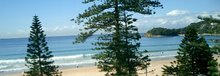
4 The Pacific ( uncluttered) viewed from North Head
5 North Head cliffs and the Pacific Ocean
Links:
Manly Council Submission to Taskforce on Tourism in National Parks, PDF
Players:
The NSW Government
The Environmental Trust, The Department of Environment and Climate Change (DECC)
Manly Council
NSWALC, NSW Aboriginal Land Council, Land Rights Act
National Parks & Wildlife Act 1974
NCC/NPA Submission to Taskforce on Tourism and National Parks, Submission of The Nature Conservation Council of NSW and the National Parks Association of NSW and the Blue Mountains Conservation Society. 0808, pdf 1,2MB
Areas to 'exploit' and 'open up':
Sydney Harbour National Park (SHNP) North Head, Quarantine Station, Dobroyd, and Garigal National Park.
Coastal Recreation and Tourism:
- UN Atlas of the Oceans
- United Nations University (2008, June 4). Coastal Management Cooperation, Enforcement Key To Avoid Pending Crisis For Millions, UN Experts Report. Retrieved September 22, 2008, via Science Daily
- Mike Davis , House of Cards, Las Vegas: Too many people in the wrong place, celebrating waste as a way of life, Sierra Club
Footprint:
-"You can't have one species growing indefinitely on a planet that is finite." Prof. Bill Rees
Update:
" The vast majority of the Australian population is clinging to the east coast, running out of land and running out of water...2043, when 43 per cent of the Gold Coast has been abandoned to ever-rising sea levels. Australia's swelling population could be accommodated in desert cities." SMH 201209
22 September 2008
Manly Beach 2048

16 October 2007
Halloween – it's kinda spooky
 Manly Council is attempting to facilitate 'community' top down. The chosen event this time is Halloween. “Make your Street Spookier” goes the postcard-blurb. We should engage in a “creepy” orgy of consuming and line the streets with debris (plastics): “fake cobwebs, bats" etc., streamers and sugar/coloured lollies and spend big on costumes. Strange ideas for a council that purports minimising waste and has a sustainability statement. The promise is that the road will be closed, but no mention is made where the many spectators will park and what the increased traffic hazard means for wildlife and adjoining streets capes.
Halloween has its origin in the agricultural rites of death and renewal for a new sustainable year. Part of the produce had to be sacrificed to the land spirits and shared within the community. Dark forces had to be soothed with gifts and bonfires held darkness and death at bay. This renewal festival has long been co-opted and commercialised to flog off (mainly plastic) merchandise. Australia has just recently hopped on to this bandwagon.  The are a lot of spooky skeletons in the Australian closet. The plastic bats, spiders, owls, crows, skeletons, the cats, werewolves, haunted houses and zombies might be contemporary props to ward off the the inevitable hot dry future created by mischief-making adults. The horror is ususally projected onto the living native spiders and bats etc - till the ritual spray or habitat destruction puts an end to the spook. The defense mechanism must lay the blame on a sacrificial being, to heal the denial, the anxious state of being. Halloween is a welcomed purging as well as an economic healer now.
Children are very anxious about the future. A world without water and food , but permanent engulfing “bonfires” does not fuel much optimism. Responsible elders not looking after our only common home make the decisions to heat it up unbearable for all, make the sea rise and melt the ice. Daily, many members of this common household have to go forever. The land, waterways and air are used as rubbish tips and all loose their health. Degraded land and toxic landscapes are part of the inheritance. This 'house of horrors' might well be less inhabitable than what their parents inherited and squandered. The disruptive nature of economic and ecological inter generational equity is creepy.  Apart from these many “natural disasters” of a turbulent future, children go through horror scenarios of neglect and child abuse in Australia. Irresponsible use of cars, guns and dogs also sacrifices many young lives. Haunted human relationships propagate in a spooky Zombie culture. It is bewitched how young people are denied independence and maybe a future too.
Till then, put on the big magical denial party and celebrate...
Images: 1. Children at Manly Beach, 2 & 3 Street art Berlin
11 October 2007
Bogong migration incompatible with human society
 As every year at this time the bright cities of NSW are swarming with Bogong moths. In the CBD of Sydney they were clinging in the crevises of old sandstone buildings, sheltering from the sun and resting. They did not go for the fauna-repelling cement/glass bunkers to hide. From Circular Quay to the CBD there was a frenzy of humans spraying poisons or sucking them in to industrial vacuum cleaners.
These creatures probably have migrated 'forever' on the same migratory routes. Growing up as a larvae in Queensland, they get a big dose of arsenic in the 'agricultural' fields. When it is time to hatch as a moth, it takes them 1000 km each year to fly to their cool Alpine granite caves. On the way they have to stop over for a rest in NSW, some just get attracted by all the light pollution.
The intolerance of humans to share the wildlife-urban interface in Australia with other creatures is high. In the struggle for control over space, the Australian animals are the ones for the extinction list. Termed by the MSM as “unskilled migrants” or even pest infestations, they are being eradicated. The concept of unique and 'protected' Australian fauna is for the zoo or emblems. After the arsenic, the pesticides generously sprayed around take their toll on the native birds. Appeals to reduce unnecessary light pollution, which attracts the swarms, also fall on clogged ears.
 The ones that make it back to the Australian Alps are eagerly gobbled up by the threatened tiny Pygmy Possum. Both moth and mountain possum are also robbed of their habitat and food sources by human-induced climate change. Snow tourism, sprawl, climate change and grazing cattle illegally deprive these Australians of their habitat. Pygmy, (video) just 'discovered' in 1966 and already on the way out, has as its main diet Bogongs. The snow is melting and the (toxic) Bogongs are not so plentiful.
Maybe the sandstone caves at Circular Quay that were eradicated to make place for the British penal settlement belonged to the Bogongs traditional space/time to ensure sustainable food for fauna and indigenous people. It was also the beginning of the mash up of spring water and sewage, as is a tradition of this unsustainable culture. The growing population quickly outstripped the clear spring at Circular Quay. They filled in the source of the stream to produce more food. Many years on from this Tank Stream saga, the stench of sewage at the Quay and the unavailability of healthy (drinking) water testifies to this culture too poor to manage its resources mindfully.
Huntsman spiders are welcoming them in Manly and the CBD...
Previous:
Bogong clouds over Manly
Other Links:
Bogong Months and Parliament House
Update:
Decline in bogong moth numbers leaves pygmy mountain possums starving, The Guardian, 25.02.2019
30 September 2007
Robbing the public of walkways and green space


 The land-grabs of foreshore Sydney is on everywhere. The small strip of green along East Esplande, Manly Cove is being conquered with the help of 4 WDRs and a lot of semi-commercial boating gear. Both the green strip and the pedestrian strip are being regularly squatted and people are excluded from using it. No one there to enforce the right of people walking (in the very few spaces set aside for them) and enjoying the Cove.
What would happen if one of these SUVs ran over a person on the 10 km/h walkway-only?
Why is the public excluded from using the green strip and their walk-way? Watch them make an aqua-car park out of Manly Cove and the jetties swallow up the blue harbour. Count the boats...
Image: Manly Cove aerial shot via Google Images, 0807
13 September 2007
The world as a car park - hot and oozing toxins running into our water streams
 A growing amount of the Earth is sealed with non-absorbent surfaces to ease the flow of automobiles. The result is warmer urban temperatures and polluted water ways.
Bryan Pijanowski found that in a mid-size shire “...parking spaces outnumbered resident drivers 3-to-1 and outnumbered resident families 11-to-1”. Car parking spaces were “...larger than 1,000 football fields, or covering more than two square miles.” Car parks “... turn out about 1,000 pounds of heavy metal runoff annually ”. Leaking car batteries and airborne fumes all found their way to the impervious surface and then to the next water body.
The temperature in these areas is raised by '2 to 3 degrees Celsius'. The researcher reminds us that 'land is not unlimited ' and we should “ seek a lifestyle that requires less automobile use”.
 Australian research has looked in detail at what is running down these hard surfaces to the beach and other waterways. “Roads make up about one-fifth of the urban land area”. They claim that the run-off is a cocktail of toxic waste. Rain or any other liquids then wash these poisons into the water bodies. “ The dust then enters the waterways, silting up creeks, ponds and wetlands.”
They found 20 chemicals on Sydney's road surfaces, such as:
- Environmentally persistent chemicals
- Polycyclic aromatic hydrocarbons (PAHs) from “ vehicle exhausts, asphalt roads and fires”
- “ Nicotine, most likely from tossed away cigarette butts, is an alkaloid with a half-life in the environment of 30 days and can be toxic to aquatic organisms”
- “ Trace amounts of heavy metals such as lead and zinc from tyres, petrol and bearings; chromium from wear and tear on car bodies, and copper from brake linings”
- Plasticisers
- “ Phosphorous that leads to algal blooms”
Links:
Convention on POPs
26 August 2007
Fire - The magic wand to create more habitat for people
 Various fires consumed Sydney's bush recently and created a smoggy dome. Primarily this form of land management “..is designed to help protect homes... from bushfire.” Especially the ones that moved to live IN the bush and then eliminated most Australian flora and fauna.
At the moment Greece is burning, large chunks of forests have burnt down and so far at least 50 people have been killed. Human beings deliberately set these fires in various places, as is also often the case in Australia. The well-to-do houses in the 'bush' have been saved. “Throughout the summer, Greece was full of rumors that many of the fires had been set by arsonists hired by developers looking to build on valuable land inconveniently covered by trees...Because there are no official maps indicating the boundaries of forests, though, once the trees have been reduced to ash, developers come in to claim land.” (Spiegel) The 'lungs' of that city have been eliminated, but there might be a housing boom...
Image: After incinerating various parts of Sydney bush the 'fog' was everywhere for days.
Update: 270807
- The 400 open tips started to smoulder with the high temperatures of global warming.
- The carelessness of smokers starts many fires the world over.
- Negligent private fires to incinerate garbage are also a cause of these fires.
- Real Estate speculation 'fuels the fire', houses are erected and all is sanctioned by council. Forests cannot vote. (The Standard at) Many of these practices are common here too.
A Greek journalist: "We had a beautiful country but we are increasingly losing it to fires, rubbish and the illegal buildings [built on land cleared by blazes]." (The Guardian)
19 August 2007
Today's Fashion, Tomorrow's Weed Liability
Australian shoppers follow all sexy trendz around here, even if it is 'costing the Earth'. Whatever is the 'in-thing', usually originating top-down gets synchronised simulatenously over the 7,617,930 square kilometres (if possible). Mono-culture rejects its (Australian) environment. Despite the jingoism, and flag hoisting in their real estate, Australian animals and plants are not part of the 'proud' picture.
Toxic Thuja, noxious South African Agapanthus, Bromelias and Dracaena were planted in the last fad. The Dragon Tree from Madagascar usually grows too large and then is 'put out' close by the house with its developing elephant trunk.
The rage of the moment is plants from: South Africa - This 'bird of paradise flower' pops up in gardens and council areas. Maybe they intend to keep Manly's dog population in check via this method?
  Mexico – delivers this Agave (attenuata) spilling from most buildings in planters or generously lining house-fronts. The 3 m inflorescence will keep future weeding volunteers on their toes or the chemical industry in business.
 The sexy mashup is 'to have and not care'.
Why not go all the way, as seen on the Corso: Agave plasticus. Spiky, to denote the privatised space, but no care is needed. Also makes exellent ash-trays.
Watch the new noxious weeds developing in this artifactual landscape. But then, why care - let future generations worry about that.
29 July 2007
National Parks for bushwalkers or vehicles?
 Off to the favourite National Park, Ku-ring-ai Chase N.P. to enjoy the flora & fauna. The Salvation Walking track features wet heath lands and hanging swamps. All in yellow and pink at the moment. While the entry fee is being charged, mainly birds provide the acoustic ambiance. After that, West Head Road turns into a free roaring racing track with wildlife smeared across the road.
For the sake or re-creation it is one of those rare places that one can move their body in Sydney without inhaling toxins or having one's attention totally focused on other people's hazardous motor-cars. Our relaxed walk was interrupted by 'hell riders'. Four mature adults insulating their bodies with plastics against the environment came hurling along on huge 'mountain bikes' from behind. As it was illegal to make a racing track out of a WALKING track we did not move aside. After various verbal bullying they crashed through the delicate heath, breaking vegetation as they went and raced off. The entire track was mushed up by mountain bike tracks for any park management to see. I especially object to the riding of these vehicles on the delicate sculptured sandstone platforms which chip easily. The indigenous artifacts are lost forever this way. Another space in 'nature' converted into a free gym where the 'I, me, myself' can hurl their body around.
Hell riders " attention is fixated onto the object of your arousal and you quite easily miss things like road signs or someone stepping off from the pavement, because your attention is absolutely locked onto the competitors"
Bush walkers tread lightly and give names to all flora, fauna and land-formations.
Update: 050807 The entire Salvation Loop full of speeding 'bicycle' riders harassing walkers. The wet track ploughed up by the many bikes daily.
Result of broad daylight car-racing: Two dead wallabies on the side of West Head Road.
See also NP going to the dogs
Bikes and damage to sandstone engravings
Images: Ku-ringai Chase N.P. tessellations, bleached,drosea and tea tree-swamp (Salvation loop) mushed by heavy vehicle use. Usually frogs breed in these puddles.
06 December 2005
Participating in maintaining Manly's landscape - ideas
The land-scape of Manly is undergoing radical and fast changes brought about by the human species, specifically in the last 200 years. For many the rate of progress/ion goes unnoticed or they are yearning for acceleration. The expansion of mono-culture over all other species and their habitat can be examined, recorded and action for a sustainable landscape (ecology) can be realised.
At the University of Vermont geologists explore this link between human action and landscape change in an interdisciplinary Landscape Change Program. Photos of the landscape are collected from regional web-based archives and individuals. The free online digital archive of the historic and current photos serves for research and educational purposes. The interactive nature allows all participants to submit images, group them into "before and after" sequences. Additionally 'smart maps' (GIS) tag the exact locations of the images. Open access to the resource makes it dynamic and sustainable.
For Manly (Sydney) this form of free access to the creation and distribution of cultural and natural heritage could be utilised by various interest groups such as environmental action groups, historical societies, ecological surveys and education.
Maybe soon...some organisation...
The Landscape Change Program
Landscape Ecology
Manly images