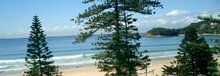
Shelly Beach is a small sheltered beach, facing Manly Beach. A coastal walkway, leads along the Cabbage Tree Bay Tree Aquatic Reserve to Shelly, which has one of the few small unbuilt headlands with native vegetation on it. Some of original cabbage tree palms were replanted as they once fringed the watercourses leading to the beach. The headland leading back to Manly beach has been undergoing intense development for years. The beach facilities are also under intense demand.
Dead Fish, how come?
Last week (02 & 03.1008) many dead puffer fish and a moray eel were washed up on Manly beach. We assume, these 'cave dwellers' were from the 'Aquatic Reserve'. On the 051008 the first blooms of an apparent red tide was visible at Shelly Beach. On the 021008 "a mysterious red sludge", believed to be red algae bloom was found on a beach in the Manly area, at Clontarf.(Image)
Nice Beach as a drain, growing harmful bacteria?
The walkway from Manly beach to Shelly beach along the aquatic reserve is studded with old, often decayed pipes of all sizes, draining the dense sub-urban  development on top of the headland, down into the little bay/'reserve'. The mossy green rocks are the sure-sign for 'rich run-off'. The little creek behind the restaurant, has spaghetti-like pipes all leading into it and straight into the beach. Most of the properties, strain to grow water and nutrient intensive foreign vegetation. A large paved car park on top of Shelly, is increasingly denuded, leading to even more run off. Numerous dogs on the beach and unleashed along the walkway help to contribute their untreated feces into the adjacent cabbage bay aquatic reserve. Sydney on the whole “dumps a billion liters of sewage into the ocean every day...” (Maude Barlow, Blue Covenant, 08 p28.) Habitat degradation, generous run off and extreme warming of the atmosphere and the ocean is a guaranteed recipe for 'red tides', then harmful algea (HABs), then hypoxic or 'dead zones'. The beaches become at first unusable, smelly and might irritate the skin and eyes. Later, even just breathing the 'mist' can cause health problems and fish suffocate in the o
 xygen-deprived sludge, “fish-kill” (video). Marine species have their central nervous systems attacked by the poisons generated by the bacteria and also seek to 'leave the ocean' gasping for oxygen. Marine mammals, such as humpbacks are also poisoned and 'beached'. 'Food-species' can become deadly to fish, shellfish and people. Sea and shorebirds fall out of the sky(pdf). The stench would repel any visitor, closing beaches becomes very costly for the human economy. Rehabilitating the ecology of a 'dead zone' is usually left for the next generations.
Beyond denial - Doing something against the red tide
Elsewhere environmental groups are enforcing measurable standards to prevent the fouling of their beaches."..To set numeric limits on the excess nutrients which trigger harmful blooms of blue-green algae...Blue-green algae - also known as cyanobacteria - produce "dermatoxins" that can create severe dermatitis and are known tumor promoters; "neurotoxins" which interfere with nerve cell function; and "hepatotoxins" which attack the liver. Exposure to blue-green algae toxins through ingestion, skin contact or inhalation can cause rashes, skin and eye irritation, allergic reactions, gastrointestinal upset, serious illness, and even death..."
Their drinking water" is now subject to almost year-round blue-green algae blooms as a result of nutrient pollution"
It is too dear to not act
The red tide algae, Karenia brevis, "costs approximately $20 million per bloom in  economic damage off the coast of Florida alone." The beauty of a beach is lost forever.
Ocean Care includes the acknowledgement of eutrophication, it seeks to alter the behaviour of individuals and the authorities bestowed with the stewardship of an biome and urban planning.
Images:
1. Shelly Beach, Google Maps, 2008
2. The walkway from Manly Beach to Shelly beach along the Cabbage Tree Bay Tree Aquatic Reserve on the one hand and the suburb on the other, Google Maps, 2008
3. Shelly Beach looking back onto the walkway with thick streakes of 'red slime' 051008
4. Shelly Beach with 'red slime'', with view to Manly Beach opposite
Update:
Red Tide 11.2010: North Head images, 1 & 2,
06 October 2008
Preventing 'Red Tides' at Shelly Beach, Manly

05 October 2007
Dog-walking in Bushland Degrades Biodiversity
 “Operation suburban storm”
Australia's growing population sprawls into 'nature', not because they like the 'bush', but it is a cost-effective way 'to get away from it all'. They take their unsustainable cultural luggage with them to not miss out on that sub-urban feeling. The unpacking happens, but on a bigger scale. First they create tabula rasa in the 'wide open spaces'. After that, the packages of McMansions, hummers, pets and lawn monoculture gets unrolled. 'Operation suburban storm' is the annihilation of Australian animals and plants. Should any creature survive this invasion, then the next growing together of the frontier settlements would run them out of a home. In no time the human settlements take up all the land-scape and resources.  Destroying what is unique about Australia
The refuges for wildlife are fast disappearing in Australia. But even the 'protected' areas are being conquered and annexed for suburbia with a vengeance. From Manly to Byron Bay to all-over the wildland-urban interface is a battle zone where Australian wildlife is eradicated. One main cause for the ecological vandalism is the anti-social behaviour of dog owners, walking their foreign animals in the last reserves for Australian creatures. There is an abundance of signs, but very little enforcement is taking place all over NSW. It seems to be tolerated that the suburbs just annex 'their bush' as their dog loo.
Vested bestial Interests
Being one of the largest pet owning communities per capita with substantial commercial interests backing it, this is a veracious force. Americans spend $41 billion p.a. on their pets, “ more than the gross domestic product of all but 64 countries in the world.” One could only guess, that Australia is not far behind. Locals consuming their 'annexed' “wilderness” hits a 'blind spot' with its guardians.
Some consume all the land-scape
Dog owners consume and degrade parks & reserves and deprive others of their enjoyment. It would be interesting to quantify the economics of this 'local consumption only' and compare it to the loss of the eco-tourism industry, even locals and visitors who would also like to immerse themselves in a green space, rich in bio-diversity. The canine community lobbies to not be 'restricted' from areas, where in fact it is them that deny the existence of wildlife or of visitors enjoying what they came for - wildlife.The loss of biodiversity is price-less (so far). 
Study: Dog walkers degrade Australian Bush New research has found that “Dog-walking in bushland significantly reduces bird diversity and abundance...We show that dog walking in woodland leads to a 35% reduction in bird diversity and 41% reduction in abundance, both in areas where dog walking is common and where dogs are prohibited...The effect occurs even in areas where dog-walking is common and where they are prohibited, indicating that birds don’t become accustomed to continued disturbance by dogs. This evidence clearly supports the long-term prohibition of dog-walking from sensitive conservation areas...Ground-dwellings birds appeared most affected: 50 percent of bird species observed in control sites were absent in dog-walked sites. The effect of dog-walking was most pronounced in the area immediately adjacent to the site where dogs were walked...There were 76 fewer birds within 10 metres of the trail when dog-walking occurred compared to control sites, suggesting birds were seeking refuge away from the immediate vicinity of threat." (Peter Banks and Jessica Bryant, Four-legged friend or foe? Dog walking displaces native birds from natural areas.)
Unchecked dog epidemic in Manly threatens rich biodiversity
The overabundance of dogs in Manly and the anti-social behaviour of their owners degrades the refuges of native animals (and plants), but also robs bushwalkers of their rights to experience these places unhassled. Some of Manly's unique residents such as the Little Penguin, ground dwelling and flight-less, the Bandicoot and many others are too often killed by dogs.
Let's keep Manly special and unique, and effectively protect our rich green areas from irresponsible vandals.
Previous:
On the Annexation of National Parks on the Cheap
Extinction and a world full of poodles
Leave some of Manly as Penguin habitat
ASBO,Dogs allowed to savage
When Rangers knock off...
Links:
More interesting reading on Manly ecology by Dr. Banks et al
Do Australian small mammals respond to native and introduced predator odours? BENJAMIN G. RUSSELL, PETER B. BANKS (2007)
"Introduced predators such as foxes and cats are twice as deadly as native predators to Australia’s unique native animals."
01 October 2007
Fire, the Mythical Wand to create more Habitat for Humans
 Global Warming on the Dry Continent
The destructive nature of wildfires will be amplified through global warming. In the Dry Continent, Australia 'the fire weather' is ubiquitous in the wildland-urban interface (WUI). At the moment fires rage in various National Parks, especially near human settlements such as Bundeena, The Basin and 'scrubland' near Newcastle. Two houses were burnt in in “fairly rugged bushland “.
Urbanisation of bushland areas
With the human sprawl over 'bush-land' and coasts, choosing to settle in 'getting away-from-it-all” leafy locations increases the costs and health hazards. The 'non-developed' green spaces such as National Parks and Reserves adjacent to urban areas have to be regularly burnt-off.
Many private landholders incinerate their land in the good old slash & burn method. Cheaply cleared land still fetches higher prices.
Incinerating protected forests & making a killing
The recent inferno in Greece destroyed 2 % of the land of which some where Europe's richest nature reserves. 67 people were killed. Many species of animals and plants are gone or have lost their refuge. Fire, as the magic wand to create more habitat for human populations, seems to have done its trailblazing for fresh real estate. The Peloponnese, untouched by mass tourism and '10 miles of virgin coastline' are now cleansed of 'protected forests' and ready to be monetarised.
Evolving Technology
Our hominid relatives, Homo erectus or Homo ergaster used fire 790,000 ago. Homo sapiens refined the tool further for the use of slash & burn 'agriculture', and for causing violence against each other and the Earth: Firebombing, Napalm, Firestorms etc. Pandora's Box
Some mythology has it, that fire was stolen by Prometheus from the gods and given, along with meat to the humans he had created. The outwitted god Zeus went into a rage and had him chained on a rock and his liver picked daily by an eagle. The punishment for humanity was to create the first woman, Pandora, bearing a box/jar out of which all evil for human-kind could come foreward.
Boxed into her Oikos, then and now s/he is obsessed by (re) possessions, that are in smaller boxes. 'Unboxing ceremonies' are highlights of possessed consumer culture now, running out of private warehouses/boxes to store all the boxes which they fetch with their box-like internal-combustion tanks from the boxed in mall. Fire might enlarge the territory for MORE McMansions/boxes. In the end they all exit in boxes back into the fire.
In the meantime Pandora's Box is wide open...
Links:
Fire, the Magic Wand to create more Habitat for Humans, Pt I
World Fire Atlas, ESA
Prometheus, Lord Byron
Update, 021007 The Cost of Sprawl
- Do check out the MSM images for 'sheds and houses' IN the bush (in bushfire-prone areas).
- The BIG DRY HEAT made in Australia is "inevitable". "Australia could be 5 degrees Celsius hotter and 40 to 80 per cent drier by 2070"
- Arson was involved when "..fires described as suspicious tore through 250 hectares and gutted a house on the state's North Coast."
- "...Bushfires destroyed a house and several sheds " on the North Coast, now they are working hard on the "asset protection zone".
- Interesting image here, Q.: How much bush has to be burnt down (contained) before a house is safe?