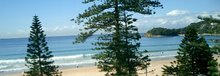
A monthly summary of what has washed onto the shore or beach through the winds, tides, waves or human action. Marine debris, flora and fauna, dead or alive:
30+ dead Leatherjackets again, possibly Meuschenia flavolineata, (10-20 cm long). Kids p laying 'ball' with them. Millions of mostly still alive Ladybirds at the water's edge, struggling. There appeared to be no 'white collar', probably a native. Many aphids, scale insects, mealybugs, and mites will not be eaten this season by this 'gardener's friend'. As with the mass occurrence of dead crickets (021108) it is unknown how they ended up in this environment.
The usual 'fast food' wrappers and many 'gift-wrapping strings' with balloons, ready to entangle. Beach worm 'harvesting' and fishing 'classes' now at the waters' edge. High speed kite surfing poses a serious danger to swimmers/surfers and beach users.
Image: sandsculpture, kelp and pine needles 021208
A seagull had both feet tightly entangled by a fishing string. It could hardly walk or balance. Do we really need 'recreational taking' on busy urban beaches? Container ships hovering on the horizon. 031208 Thousands of Ladybirds struggling at the water's edge again. Seagulls gorging on the live ones. No one seems to notice, as strangers are usually recognised, by exhibiting curiousity and looking at objects at the beach. For the locals it is just a tabula rasa to do stuff on. Giant sand castles with deep trenches, possibly to trap joggers in the dark?. Various container ships cluttering up the horizon, possibly heavy in junk for the coming exchange festivities. At the North Steyne cliff end a White-faced Heron (Egretta novaehollandiae) was stalking insects and amphibians in the urban run off. Rock engravings of the Eora people depict this coastal bird doing its thing for thousands of years. An off leash dog did not allow the bird to continue feeding. 041208
 A 2 m long log covered densly in living Crustaceans. The Goose barnacles were of white/blue colour. The life raft was returned to the sea. A pelican was gliding north, looking like a flying ancient lizard.
A double rainbow again, nicely offset against the plump white clouds. A few blue bottles , many dog paw prints in the sand and black dog feces plastic bags sloshing in the water. 051208
Post Care Day and after rain. A huge soggy pond at the pipe. Leaf litter plus sub-urban run off, hanging around the surf. A large amount of garbage, mainly plastics: wrappers, bottles and an unusual amout of 'party ballons' with long 'fancy' wrapping ribbon of all colours- ideal to entangle. Inflated baloons blowing around. Again, full nappies, a syringe and chemical loo cleaner.
A near-death shearwater, an unusual number of seagulls with only one leg. Many blue bottles, nice kelp of all different shapes. Painted driftwood and building materials. The daily dog on the beach, hopping about on the prize winning North Steyne beach. A person flying his surf kite over the heads of swimmers/walkers ('obstacles') at very high speeds. Above the water, control of the medium seems to be beyond the guy stearing it. One day a beach user will be injured by these speeding installations. Council probably is liable for such eventualities. 081208 A few small Abalone shells (Haliotis coccoradiata), rarely larger than 3 cm. A nice audio-scape coming from the rows of pines: Sulphur-crested Cockatoos (Cacatua galerita), Red Wattlebirds, (Anthochaera carunculata) and Ravens (Corvus coronoides). Black faced Cormorants flying north. 091208
Powerful fast clouds stroke the beach. Welcome Swallows (Hirundo neoxena) surfing the dunes at high speed, mopping up insects. Ravens eye the dead fish. Rich leaf litter, blown down the hills from endless noisy debris blowers which move the sub-urban debris into the public gutter and down to the beaches. Civilised places have given up the polluting of air and water a long time ago. 101208
> Drift "wood", November 2008
02 December 2008
Manly Beach Drift "wood" - December

08 October 2008
Dead Fish and Noisy Motors at Manly Beach
 Dropping anchors onto the aquatic reserve
In the Marine Reserve today 'leisure crafts' were throwing their heavy anchors into the low reef today to pop some champagne. Motorising the beach, air and land
Helicopters hovered over Manly beach and sub-urbs, giving it that VN ambiance. Are there any restrictions on people perving from above, destroying the space with their noise? How many noisy aircraft routes can Manly Beach handle, in addition to the diesel-spewing coaches, running their air-conditioners hot? Beach findings
On the shore of Manly Beach an unusual number of ocean/leather/mosaic jackets. We mentioned that an unusual amout of puffer fish and moray eel were also washed up onto Manly Beach. They all seem to have been dislodged from the safety of the reef caves of Cabbage Tree Aquatic Reserve. Maybe they are all just ploughed into the industrial beach sweeper and disappear with the tonnes of garbage into the tip? Does anyone record why there were so many dead reef fish last week?
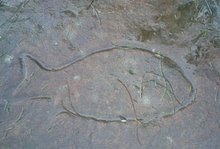
Images: Some of the dead fish (ocean leatherjacket, pdf & Eubalichthys mosaicus) washed up on Manly Beach 071008 and possibly an Eora engraving from the Pittwater region.
Plundering the Cabbage Tree Bay Marine Reserve again


Via Manly Daily 'How can anyone be so bone-headed?' 071008 (Maybe it is has not fallen out of the archives, as the 'red tide' 021008 has.
Images:
Portrait of a male Eastern Blue Groper (Achoerodus viridis) with escorts. Shelly Beach, Manly, NSW, Flickr
Eastern Blue Groper (Achoerodus viridis). Fairy Bower, Manly, NSW, Flickr
Report all illegal taking and vandalising in protected aquatic habitats: Ph: 1800 043 536
- Manly Council Rangers Ph.:9976 1630
- Sydney North Fisheries Office Ph.: 8437 4983
Update: The 'Spearoz' community is also discussing the matter here
23 June 2007
Tasmanian Salmon marinated in...
 Next time you go out and have that nice salmon dish – think again.
Salmon from underwater factories contain huge amounts of antibiotics and they also may contain dioxin and PCBs. The Tasmanian salmon industry “...has used nearly double the amount of OTC (Oxytetracycline) than was anticipated under the permit application.” The use of antibiotics on salmon and trout "...has jumped from just 12 kg a year a decade ago to eight tonnes in the first three months this year.”
High population densities of fish lead to stress and dis-ease. Pathogens are fought cost-effectively with these high doses of anti-bio-tics.
Some of the drugs cause allergic reactions in some humans and there are concerns of huge amounts of these drugs entering the human food chain and having negative effects on our health.
Aqua- 'culture' has also negative impacts on the water quality and increases probabilities of emerging diseases spreading to aquatic ecosystems. One disease expert is concerned that Australia “...may not be well enough prepared to counter emerging disease threats from aquaculture.”
The industry is worth $250 million dollars and received its last tax boost of $1.285 million recently.
You can make a decision by choosing organic fish from your shop or restaurant and supporting the sustainable management of fishery stocks and marine ecosystems.
Plundering the aquatic pantry
food
Update, 250907
"Sea lice from salmon farms threatening wild Pacific salmon...In some cases, sea lice originating from salmon farms are estimated to have killed up to 95% of the wild juvenile salmon. We can expect long-term wild salmon stock decline if farmed salmon are not quarantined. When our government ignores the immutable natural law that disease is amplified when host populations are crowded, we pay the price of irreversible loss of a very valuable resource."
Scientists writing a public letter to the Canadian government, as "a sense of duty to future generations".Via Science Daily
24 June 2006
Plundering the aquatic 'pantry'
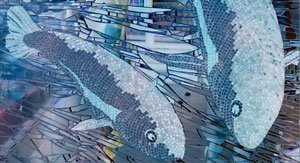 The plunder of the world oceans goes unchecked and even increases. The over-exploitation takes place in the oceans, Marine Parks and the deep seas. The additional 'by-catch' of albatross, seals and dolphins goes unmentioned. Aqua-'farming' is also unsustainable. The 'I'd rather be fishing' culture also engages in practices outside all regulations. Australia is amongst the few nations with 'the largest numbers of threatened species in the world.' Species are disappearing, shrinking in body size or done out of a habitat altogether.
Many of the aquatic beings are gobbled up. The iconic Barramundi has been on the menu from Darwin to Tasmania in every little eatery, it has become the new 'flake' now that the sharks are going. There is no culture of informed decision making or a will to make informed sustainable choices with regard to ocean produce. Try to ask your shop or restaurant where the ocean food originated from, or if it is produced in tubs of anti-biotics on cleared mangroves. Slowly certain foods are being banned, wild cavier and some do not sell live lobsters and crabs.
Utilising the world waterways and the oceans as cost-effective sewage and industrial discharge ponds, it is no wonder that high readings of toxins are accumulated in sea creatures. Dioxin here, dieldrin here or mercury there.
Sharks and other living fossils inhabited the oceans for 350 million years. 'Harvesting' them in a blink of history is irreversible. Newly discovered species disappear immediately. Mining the mysterious deep seas with high technology combined with blind watchdogs makes for an empty 'pantry' for the ones to come. Grazing the tree of biodiversity to the deep ground.
National Parks Association of NSW
Australian Museum Fish site
Fish movies
Free sustainable seafood guides
Best and worst seafood
Australia’s Sustainable Seafood Guide ($)
Fish caught with 'hi-tech' methods has a wastage rate of 80 %
Manly Leafy Seadragon