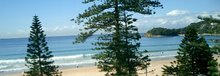
Whales are passing by. Today two Humpback Whales (Megaptera novaeangliae) swam slowly along Manly Beach. It appeared like mother and calf logging, in close contact. After Shelly Beach they slowly drifted along the shore in the shallow water. Their habitat was free of polluting motors in the air and in the ocean, which is rare.
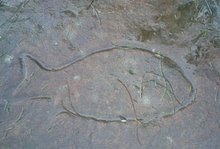
 A bit further north in a more protected terrestial area, there are rock engravings by the Eora of a Humpback mother and her calf. The 14 m long petrography depicts them overlapping in close body contact. An engraved person nearby is watching with views of the Pacific. Today the aquatic territory is littered in motorboats. Like measles they clutter up the shorelines. Noise and chemical pollution emanating from their presence interferes today with the large marine mammals pursuing their ancient migratory routes.
 The place is framed by the Eora shield, lovers and various symbols etched onto the sandstone.
With the unregulated access of mountain bikes these memes from 25000 years ago could disappear from the rocks and human memory. The whales too have to battle a degraded habitat with many human-made dangers.
More on whales and bikes in NPs.
10 August 2009
Humpback Whales Passing Manly Beach

20 October 2008
Marine Conservation and The Use of Beaches
 Marine Parks - the only way to go
The battle over 'No Take' and 'Grab it all Now' is grinding along Australia's coastline. Moreton Bay Marine Park , rich in biodiversity is having 16 % of the Bay declared free from fishing and boats have to "go slow" to not continue injuring the dugongs and turtles. It is " home to 750 species of fish, 120 species of coral, an abundance of dolphins, migratory whales and the world's largest population of dugong next to a capital city.""Each year some 200 turtles are found dead, sick or injured in Moreton Bay Marine Park and an average of 15 dugongs die from human impacts." The Australian Marine Conservation Society says that at least 30 % of the bay should be protected. "It exposes actually a whopping 84 per cent of the marine park to intense fishing pressure".
Manly Cove, Sydney Harbour and the Pacific hugging the Northers Beaches should also go 'slow' and have an effective 'no take' Marine Park to conserve some of the biodiversity for the future.
An observant person on Bribie Island wanted to report a loggerhead turtle stranding. He rang the Environmental Protection Agency's hotline just to be diverted to a call centre in Indonesia. The stranding was never followed up. Sounds soo familiar... abc 201008
A whale sanctuary has been created off Chile's coast, ensuring save passage for the cetaceans migration over 3,400 miles (5,500 km). Here, news of entanglement, starvation etc is almost daily. Noisy obstacles, such as human infrastructure off shore probably do not aid the journey of the giants.
Taking the beach away to attract beach holiday seekers
It is interesting to see how far 'developers' in the tourism industry go: They carted their biggest asset away, 500 truck loads of beach sand to build a a $1 billion resort with it. In the absence of the key feature, the project is now on hold. It will take 100 years for the forces of nature to replace the stolen sand. BBC
Choking on the air and pulverised stuff
"Australia's asthma mortality rates are one of the highest in the world according to a new report by the Australian Institute of Health and Welfare." HealthInsit.au does not mention car pollution as a 'cause'. It all seems a matter of 'managing' it by medical professionals, not preventing it by involving urban planning. Elsewhere, they have found that tree-lined streets can make a difference.
Privatising public spaces
At dark, Manly's coach-led body-fitness customers are cluttering up the paths, dipping into the doggy lawn and punching into the night. All apparently unregulated. Most businesses have to pay the rent, events have to register and pay a fee, but feral businesses occupying public space with business activities seem to be exempt. "City of Yarra and several other municipalities are following the lead of five bayside councils, which recently moved to clamp down on boot camps that operate on beaches and foreshore parks.But Yarra has gone a step further and proposed a ban on commercial exercise groups of more than six people from 18 public parks in Fitzroy, Clifton Hill and Richmond. Fitness classes will also be prohibited from exercising within 10 metres of playgrounds or 15 metres of picnic sheds and park benches." It might be... "reasonable to pay a fee to conduct a business in a local park", but is it desirable to privatise public spaces?
06 October 2008
Preventing 'Red Tides' at Shelly Beach, Manly
 Shelly Beach is a small sheltered beach, facing Manly Beach. A coastal walkway, leads along the Cabbage Tree Bay Tree Aquatic Reserve to Shelly, which has one of the few small unbuilt headlands with native vegetation on it. Some of original cabbage tree palms were replanted as they once fringed the watercourses leading to the beach. The headland leading back to Manly beach has been undergoing intense development for years. The beach facilities are also under intense demand.
Dead Fish, how come?
Last week (02 & 03.1008) many dead puffer fish and a moray eel were washed up on Manly beach. We assume, these 'cave dwellers' were from the 'Aquatic Reserve'. On the 051008 the first blooms of an apparent red tide was visible at Shelly Beach. On the 021008 "a mysterious red sludge", believed to be red algae bloom was found on a beach in the Manly area, at Clontarf.(Image)
Nice Beach as a drain, growing harmful bacteria?
The walkway from Manly beach to Shelly beach along the aquatic reserve is studded with old, often decayed pipes of all sizes, draining the dense sub-urban  development on top of the headland, down into the little bay/'reserve'. The mossy green rocks are the sure-sign for 'rich run-off'. The little creek behind the restaurant, has spaghetti-like pipes all leading into it and straight into the beach. Most of the properties, strain to grow water and nutrient intensive foreign vegetation. A large paved car park on top of Shelly, is increasingly denuded, leading to even more run off. Numerous dogs on the beach and unleashed along the walkway help to contribute their untreated feces into the adjacent cabbage bay aquatic reserve. Sydney on the whole “dumps a billion liters of sewage into the ocean every day...” (Maude Barlow, Blue Covenant, 08 p28.) Habitat degradation, generous run off and extreme warming of the atmosphere and the ocean is a guaranteed recipe for 'red tides', then harmful algea (HABs), then hypoxic or 'dead zones'. The beaches become at first unusable, smelly and might irritate the skin and eyes. Later, even just breathing the 'mist' can cause health problems and fish suffocate in the o
 xygen-deprived sludge, “fish-kill” (video). Marine species have their central nervous systems attacked by the poisons generated by the bacteria and also seek to 'leave the ocean' gasping for oxygen. Marine mammals, such as humpbacks are also poisoned and 'beached'. 'Food-species' can become deadly to fish, shellfish and people. Sea and shorebirds fall out of the sky(pdf). The stench would repel any visitor, closing beaches becomes very costly for the human economy. Rehabilitating the ecology of a 'dead zone' is usually left for the next generations.
Beyond denial - Doing something against the red tide
Elsewhere environmental groups are enforcing measurable standards to prevent the fouling of their beaches."..To set numeric limits on the excess nutrients which trigger harmful blooms of blue-green algae...Blue-green algae - also known as cyanobacteria - produce "dermatoxins" that can create severe dermatitis and are known tumor promoters; "neurotoxins" which interfere with nerve cell function; and "hepatotoxins" which attack the liver. Exposure to blue-green algae toxins through ingestion, skin contact or inhalation can cause rashes, skin and eye irritation, allergic reactions, gastrointestinal upset, serious illness, and even death..."
Their drinking water" is now subject to almost year-round blue-green algae blooms as a result of nutrient pollution"
It is too dear to not act
The red tide algae, Karenia brevis, "costs approximately $20 million per bloom in  economic damage off the coast of Florida alone." The beauty of a beach is lost forever.
Ocean Care includes the acknowledgement of eutrophication, it seeks to alter the behaviour of individuals and the authorities bestowed with the stewardship of an biome and urban planning.
Images:
1. Shelly Beach, Google Maps, 2008
2. The walkway from Manly Beach to Shelly beach along the Cabbage Tree Bay Tree Aquatic Reserve on the one hand and the suburb on the other, Google Maps, 2008
3. Shelly Beach looking back onto the walkway with thick streakes of 'red slime' 051008
4. Shelly Beach with 'red slime'', with view to Manly Beach opposite
Update:
Red Tide 11.2010: North Head images, 1 & 2,
21 August 2008
Watching Whales and Dolphins in their habitat
WATCH the beauty of these free whales and dolphins in the ocean, unencumbered by human artefacts and not harassed by human noises. Great work by Okeanos – Foundation for the Sea which is concerned with whale welfare. More resources on the impacts of human noises and their blog.
20 August 2008
Whale Calf Rescue, Sydney, Pt. II
 An abundance of vessels and a new abundance of whales in the "least concern" category set the scene in this inter-species competition. The infant 'Moby Dick' seeks protection in the sheltered bay of the Sydney Basin.
Speculation has it, that it was "abandoned". As the bay of Pittwater is synonymous with yacht racing the Humpback calf turns into a 5 tonne 'problem'. Coaxed out into the deep Pacific, it would have been unclear whether the 5 m mammal was the responsibility of Zoo vets, NSW Parks and Wildlife Service, international agencies or even marine experts. The lone infant returned for the sheltered bay, seeking out what is most plentiful there, namely boats. Voices say that it would "have to be put down", "destroyed" or "euthanized".
Options of feeding it krill outside of captivity are dismissed, despite the 1997 baby whale rescue in the U.S."...The whale was hand-reared back to health before being released into the wild 14 months later. Our veterinarians and our animal care teams immediately went to work to try and save the animal" Such a rescue of a fellow mammal infant would only take a fraction of the budget of dog food or imported seafoods.
Human caused stressors to whales:
- In the anthropocene, megafauna (Megaptera novaeangliae) have been radically depleted due to commercial exploitation. Just recently were they allowed a little bounce back. The bounce comes to a halt with vessel strikes or collisions. Whales are slow to respond to approaching boats, especially those trying to smash race records."A collision with a ship’s propellers can sheer off a whale’s tail, slice them apart, or cause huge contusions." Speed in the marine environment is as deadly as it is on roads. Speed restrictions would reduce the likelihood and severity of vessel collisions. A set-aside Area to be Avoided (ATBA) in the prime migration season would reduce the risks of being separated, severely injured or killed on the annual trek.
- Noise : The roaring of the industrialised marine commerce or 'sport' is interfering with whale communication. The noise can cut off vocal, behavioral and physiological responses between a whale and its offspring. To get entangled in our debris is a further hindrance.
- Human-caused climate change deprives whales of food. Krill populations decline in rising temperatures, which " will require migratory whales like this Humpback whale to swim further for less food."
- Mining the oceans with invasive, noisy and polluting practices "Oil and gas exploration expose whales to noise pollution, oil spills, chemical pollution, vessel collisions and entanglement with or ingestion of marine debris."

Share the habitat!
- Effectively protect these highly migratory marine mammals in their habitat.
- Impose (seasonal) speed restrictions in areas frequented by whales and other protected fauna.
- Create a protected crucial habitat as an Area to be Avoided (ATBA).
- Divert some of the attention and budget bestowed on pets to unique marine mammal protection.
- Reconsider mining and dredging Megaprojects on the coastline
Previous:
Humpback whale calf lost in Sydney's buzz, Pt I
Desalination, a Megaproject or Water Conservation and Whales
Links:
-Melville, Herman, 1819-1891. Moby-Dick
- "Vessel Collisions with Whales: The Probability of Lethal Injury Based on Vessel Speed," (PDF) by Ms. Vanderlaan and Dr. Taggart,MARINE MAMMAL SCIENCE, 23(1): 144–156 (January 2007), C# 2006 by the Society for Marine Mammalogy, DOI: 10.1111/j.1748-7692.2006.00098.x
- IUCN, the International Union for Conservation of Nature
Images:
1. Humpback whale, Brehm, Alfred, Brehms Thierleben, via Zeno
2."The Large Fish eating the Little ones", Bruegel d. Ä., Pieter, via Zeno
Updates 210808
- Now the military has been approached about towing it out to sea again. Imagine the smelly giant carcass in the middle of a yachting bay! abc 210808
- One person was attempting to feed the whale, but authorities stepped in.
- Event hungry people are moving in on the starving whale, keeping authorities busy to enforce the required exclusion zone, Manly Daily 210808
- Image:" The baby whale with wounds on its back thought to be from swimming under the yachts" SMH Blog 210808
- Meetings are on: tow out 'with the sharks' again or euthanise. Feeding option, a 'can't do'. SMH 210808
- A carcass in the Pitwater Bay would be smelly, an obstacle for yachts and would attract sharks.
- The death penalty has been pronounced by the the National Park and Wildlife Service: ".. the calf would be killed by lethal injection overnight or in the morning... Aboriginal "whale whisperer" Bunna Lawrie, who spent time with the whale this afternoon, patting the calf and singing to it..He heard me singing and came over. I looked at him and he was full of life. He had a few scratches and cuts on him and I was a bit worried about his eyes...All we have to do is get it out to sea, nurse it out there and guard and wait for pod of whales. Let the whales figure out if they can accept it. A mother may think it can feed two." SMH 210808
Update 220808:
- Euthanasia for the lost whale calf. A cost-effective and widely used chemical club on Australian wildlife. New experts will seek the truth in the entrails of the mammal and the remaining bones will serve “research” (sounds familiar!). So much for the human wildlife interface. via SMH 220808
MORE Starving Whales:
- Another starving humpback whale is in the overfished Baltic sea. It " is getting critical ... the whale is having trouble nourishing itself." Greenpeace " is now prepared to intervene to stop the whale from beaching itself." Spiegel 200808
Update 110908:
An application has been lodged for a licence to explore for gas in a 6,000 kilometre zone between Sydney's and Port Stephens, north of Newcastle. Seismic tests could interfere with whale migration. In Alaska the whale watching industry it taking mining operators to court. Gas exploration on the coastline has the potential to devastate the beaches and ruin the whale habitat. abc 110908
Update 180908
- "The International Fund for Animal Welfare (Ifaw) says undersea noise blocks animals' communication and disrupts feeding. Levels of noise in the world's oceans are causing serious problems for whales, dolphins and other marine mammals. Humanity is literally drowning out marine mammals" BBC 150908
Update 111008
- Speed limits for large commercial ships travelling coastal waters populated by whales migrating have been applied by the U.S. government.Ships must now go below 10 knots in specified coastal regions. 091008 The NEW YORK TIMES
Update 171008
Autopsy results: The male calf "was suffering from acute pneumonia, serious body and pancreas emaciation, acute intestinal erosion and ulcers in the stomach and there were a number of infected shark bites as well" abc 171008 But why did he get so ill in the ocean?
Update 211008
"NOAA officials today issued a regulation that will implement new measures to protect endangered North Atlantic right whales. The regulation will, for the first time, require large ships to reduce speeds to ten knots in areas where the whales feed and reproduce, as well as along migratory routes in between. The goal of the regulation is to reduce the risk of ship collision with the whales." But it would also lessen the possibility of separating the mother and calf in busy traffic! More on ship strike noaa news 211008
Update 061208
More on disruptive noise in the oceans for marine mammals:
"Ocean Noise: Turn it Down", pdf
Noise from vessels, increased seismic surveys for oil and gas, off-shore construction and recreation, and a new generation of military sonars can interfere with whales. "The United Nations Environment Programme's Convention on Migratory Species conference in Rome, are urging governments and industry to adopt quieter engines for ships, tighter rules on the use of seismic surveys, and new, less intrusive sonar technologies by navies...Ship noise in the Pacific Ocean has doubled every decade over the past 40 years and the global shipping fleet is expected to double in size by 2025, after doubling between 1965 and 2003.There is now evidence linking loud underwater noises with some major strandings of marine mammals.
By 2050 the chemistry of seawater could increase in acidity by 0.3 pH units... this change in ocean acidity would allow sounds to travel up to 70 percent farther underwater." Environmental News Service 031208
19 August 2008
Humpback whale calf lost in Sydney's buzz
 Imagine a baby and its carer get separated at a busy freeway node – impossible to find each other again, the weakened child mistakes a parked SUV for its mother and attempts, in vain, to get nourishment. Helpful creatures manoeuvre it out into the 'wide and open spaces' where it might be hopefully reunited with its mother.
Humpback calf lost in Pittwater
Such is the story (sad video) of a very young humpback calf found in isolation from its mother in busy Pittwater bay, north of Sydney. These slow-moving marine mammals, with their offspring in tow are on age-old journeys across the globe. For eons they have traversed their same marine territories. First, they were massacred by Australian whalers, now the whale watching industry has to lure the tourist dollar. Their habitat has also changed rapidly: The sheltered bays and the open ocean are more like the terrestial world's car-parks, oozing repair workshops, endless wider roads to shoot private mobility capsules along. The largest obstacle to their efficient flow are soft-bodied, slow-moving organisms, known as pedestrians and wildlife.
Boating Habitat
Aqua motoring in the Pittwater region (or anywhere else) operates according to t he same mind-set. One look at Google Maps reveals the area is criss-crossed with boats racing and most of the shores are more akin to "car-parks". Industrialising and commercialising the water-bodies and the marine habitat brings about many "externalities" for the environment. Eutrophication from combustion powered boats, from sprawling sub-urbs and the associated 'shared debris' turns the beautiful Pacific and its bays progressively into dead zones. Not just for seasonal visiting whales - but for all living creatures. If they do not get entangled by anthropogenic debris or get infected, human business also robs them of their habitat, the open ocean.
Mega fauna is in the way
The intensification is a take-over by the terrestial mammals of the habitat of the whales, that do not have any other habitat to survive in. On the open oceans, whales are simply in the way of busy shipping lanes and other boats.. "In places where marine traffic is heavy, vessels fast and whale numbers expanding, violent encounters are increasingly common.” As on our roads - many cetacean and other marine animals are being maimed or killed by the 'collisions'. The wildlife of the oceans is becoming a "a hazard to sea craft" in their own habitat. In some areas the International Maritime Organization has designated an "Area to Be Avoided" for container ships to avoid killing them.
Noise
Even when not assaulted by aqua motoring the noise and vibration caused by the  human racket will diminish their life or even kill them: "The throb of mighty engines and the thrash of propellers as 60,000 huge vessels plough the world’s sea lanes; the hammer of diesels and scream of outboards as 4 million fishing boats and more than 10 million ferries and pleasure craft surge to and fro; the thump and ping of military and fishing sonars; the deafening crash of seismic ships seeking oil and gas; the blare of acoustic harassment devices; the grinding of drills and dredges; the low-frequency growl of scientific experiments designed to monitor global warming."
Could it be, that in such a hostile habitat the whale and its calf became seperated though a degraded habitat and many missiles interjecting their journey?
> > Part II, Whale calf rescue, Sydney Basin
See also:
Desalination, Drilling rigs Sth of Sydney & Whale migration
More on Whales
MSM Updates:
- 'Out with the sharks', abc news, 190808
- Three weeks old calf "abandoned" and "doomed to die" speculations, SMH, 190808
- "The baby has further injured himself from its attempts to rub up on boats, with clearly visible sores on its back. In a last-ditch effort they convinced the whale to follow their boat out to sea, and it disappeared from view about 1km off Barrenjoey headland. It wasn't in good condition." Manly Daily, 190808
Images:
1. Part of Warren Langley's, Manly Visions, glass art at Manly Library
2. & 3. dotAtelier, inspired by Eora Rockengravings of the Pittwater region.
13 August 2008
Desalination - a Megaproject ! or Water Conservation and Whales
 Today's news of the construction of a 16-storey drilling platform off Kurnell, Cape Solander assured us that "The six-month operation will..not have any impact on migrating whales. I have every confidence the whales will swim around it..There will be no impact on the residents of Kurnell"
Will the whales still make it past Manly?
Could Manly become another 'Kurnell'?
Once water conservation is off the agenda, the high cost and high energy option of desalination plants appears to be the only way to continue unsustainable practices on the driest continent. The environmental costs, apart from turning the sea/shore into an industrial zone (image) are carried by the wildlife and its biome.
The following reading list is highly recommended on topics that will not disappear in our life-time:
Desalination projects & transparency:
Phil Dickie of melaleuca media investigatives the options of desalination plants in "Making Water - Desalination option or distraction for a thirsty word" 0707 for WWF’s Global Freshwater Programme. "The first global survey of desalination from a non-industry perspective" (pdf) Regarding Australia:"All of the areas where seawater desalination is rapidly assuming a more prominent water supply role had more cost effective and less potentially environmentally damaging alternatives available. This is particularly true of demand management, water conservation and water efficiency measures, where many of even the more advanced economies such as Australia do not uniformly require easily achievable water and energy efficiency standards in new buildings."
Megaprojects & Transparency:
Bent Flyvbjerg, on megaprojects, Chapter 1 of his book Megaprojects and Risk: An anatomy of Ambition, by Bent Flyvbjerg, Nils Bruzelius, and Werner Rothengatter (Cambridge University Press, 2003). Some of his interests are transparency in policy planning and strategic misrepresentation wrt megaprojects.
Links:
- Towra Point Nature Reserve, Kurnell
- Botany Bay National Park
- NSW Fisheries - Towra Point Aquatic Nature Reserve
- Amid Water Shortage, Australia Looks to the Sea, Patrick Barta, The Wall Street Journal, 110308
- Ecotoxicological marine impacts from seawater desalination plants, Rachid Miriaand Abdelwahab Chouikhib, Desalination and the Environment Volume 182, Issues 1-3, 1 November 2005, Pages 403-410
- Environmental impacts of water desalination along the coastal region of Israel and the Palestinian Authority (pdf) (environmental impacts and noise pollution)
- Sydney Water, Desalination Factsheet
- Riverkeepers fighting to not mush up the "small aquatic organisms into the cooling mechanism; the resulting impingement and entrainment from these operations kill or injure billions of aquatic organisms every year." (pdf)
- Protests against desalination in Victoria, abc 140708
- Scorched Earth for water plant we might not need, SMH, 0807 (Great image of the 'scorched earth' near Towra Point Nature Reserve!)
Image: GoogleMaps, Cape Solander , Kurnell, (NB note the ocean colour, approx. 2007)
Update 210808
- Plans to dredge Botany Bay as part of a $1 billion port expansion, taking 60 hectares of land to construct five new shipping berths. abc 190808
Update 300808
- "Australia could be using 400 per cent more energy to supply its drinking water by 2030 if the policy trend towards seawater desalination were to continue...seawater desalination was likened to a petrol-guzzling "six cylinder" family car by one of Australia's top water bureaucrats at a major summit in Melbourne." The Age 290808
- On offshore drilling platforms in the coastal path of hurricanes, the ecological and economic damage. Science Daily 290808
- What's the Deal With Offshore Drilling? Will it do any good at all? Jacob Leibenluft, Slate, 120808 (A good overview of the environmental impacts of offshore industrial activities)
Update 091008
- Peak Energy also was concerned about the impact on the sea dragons at Kurnell.
- Water and Desalination Factories by M. Barlow, Environmental Folly
- Climate-caused acidity of oceans, creates a noisier environment for whales, apart from the construction and operation noise of such a large infrastructure (click graphic!)
31 May 2007
Whales visiting Manly - still
 Whales are passing again on their long journey. Wednesday two Humpbacks were sighted. Today at around 5 pm two were sighted from North Head. As it was already dusk, it was too hard to distinguish if it was a Humpback or a Pilot Whale. Many of the motorised speeding boats did not seem to notice anything. At least there was no marina developer 'buzzing a humpback whale in a speedboat'.
These mammals have been doing their routes for 15-36 million years of their evolution and can become some 200 years old and have a language/dialect. Like a lot of other species they are being forced out of their habitat by us.This giant megafauna 'cloggs up' the shipping routes. Good news for human beings is, it is cheap meat with low production costs and 'advances science'. Additionally they can also be monetarised 'as a resource for tourism'. Paying audiences can have a good commercialised look from a noisy motorboat.
Just like in our motorised traffic it becomes near impossible to communicate to each other over motor noise. So with the whales, the noisy motors shred the syntax and block any of their cool remix mating songs. "A blue whale, which lives 100 years, that was born in 1940, today has had his acoustic bubble shrunken from 1,000 miles to 100 miles because of noise pollution".
Sonar military communication...”Causes hemorrhaging in their brains and lungs. They've found them bleeding from their ears, bleeding from their eyes...It kills them." Planned oil and gas mining in the ocean “Would expose whales to noise pollution, oil spills, chemical pollution, vessel collisions and entanglement with or ingestion of marine debris “
About whalewatching, NSW
Leaving some personal space for them if you have to go near them
Learn more about marine mammals
Greenpeace
Video: Destruction of 3000 whales p.a.
Whalesong
Update: 010607, 11:30 am Humpbacks of different sizes passing North Head/Manly.