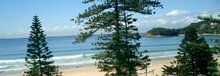
Salmonella has been found in sand of playgrounds in Mona Vale, Winnererremy Bay, Warriewood, Palm Beach and North Avalon. One year on and the bacteria (Salmonella paratyphi bio var java) have resurfaced in the sand. In Dunbar Park, which is now closed the sand will be replaced with 'treated bark'. Both in May 08 and November 08 Mnly wrote about the connections between(exotic) pets, fecal contamination and aggregation of minors in beach sand.
New research has also found that people digging in beach sand or building sandcastles risk gastrointestinal diseases and diarrhea. The epidemiological study looked into sand contact activities and illnesses.
"Researchers found evidence of gastrointestinal illnesses, upper respiratory illnesses, rash, eye ailments, earache and infected cuts. Diarrhea and other gastrointestinal illnesses were more common in about 13 percent of people who reported digging in sand, and in about 23 percent of those who reported being buried in sand...We have known for some time that swimming in waters polluted by fecal contamination can result in illness, but few previous studies have focused on sand."
Beach users should use a hand sanitizer or wash their hands/body after contacting beach sand.
The runoff from urinating and defecating dogs at the beach promenade/wall, draining through the pvc pipes/stairs onto the beach sand does not seem to make the beach sand less risky.
 Questions remain:
Where was the sand sourced from that covered the playgrounds?
Where can information be obtained regarding fecal contamination of beach sand at Manly Beach?
Links
Sand, salmonella, e-coli and that cute pet, May 08
More salmonella mysteries on the Northern Beaches, November 08
University of North Carolina at Chapel Hill (2009, July 10). Digging In Beach Sand Increases Risk Of Gastrointestinal Illness. Via ScienceDaily
Christopher D. Heaney et al., Contact With Beach Sand Among Beachgoers and Risk of Illness, American Journal of Epidemiology Advance Access published on June 18, 2009, Am. J. Epidemiol. 2009 170: 164-172; doi:10.1093/aje/kwp152
17 July 2009
Beach Sand, Fecal Contamination and Salmonella

30 June 2009
19 November 2008
More Salmonella 'mysteries' on the Northern Beaches
 'Mystery' has struck again. Sand contaminated with Samonella paratyphi B var java was found again on the Northern Beaches playgrounds. "Hitchcock Park at Avalon and Winnererremy Bay at Mona Vale on the Northern Beaches have been fenced off for the second time this year, while a third South Avalon playground has not re-opened since May". Replacing (some) of the sand did not work. The bug, linked to exotic fish/pets can cause serious illness.
In pet-fanatic Manly off leash dogs mingle in playgrounds and on the beaches with toddlers. Apart from community hygiene standards and enforcements, it does not instill confidence that possible bio hazards could also turn out to be 'mysteries' for half a year or more...
More:
Salmonella paratyphi bio var java contaminated grounds May 2008
27 September 2008
Manly Beach Bike Week - Sustainable Mobility
 Manly Council is hosting the NSW Bike Week, (pdf) (RTA) on Sunday, 280908 from 10 am to 4 pm at North Steyne.
The key objectives are to
" Raise the profile of the use of bicycles for short local trips.
Promote safe cycling and the use of shared bicycle/ pedestrian facilities."
The Road and Transport Authorities main aim is to improve safety on the roads.
Once one has "dusted off" one's push bike and obtained safety gadgets it is off to a high risk territory of armoured and petrol-powered vehicles.
The motorised community's behaviour hits the attention-economy daily with news of road rage, bullying, 'hit and run' and ploughing into pedestrians or their houses. "Accidents", speeding and intoxicated vehicular manslaughter are the norm. Bodily harm is also caused by  the noise and chemical pollution that is being inflicted on all. Pedestrians and cyclists wishing to share this space seem to be perceived as a lower species with less rights, as they are not obtaining power derived from fossil fuels. Not contributing to Australia's record emissions they are treated as being 'in the way'.
Awareness needs to be raised not in the community that is achieving sustainable mobility, but in the petrol vulnerable car-dependent nation and its mind-sets. Structural change needs to to facilitate safe and emission free transportation.
Many bikes in Manly still arrive on/in cars. The 'leisure bikes' get unpacked with idling motors at t he beach/car-park. Variations range from plastic uniformed racing bikes, to large family groups, with children often on dysfunctional cheap 'throw-away' bikes and mounting-bikes looking for municipality tree-edges to crack. Of course, there are some real-life cyclists arriving on bikes as well. But all are seeking to join in on the heel-to heel packed 2.4 kilometre (1.5-mile) Pacific beach path. The cycle/walkway proper is situated along the beach car park with many cars having hard or sharp protrusions right over the cycle path. At night the beach walkway has racing bikes endangering pedestrians. Off the beach drag, the fragmented bike paths are often parked on. Without the provision of physically-separated bicycle paths the life of a bare body on a wire frame is taking a higher risk. Arriving for ones "short local trip" there are insufficient bike racks to do the shopping. The odd bicycle bar is often taken up by motor-bikes, conquering the pedestrian paths increasingly. Resorting to tie the bike to trees/palms further degrades the neglected trees.
Leaving the bike and attempting to cross any marked pedestrian  path is a struggle, and one had better run. The designated 'pedestrian zones' are most of the time filled with delivery trucks and trades vehicles. Idling is the norm. Car design regulations in Australia are lagging behind causing injury and death to walking people and cyclists. Fatal injuries could be avoided by spending a bit on reducing harm to the 'collided objects'.
"About 300 pedestrians and cyclists are killed in vehicle-related accidents on Australian roads each year and another 3000 sustain serious injuries.Cycling is a wonderful form of mobility, but the mind set of the car addicted community and their practices has to be targeted and structural urban changes have to be realised and enforced.
The most common injuries are serious head injuries, broken legs and ribs and fractures to the pelvis."
Images:
1. Corso 'bike path'
2. Beach bike path with dangerous protrusion in ya face
3. Beach bike path with knife-like instrument at head level
4. Manly Cove pedestrians & push bikes only!, 3 large motorbikes, one idling bus.
Links:
- Video, Physically seperated bike lanes, US
- Fatality Analysis Reporting System with Google Maps, US
- Shocking the suburbs: urban location, housing debt and oil vulnerability in the Australian city , Jago Dodson and Neil Sipe / Urban Research Program
- Pedestrians at risk as car safety rules slip behind, SMH 270908
- Risk for cyclists 'increasing' on Beach Rd, SMH 270908
- Bicycle Paths, Manly Council
- Bikely Maps and Routes
- Sydney Cyclist
- Pedal Mobility
- They complain about birds swooping cyclists in their breeding season as they run out of habitat. Pity, there are no corresponding articles about the deadly dangers posed to pedestrians and push-bike riders by urban tanks steared by aggro drivers at pedestrians, push-bike riders and birds. (Manly Daily 021008, the dead-tree version is most reliable!)
24 September 2008
North Head NP Occupied - More Toxic Diesel in Wildlife Habitat
 North Head, Lady Fairfax walk today. Toilet litter all over on the ground from mass-tourism (without the facilities). The National Parks sign is a sure indicator for what is to be expected: dogs, bikes, litter. The rare Banksia vegetation had been damaged on the 'walkway' by cars. Although there were no black plumes (soot) visible from ocean-going vessels, the entire air around the walk seemed saturated in diesel fumes. And then there it was again - another giant infrastructure development IN the national park, placed on the main 'tourist-attracting' look-out, directly on the cliff of North Head.
Diesel-belching clutter IN the wildlife refuge (NP)
A huge diesel-belching, humming demountable, with a large spinning radar antenna had been placed in the middle of the Sydney Harbour National Park's territory. Seeking to “add value to all aspects of Sydneys port operations... (and) protect the environment and have regard to the interests of the community “, the Sydney Ports Corporation planted this air-conditioned, video and radar surveillance object into a wildlife refuge. This 'state-of-the art' technology (pdf) is to aid in the intensification of trade and logistics from Botany Bay to Sydney Harbour (North Head). Intensify - more for more, 'exploit & open up NPs'
The “Vessel Traffic Service (VTS) provides active monitoring and navigational advice for vessels in particularly confined and busy waterways with complex traffic movements...Sydney’s ports alone handle over $50 billion of international and domestic trade annually. Total trade through Sydney’s ports was 29.2 million mass tonnes, 5.0 per cent higher than last year.” Obtaining ROI in a harbour full of tinnies is not easy. Infrastructure is likely to be erected in various harbour sites and widening the bays (dredging) is already starting in Botany Bay and elsewhere.
Deadly trade
As in colonial times, the growing population (pdf) is still dependent on the boats coming in, bringing the essentials. Only this time, the huge diesel-powered vessels (container ships, tankers, bunk carriers, tugboats and cruise ships) are costing lives and health. Most diesel powered ocean-going vessels are significant contributers to air pollution in the heads, the harbour, ports and cities. Ports, handling the bulk of imports, are among the biggest sources of air pollution and greenhouse gas emission. “Each step of the goods movement process is powered by diesel fuel, which releases greenhouse gases and toxic, smog-forming air contaminants...ports pose "grave health risks" to millions of people living in metropolitan coastal areas, especially those living nearest the ports." In 2002 "60,000 people living in coastal communities along major shipping routes died from lung and heart complaints as a result of high sulfate emissions from ships". Particulate matter from ocean-going ship causes asthma, heart attacks, hospital admissions, and premature mortality. “Particle pollution from shipping to tens of thousands of premature deaths each year, most of them along coastlines in Europe, East Asia, and South Asia." This dirty trade is causing harm to public health and to the environment. The ocean, its life and the atmosphere becoming degraded
"Ships use the tar-like, sulfur-concentrated remains of petroleum left once the gasoline, oil and all other products have been extracted. This high-sulfur fuel is responsible for the significant environmental impacts of ship sulfur emissions. Regionally, sulfur emissions contribute to acid rain, which can pollute freshwater lakes and rivers, and damage vegetation." Even cloud formation over the Pacific is influenced by trade-carrying cargo ships powered by diesel engines."The annual costs of sea traffic’s contribution to air pollution, climate change and marine pollution are estimated to amount to 260 billion euro for the world fleet and 57 billion euro for the EU fleet." These 'externalities' are probably not lower for the Asian/Pacific region.
Intensifying diesel-powered traffic that 'costs the Earth' and has negative impacts on the marine foreshore and protected wildlife refuges is unsustainable.
Links:
- International Maritime Organization
- "In accordance with the Australian Government's responsibilities and policies, Australia's obligations under IMO Conventions and AMSA's functions specified in Section 6(1)(a) of the Australian Maritime Safety Authority Act 1990, AMSA coordinates a national pollution prevention and response strategy to protect Australia's marine environment from pollution caused by shipping and related activities. This document lists the prevention components of this strategy, based largely on several IMO Conventions given effect by domestic legislation, implemented and enforced by Commonwealth and State/NT Governments." Protection of the Sea - Conventions and Legislation in Australia, AMSA, Australian Government
- Protection of the Sea (Prevention of Pollution from Ships) Act 1983, NSW
- The National Parks and Wildlife Service, DECC
- National Parks & Wildlife Act 1974
- NCC/NPA Submission to Taskforce on Tourism and National Parks, Submission of The Nature Conservation Council of NSW and the National Parks Association of NSW and the Blue Mountains Conservation Society. 0808, pdf 1,2MB
Update 111008
"The International Maritime Organization on Thursday adopted stringent new controls on airborne pollution from the world’s 300,000 oceangoing vessels. Emissions from ships steaming into ports from Rotterdam to Shanghai to Long Beach, are blamed for about 60,000 premature deaths around the world annually. Sulfur emissions are a major source of airborne fine particulates, which have been associated with pulmonary and cardiovascular disease. In some ports in Europe and in the United States, environmental groups, using the courts, and local governmental bodies have required ships to shut off their engines and plug in to the local electrical grid to keep ship operations functioning while in port." NYT 101008
13 August 2008
Desalination - a Megaproject ! or Water Conservation and Whales
 Today's news of the construction of a 16-storey drilling platform off Kurnell, Cape Solander assured us that "The six-month operation will..not have any impact on migrating whales. I have every confidence the whales will swim around it..There will be no impact on the residents of Kurnell"
Will the whales still make it past Manly?
Could Manly become another 'Kurnell'?
Once water conservation is off the agenda, the high cost and high energy option of desalination plants appears to be the only way to continue unsustainable practices on the driest continent. The environmental costs, apart from turning the sea/shore into an industrial zone (image) are carried by the wildlife and its biome.
The following reading list is highly recommended on topics that will not disappear in our life-time:
Desalination projects & transparency:
Phil Dickie of melaleuca media investigatives the options of desalination plants in "Making Water - Desalination option or distraction for a thirsty word" 0707 for WWF’s Global Freshwater Programme. "The first global survey of desalination from a non-industry perspective" (pdf) Regarding Australia:"All of the areas where seawater desalination is rapidly assuming a more prominent water supply role had more cost effective and less potentially environmentally damaging alternatives available. This is particularly true of demand management, water conservation and water efficiency measures, where many of even the more advanced economies such as Australia do not uniformly require easily achievable water and energy efficiency standards in new buildings."
Megaprojects & Transparency:
Bent Flyvbjerg, on megaprojects, Chapter 1 of his book Megaprojects and Risk: An anatomy of Ambition, by Bent Flyvbjerg, Nils Bruzelius, and Werner Rothengatter (Cambridge University Press, 2003). Some of his interests are transparency in policy planning and strategic misrepresentation wrt megaprojects.
Links:
- Towra Point Nature Reserve, Kurnell
- Botany Bay National Park
- NSW Fisheries - Towra Point Aquatic Nature Reserve
- Amid Water Shortage, Australia Looks to the Sea, Patrick Barta, The Wall Street Journal, 110308
- Ecotoxicological marine impacts from seawater desalination plants, Rachid Miriaand Abdelwahab Chouikhib, Desalination and the Environment Volume 182, Issues 1-3, 1 November 2005, Pages 403-410
- Environmental impacts of water desalination along the coastal region of Israel and the Palestinian Authority (pdf) (environmental impacts and noise pollution)
- Sydney Water, Desalination Factsheet
- Riverkeepers fighting to not mush up the "small aquatic organisms into the cooling mechanism; the resulting impingement and entrainment from these operations kill or injure billions of aquatic organisms every year." (pdf)
- Protests against desalination in Victoria, abc 140708
- Scorched Earth for water plant we might not need, SMH, 0807 (Great image of the 'scorched earth' near Towra Point Nature Reserve!)
Image: GoogleMaps, Cape Solander , Kurnell, (NB note the ocean colour, approx. 2007)
Update 210808
- Plans to dredge Botany Bay as part of a $1 billion port expansion, taking 60 hectares of land to construct five new shipping berths. abc 190808
Update 300808
- "Australia could be using 400 per cent more energy to supply its drinking water by 2030 if the policy trend towards seawater desalination were to continue...seawater desalination was likened to a petrol-guzzling "six cylinder" family car by one of Australia's top water bureaucrats at a major summit in Melbourne." The Age 290808
- On offshore drilling platforms in the coastal path of hurricanes, the ecological and economic damage. Science Daily 290808
- What's the Deal With Offshore Drilling? Will it do any good at all? Jacob Leibenluft, Slate, 120808 (A good overview of the environmental impacts of offshore industrial activities)
Update 091008
- Peak Energy also was concerned about the impact on the sea dragons at Kurnell.
- Water and Desalination Factories by M. Barlow, Environmental Folly
- Climate-caused acidity of oceans, creates a noisier environment for whales, apart from the construction and operation noise of such a large infrastructure (click graphic!)
17 October 2007
Drinking Water Security
 Sydney Belly
“Sydney Belly”, gastrointestinal illness and diarrhoea is probably as old as Sydney. As long as water and feces are being mashed up the winners are the pathogens. At the moment care facilities for the young and old are being hit by a norovirus (stomach cramps, diarrhoea and vomiting) again.
Crypto in the drinking water
Bugs (“low levels of cryptosporidium”) found in Sydney's water supply it was reported yesterday are “not posing any threat to the city's drinking water supply“. A boggling check at Sydney Drinking Water Quality report claims that there are NO Cryptosporidium and Giardia found in the crystal clear water. Going a few days back, this seems to have been the case too.
Cryptosporidiosis
Cryptosporidium is a parasite resistant to most disinfectants. It is “ spread through feces of infected hosts and causes sometimes severe diarrhea in humans and animals.” Once it gets into the body via water, food or unhygienic practices, the symptoms are usually gastrointestinal illness, diarrhoea and sometimes vomiting. "...It is the most common non-viral cause of diarrhoea worldwide... People can literally die of diarrhoea: they can lose over 13 litres of fluid a day.“
Some Crypto cases: Rapidly growing populations outstrip infrastructure
Galway, the fastest growing city in Ireland is the prototype “where rapid expansion of housing developments has not been matched by infrastructure upgrades...236 laboratory confirmed cases of Cryptosporidium infection had been identified, with at least 40 resulting in hospitalisation...sewage is the major source of contamination.” Many in the tourist industry have “installed their own water filtration systems to reassure guests.”
The cause of the Milwaukee Cryptosporidium epidemic in 1993 was "found to be sewage that passed through the filtration system of one of the city's drinking water plants.” “ 400,000 people became infected and 60 people" (or 100) "died as a result of drinking infected water”.
The 1998 Sydney Water Crisis requiring 3 million residents to 'boil water ' was memorable for residents and visitors. Two small bugs, Cryptosporidium and Giardia led to changes in Sydney Water Corporation. Years on in 2007 the two pathogens are still causing “severe gastrointestinal illness”. In SA too there were “ 228 cases of cryptosporidiosis this year, compared to 52 for the same period last year.” Sewage and water mix in Australia, South Africa and many other places. How many is ok?
In Milwaukee there are no more than one Cryptosporidium oocyst per 10 litres allowed. It is “now a criminal offence in the UK to supply drinking-water that has more than one Cryptosporidium oocyst per 10 litres”. The 1998 Sydney incident "has shown no evidence of any illness that could be attributed to drinking water contamination. Accordingly, law suits claiming for illness among consumers have recently been withdrawn from Australia's high court.“
Wait- there is more than Crypto and Giardia
There are other pathogens, but there are chemicals that could have very adverse health effects on humans and animals. “Disinfection by-products (DBPs), endocrine disrupting chemicals, antibiotics, polymers and pesticides”. The question is no longer in a risk-society to aim for not having any harmful substances in the drinking water, but the “Acceptable Daily Intake (ADI) ..which can be ingested for an entire lifetime (70 years) without appreciable health risk” Health and the possible cancer are a matter for probability/statistics. (Micropollutants, pdf)
“Balancing burgeoning public needs for safe drinking water with dwindling supplies will be a major challenge for public works managers and regulators in the years to come.”
Previous:
More on Sydney Water, Health and Pollution
Drinking water security and sewage
Reducing Risks when eating out
Reading:
The Sydney Water Crisis, Another Lesson in Health Risk Communication Failure, Dr. Steve E.Hrudey (Professor of Environmental Health Sciences in the Department of Public Health Sciences)
Organic Micropollutants in Water, pdf (www.waterquality.crc.org.au)
Galway Cryptosporidium Outbreak, Health Stream Article - Issue 46 - June 2007
Critical processes affecting Cryptosporidium oocyst survival in the environment, King, B.J. and Monis, P.T. (2007) Parasitology, 134 (Pt 3); 309-23.Health Stream Literature Summary - Issue 46 - June 2007
Waterquality, CRC, au
"Cryptosporidium"- tag, ABC
Image: Water sculpture for gathering clouds by Eora
30 September 2007
Aqua-motoring in Manly - an Accident Waiting to Happen
 The aquatic space is used the same way as the terrestial space – just a space to rev motors along. Just as the asphalted Earth is becoming too congested to get anywhere, the little bays, coves and even beaches become race-courses to blow the abundance of fossil fuel away. Problem is, there are these pedestrians and wildlife 'cluttering up my road'. In the blue waterbodies and oceans, swimmers take the fun out of 'having a good spin'.
Whatever takes place on the roads, is taking place on the water. Out of control, under the influence of alcohol these motors are being steered into bodies. Here a child is being hit by a jet ski on their rubber duckie, there another gets their face shaved off by boat propellers. Another gets 'mangled' by a speedboat while swimming. Speeding jet skis on Narrabeen Lagoon endanger the life of people, as well as eliminating swans and pelicans. They even insist to race The Big Dry Murray.
In Manly the season for mixing water & petrol is truly open. At Manly Beach the fumes of the speeding 'life-saving' boats are breathtaking. The proximity to swimmers of all boats is a great danger to people in the water, at Shelly Beach and Manly Beach.
21 September 2007
Reducing risks when eating out
The right to know.. What's in the stuff, where is it from?
Occasionally restaurants specify the origin or the quality of their produce.  Free-range eggs being the most commonly declared product in Manly. Most other ingredients, one has to trust, but one can not engage in informed consent. If one does not want to consume food with detrimental health effects, there is very little information provided.
” In Australia alone, more than $1 billion worth of herbicides, fungicides and insecticides are applied each year.“ Part of food literacy might also be that one would like to know the origin and treatment of the food and the ecological footprint of the resource. In various cities people eat local now, even restaurants offer locally produced foods.
Menus with imagination and consideration would be appreciated. Instead it often is the usual fish&seafood-mash up, platters full of lobster by the kg or just meat. Vegetarian dishes containing protein are as rare as organic vegetables on the menus.
Bugs in food and water can cause sickness and death - Sydney 'Gastro'
“In Australia, there are an estimated 5.4 million cases of food-borne illness every year ” In Queensland for example it has “...caused an estimated 10 deaths and 750 hospitalisations in the state every year.” In Sydney, customers do not seem to have a right to know which eateries did not pass as “ the names were best kept secret as revealing them could damage the businesses unnecessarily.“ “Over 80% of foodborne gastroenteritis due to ‘known’ pathogens is caused by pathogenic E.coli, norovirus, Campylobacter and non-typhoidal Salmonella. 32% of all gastroenteritis may be transmitted via contaminated food. Foodborne gastroenteritis results in about 1.2 million people visiting the doctor, 300,000 prescriptions for antibiotics and 2.1 million days of work lost each year.” (pdf) Water as well as food is of course a medium of possible transmission.
Hygiene – as infrastructure and practice
A measure for good hygiene in eateries (or anywhere) are the bathrooms. Facilities and updated cleaning are essential. There seems to be a general decline in the tradition of washing hands (properly, video), often the infrastructure to do so for staff and clients is also lacking.
Recently it was overheard in Manly that a small boy wished to wash his hands after a pee. His male carer convinced him that it is not important. With eateries that do not offer a lavatory one is forced to use the public ones which are in dubious states.
Having (lap-)dogs on seats or eating off dishes is common and a health hazard.
Olfactory assaults
As most bathrooms lack windows some businesses offer 'air freshner sprays' in each cubical. This practice seems more hazardous (pdf) than the previous fumes, the artificial volatile chemical vapours have been distributed into the small confined space. Some of the effects of Volatile Organic Compounds are: ”Eye, nose, and throat irritation; headaches, loss of coordination, nausea; damage to liver, kidney, and central nervous system. Some organics can cause cancer in animals; some are suspected or known to cause cancer in humans”
More cocktails to inhale
Other ambient pollutants in Manly are of course air and noise pollution from  motor vehicles, which often gets topped up with gas/fire heaters (even unflued inside). Occasionally 'romantic' candles add to the cocktail of pollutants. “ Paraffin-based candles.. tend to use wicks which are made with a metal core like zinc or possibly lead." Passive smoking is still an issue, while trying to smell and taste your food. As reported before, most eateries reserve the fresh-air area for people polluting the air. Just where the air is to enter the premise, the combined toxic fumes of the smokers enter the 'non-smoking part' and accumulate there.
Mental spam pollution – while having a drink
Apart from many neon-lit 'convenience' places springing up, another new form of enforced attention grabber has sprung up. Huge screens peddling 'solid state spam', unwanted and unwelcome messages "
It would be advisable to have ecological and ethical audits for businesses, as well as for municipalities, to encourage an open transparent communication with their clients that is sustainable and reciprocal.
See also: Manly Restaurants and Eateries - a Wishlist
Links:
-"...Three-quarters of the world's fish stocks have been over-exploited, mainly by commercial fishing"
- Disclosure on industrially 'farmed fish'
- Choosing sustainable seafood, ca
- Food, Mindfully
- Public rating of restaurants, web 2.0
- One Los Angeles menu boasts dishes where 90 percent of the ingredients were raised within 400 miles.