Marine Parks - the only way to go
The battle over 'No Take' and 'Grab it all Now' is grinding along Australia's coastline. Moreton Bay Marine Park , rich in biodiversity is having 16 % of the Bay declared free from fishing and boats have to "go slow" to not continue injuring the dugongs and turtles. It is " home to 750 species of fish, 120 species of coral, an abundance of dolphins, migratory whales and the world's largest population of dugong next to a capital city.""Each year some 200 turtles are found dead, sick or injured in Moreton Bay Marine Park and an average of 15 dugongs die from human impacts." The Australian Marine Conservation Society says that at least 30 % of the bay should be protected. "It exposes actually a whopping 84 per cent of the marine park to intense fishing pressure".
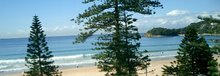
Manly Cove, Sydney Harbour and the Pacific hugging the Northers Beaches should also go 'slow' and have an effective 'no take' Marine Park to conserve some of the biodiversity for the future.
An observant person on Bribie Island wanted to report a loggerhead turtle stranding. He rang the Environmental Protection Agency's hotline just to be diverted to a call centre in Indonesia. The stranding was never followed up. Sounds soo familiar... abc 201008
A whale sanctuary has been created off Chile's coast, ensuring save passage for the cetaceans migration over 3,400 miles (5,500 km). Here, news of entanglement, starvation etc is almost daily. Noisy obstacles, such as human infrastructure off shore probably do not aid the journey of the giants.
Taking the beach away to attract beach holiday seekers
It is interesting to see how far 'developers' in the tourism industry go: They carted their biggest asset away, 500 truck loads of beach sand to build a a $1 billion resort with it. In the absence of the key feature, the project is now on hold. It will take 100 years for the forces of nature to replace the stolen sand. BBC
Choking on the air and pulverised stuff
"Australia's asthma mortality rates are one of the highest in the world according to a new report by the Australian Institute of Health and Welfare." HealthInsit.au does not mention car pollution as a 'cause'. It all seems a matter of 'managing' it by medical professionals, not preventing it by involving urban planning. Elsewhere, they have found that tree-lined streets can make a difference.
Privatising public spaces
At dark, Manly's coach-led body-fitness customers are cluttering up the paths, dipping into the doggy lawn and punching into the night. All apparently unregulated. Most businesses have to pay the rent, events have to register and pay a fee, but feral businesses occupying public space with business activities seem to be exempt. "City of Yarra and several other municipalities are following the lead of five bayside councils, which recently moved to clamp down on boot camps that operate on beaches and foreshore parks.But Yarra has gone a step further and proposed a ban on commercial exercise groups of more than six people from 18 public parks in Fitzroy, Clifton Hill and Richmond. Fitness classes will also be prohibited from exercising within 10 metres of playgrounds or 15 metres of picnic sheds and park benches." It might be... "reasonable to pay a fee to conduct a business in a local park", but is it desirable to privatise public spaces?
20 October 2008
Marine Conservation and The Use of Beaches

08 October 2007
On Designing Community Life in Manly Sustainably
 Manly already has an extreme density of pubs and other venues to consume alcohol in. Now the small lanes will be developed to 'entice' us to drink there as well. At night they “will become a buzzing lane way bar.“ To complement "The pub culture in Sydney" another adult shop is thrown in.
Alcohol-related incidents are “ the state's biggest single crime factor”, costing $50 million a year and contributing to “ violence, malicious damage, public disorder and road fatalities” The cost of negative health effects and social disintegration is probably not reflected by that sum.
A laissez-faire approach to urban 'planning' allows corporate culture to usurp increasingly more public space and intensify their commercial activities. A space/time environment is constructed primarily for rapid profit generation, which the 'consumer' is allowed to immerse themselves in.
In an accelerated globalised world the dominant lifestyle for all is to be 'on the go', drive-through & grab something, getting things done, getting it over with and maybe getting there. In this mobilised and intensified culture the dominant lifestyle for all is to be mobile and flexible. The 'fast world' of fast food, fast drinks, fast travel, fast relationships etc are part of the speedy packages offered by Big Business.
Our social practices take place in a specific space and time, they are place making and also the construction of who we are:"A city isn’t just a place to live, to shop, to go out and have kids play. It’s a place that implicates how one derives one’s ethics, how one develops a sense of justice, how one learns to talk with and learn from people who are unlike oneself, which is how a human being becomes human."
"The Civitas of Seeing"(1989), Richard Sennet
One approach to culture the human within us and amongst us is mindful and slow living. This movement has been adopted in various cities. A (re) discovery of place-(making) gives distinctiveness and identity to a location. The Slow Cities movement has the following aims:
- Preserving and maintaining the local natural and built environments;
- Developing infrastructure in harmony with the natural landscape and its use;
- Using technology to improve quality of life and the natural and urban environment;
- Encouraging the use and production of local foodstuffs using eco-sensitive methods;
- Supporting production based on cultural traditions in the local area;
- Promote quality of local hospitality. CommunityBuilders NSW
- The city centres are free of cars and have functional cycle paths and real pedestrian zones. Sustainable mobility, such as walking and biking is encouraged.
- The use of sustainable energy, consideration of the natural and social ecology are integrative.
- Air pollution, noise pollution and light pollution are kept in check.
- Public places are inviting and free of ads (solid state spam) and neon lights.
- New developments have to conform to an eco friendly architecture.
Environments open to a participatory and open difference allow creative people to escape the self-sameness of iconic bland-burbia. Attempts to transplant 'the good bits' from cities in to the mall & sprawl burbs could only be cosmetic. The 'untidy' nature of un-'developed', teeming urban places and its productivity would be a night-mare in tidy town.
When corporate gaols and the aims of individuals seem to match in that both seek rapid gain before any consideration of civil society, then sustainability is impossible. When the private mind-set does not need public spaces, but most 'life' takes place in one's own castle, the civic life beyond the BBQ or sport is a burden. The public space/arena and untidy/uncertain urban spaces not valorized are unthinkable in Australia. Berlin is open to differences, open to allow creative forces to find niche environments to flourish in. It encourages participatory co-construction of the urban interface by its residents. One can 'Get a Life' in the public ecology instead of in the private form only.
Links:
Monoculture or creative environments
LIQUID CITIES: BERLIN AND SYDNEY IN CONVERSATION
New Urbanism Charter
Creating Ordinary Places: Slow Cities in a Fast World,Paul L Knox, Journal of Urban Design, Vol. 10. No. 1, 1–11, February 2005
Jason Adams, Paul Virilio and the Phenomenology of the Political Body, 2003
26 September 2007
Ivanhoe Park/ Manly Oval as source of noise pollution
The privatisation and intensification of public spaces is racing ahead in most urban places. Industrial commercialisation seeks out urban places (with infrastructure) where people aggregate. It relieves them of their money and is a 'block-buster' for the adjoining residential community.
Popcorn -Yoo Hoo!
Manly already has lost a lot of public space to sectional interests. At this stage Manly Council “has given its provisional support” to allow late night open-air movies in Manly Oval/ Ivanhoe Park. This small 'green space' already hosts a variety of sport, childcare and alcohol-related activities.
The impact of such a 'movie', blasting advertisements and films over the block would constitute noise trespass for the adjacent residents. Parking and traffic congestion, light spill/glare, littering, garbage, smashed glass and increased vandalism are sure to follow. The pumping noises of the large inflatable screen would further add to the outdoor noise pollution.
24/7 open air entertainment
The issue of noise is a serious health concern for people who live in this area. The strategies are not to prevent noise, but to manage, “regulate” it to acceptable noise intrusions in homes. Initial 'recommendations' , 'restrictions' and practices will find their way to a 24/7 open air entertainment in the end.
Noise kills
Noise complaints already have risen dramatically in the last few years. People do need a place to recuperate and sleep. The suburbs are already very loud and noise simply kills. If you don't like it, you might resort to complain. You can ring till your fingers are numb, if there is a response, then be ready for a bungle of noise experts and the muddle of the decibel haggle and a lot of silent buck-passing. There is no shortage of laws, regulations etc.
Vibrant Manly – Luv it or...
With the degradation of an 'residential area' the most sensible thing is probably to pass on the rest-less 'home' to the “vibrant community” that never sleeps, needs commercial entertainment 24 hrs and only lives off alcohol (and other stimulants). Then Manly is THEIR place!.
What's a park good for anyway?
And there is the poor park, already so built over and ruined by foreign water-loving pansies. It was once renowned for its beautiful native flora. More and more birds and possums get flattend on busy Raglan St. Many people might have moved there, because of the 'quite green space'.The authorities will probably do a professional flora and fauna impact study before further developing the 'park'.
Links:
EPA, Noise Management, NSW
EPA, Noise Guide for Local Governmnt
WHO, Noise & Health, EU
Noise and Health Journal
Noise concerns expressed at North Sydney ,0507(pdf)
'Acoustic Management Strategy' example for “Open Air Entertainment” 0807 (pdf)
04 June 2007
Investing in public art and young people in Manly
 The trend in Manly's CBD 'to paint buildings in an asphalt colour to merge in with the car parks and roads' was mentioned before. Some local councils invest between $50,000 to $126,000 a year in “removing graffiti from public infrastructure.” In the sprawl-and-mall age, young people seek spaces away from bland sub-urbs.The apparent public space under constant surveillance becomes contested by youth wanting to make a mark. Many hundreds of years ago, it was a common practice here. Now, so it seems only the one that pays can speak and leave their mark in the minds of many. They call it advertisement. This is today's mechanism for inclusion and exclusion of public voice.
Yes, often the graffiti lacks social capital, but one could decide to invest the $126,000 in the education and training of the young 'vandals' and turn out muralists, artists and end up with a unique city. In times the young artists might even bless their place with a contemporary urban interface design.
On Banksy
Mexican Muralist
Northern Irish murals
Convert a digital photo to a multiple layered stencil
Image: 1. Manly CBD, 2. mural in Europe