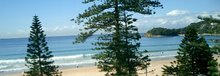
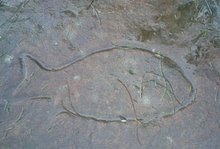
MNLY is a time-capsule of Manly Beach, Sydney and Australian culture specifically. The Manly Blog is a year old and provides a snapshot of how human society interacts with the Earth and life. It could also be anywhere on this planet.
The authors will leave Australia for a long period and live in urban environments.The bookmarks will continue.
02 July 2006
MNLY: A time-capsule of Manly, Australia

30 June 2006
Missing fig tree, stripped paperbarks & bitou
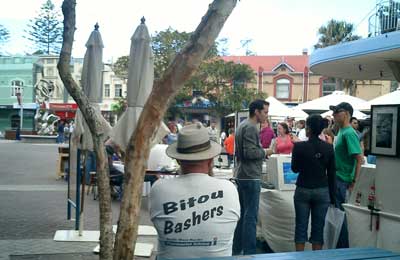 The last photo of the large fig that was eliminated today. Many pedestrians found shade and rest underneath its large branches.
In the foreground are paperbarks, stripped to the core. Handy free wrapping for the market-place or the dog loo. Unfortunately the Melaleucas die when skinned.
Keep bashing that bitou!
28 June 2006
Overheard & seen in Manly
 Cockatoos all over the road, Mum to excited child: "They are very noisy and destructive!"
Shelley Beach sporting adventurers: 20 something female: "Help! I'm scared of possums"
Picnicker's lawn under pines: Mum makes boy urinate on the lawn, just steps away from the public toilet.
Beach car park: Obese guy chucks armful of fast-food rubbish under a car.
In the Aboriginal Art Shop: An elderly Caucasian man to a young Chinese man: "And these were the natives' instruments"
26 June 2006
Corso tree watch
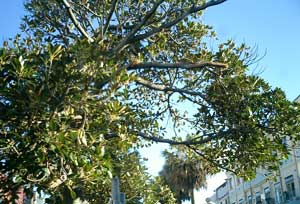
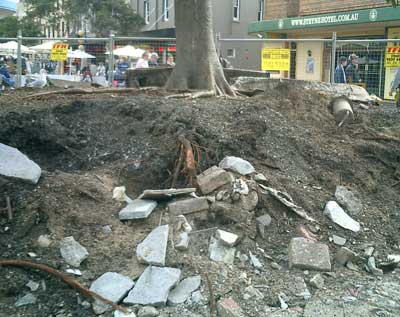
Trees on Council land
Update, 30.06.06: This iconic fig of the Corso intersection has now been 'graded' away by a bulldozer.
Choppers over asphalt Sydney
Up to 8 helicopters were whipping the community with noise pollution yesterday from Manly to The Harbour Bridge and the city. It had that war-like ambience being under these hovering choppers on a Sunday.
The other trend from Darlinghurst to Potts Point and Manly was to paint buildings in an asphalt colour to merge in with the car parks and roads. A mysterious design choice to extend that bitumen-look.
Many un-leased shops and office towers embedded in a car-friendly and pedestrian-hostile environment provided a spooky 'ghost-town' feeling.
24 June 2006
Plundering the aquatic 'pantry'
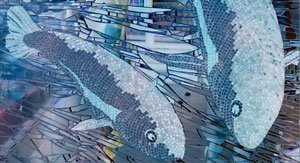 The plunder of the world oceans goes unchecked and even increases. The over-exploitation takes place in the oceans, Marine Parks and the deep seas. The additional 'by-catch' of albatross, seals and dolphins goes unmentioned. Aqua-'farming' is also unsustainable. The 'I'd rather be fishing' culture also engages in practices outside all regulations. Australia is amongst the few nations with 'the largest numbers of threatened species in the world.' Species are disappearing, shrinking in body size or done out of a habitat altogether.
Many of the aquatic beings are gobbled up. The iconic Barramundi has been on the menu from Darwin to Tasmania in every little eatery, it has become the new 'flake' now that the sharks are going. There is no culture of informed decision making or a will to make informed sustainable choices with regard to ocean produce. Try to ask your shop or restaurant where the ocean food originated from, or if it is produced in tubs of anti-biotics on cleared mangroves. Slowly certain foods are being banned, wild cavier and some do not sell live lobsters and crabs.
Utilising the world waterways and the oceans as cost-effective sewage and industrial discharge ponds, it is no wonder that high readings of toxins are accumulated in sea creatures. Dioxin here, dieldrin here or mercury there.
Sharks and other living fossils inhabited the oceans for 350 million years. 'Harvesting' them in a blink of history is irreversible. Newly discovered species disappear immediately. Mining the mysterious deep seas with high technology combined with blind watchdogs makes for an empty 'pantry' for the ones to come. Grazing the tree of biodiversity to the deep ground.
National Parks Association of NSW
Australian Museum Fish site
Fish movies
Free sustainable seafood guides
Best and worst seafood
Australia’s Sustainable Seafood Guide ($)
Fish caught with 'hi-tech' methods has a wastage rate of 80 %
Manly Leafy Seadragon
21 June 2006
Collaborative satellite maps of Manly
 Now you can be a bird and fly over Manly to see how the Earth is cared for.
Fly over North Head and watch it disappear. Some of the building sites are here or proposed. Check out the Corso 'before pictures'. Watch Shelley beach car-park expand and the bush disappear. See how much land is devoted to push balls around, rather then develop it as a community park with fresh water for native animals. Watch the blue harbour converted into a boat-park. Check out that Beach strip being privatised with gear and ads. Don't' forget to count all the many pools,re water shortages.
You can enter significant places of Manly on this Wikimapia
On the Australian version you can collaboratively enter Manly sites or place local comments. Do zoom in!
Wonderful tools to check developments and missing trees.
More: On homeless Bandicoots
18 June 2006
Delights of Manly
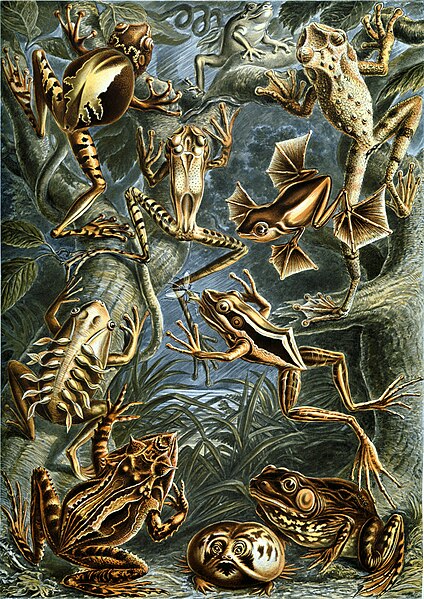
Image: Ernst Haeckel's 1904 Kunstformen der Natur,via Wikipedia.
16 June 2006
Chainsawing the tree of life
 'Give a fish a home', 'Dog/cat needs a home', so run the advertisements appealing to that noble feeling of empathy. The exotic fish is extracted with dynamite out of its tropical habitat and floats, if it survives, in some Manly shop or restaurant thumped by mega stereos, till it drops. Elephants are dislocated out of their environments to do time, serving as family amusement in animal-prisons. Life is only tolerated, if it is domesticated and subjugated to the arbitrary whims of an (pet) owner. Commercialising exotic flora and fauna establishes consuming patterns.
The human species' insatiable hunger for resources and space deprives more and more species of a habitat at ever increasing speed. Ineffective international stewardship of the biodiversity of life on this planet sets the example for regional and individual practices. Most species are being robbed of their homes. Australia tops the charts of eradicating life on the planet. In 'New South Wales, 1004 native species, populations and ecological communities are listed as threatened with extinction.' The land and its native species are rolled up like a carpet, chucked or flogged off. This process ensures economic and ecological poverty. Large branches of the tree of life are irreversibly chain-sawed. It will never ever resprout.
Why not provide habitat/home for Australian plants and animals around your houses, in the subs, in the city and in parks? Encourage clean water and food sources for endemic species. Observe at a distance and enjoy living in an urban wilderness together.
Extinction and a world full of poodles
Update 18.06.06: Australians are actually reversing the historical trend and are converting dwellings for human beings into stables. As reported in the SMH,(paper edition, 17.06.06). 64 % of households, that is 7.5 million places keep dogs & cats. It is the largest pet owning community per capita. The task now is to make real estate 'pet friendly', convert flats, gardens and houses to stables for reliable life companions.
14 June 2006
13 June 2006
The only good tree is a pulped tree
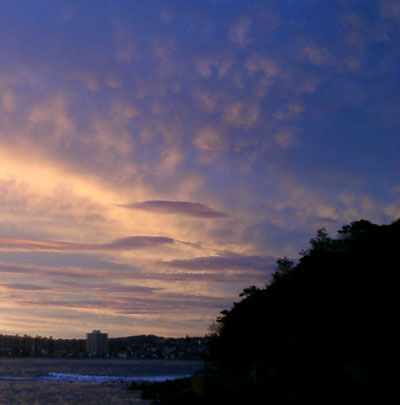 It seems that most trees in Manly are being shaped into a truck, car and wire-friendly shape at the moment. Ideally they are pulped or allowed to resemble toothpicks. Residents seem annoyed with a few leaves. One can't help feeling that they would love to drop some Agent Orange on them to eliminate that 'untidy problem'. Till then the armies of debris blowers whiz about daily creating an Iraq-like sound-scape, shifting the organic matter to the public or neighbouring property. Pouring rain or the dark are no hinderance in shifting the mush.
First, people seek to move to the 'leafy suburbs' with high property values, then a 'view' would increase values even more. Many tree vandals are clearing whole creek-banks in public bush-reserves to have that $-view. Once on the market, the view is further 'improved'. Then a few more branches are trimmed to place that giant real estate billboard in your face, even on public reserves. In the subs, the trees go bit by bit via chainsaw gardening and silent poisoning. Never mind any permits! And then there is that branch over the third driveway, there is too much shade on the new deck, the leaves on the pool and the bottlebrush in the public 'nature strip' was always a hassle to mow around. And so they go - week by week, by council staff, contractors, staff from Energy Australia and local residents. The ideal seems to be low-maintenance cement bunkers from fence post to fence post set in a giant car-park. Sales could be enhanced by popping a few toxic foreign conifers at the entry. No trees, no birds and no possums.

Elsewhere the community initiative Canopy is working to improve their urban tree canopy.
· Trees add to the aesthetic enjoyment of life. An environment abundant with trees is both healthful and restorative.
· Trees significantly increase real estate values for residential and business properties; an ordinary 36 inch tree can add $30,000 - a special tree can be worth $100,000.
· Trees enhance economic stability by attracting businesses; people linger and shop longer where trees are present.
· Well-landscaped areas experience less crime against people or property.
· Apartments and offices with a canopy of trees rent more quickly and have a higher occupancy rate. Workers report more productivity and less absenteeism.
· Trees save energy. Strategically placed trees can reduce the need for heating in winter and cooling in summer, with energy savings of 15% to 35%.
· A large street tree has the cooling power of ten air conditioner units operating twenty hours a day. Shaded air conditioners operate 10% more efficiently than those in direct sun.
· A windbreak can cut heating cost from 10% to 50%.
· Trees reduce wind intensity and act as a noise buffer.
· Drivers slow down on canopied streets.
· Trees need less water than lawns. Trees also reduce the amount of storm water runoff, which can cause erosion and complicate flood control.
· Birds and other wildlife find welcome habitat in trees.
· Trees reduce the impact of greenhouse gases by removing carbon dioxide and releasing oxygen. They improve air quality by reducing the formation of smog, capturing airborne dust particles on their leaves and increasing humidity.
More on the value of trees
12 June 2006
Reading Manly library
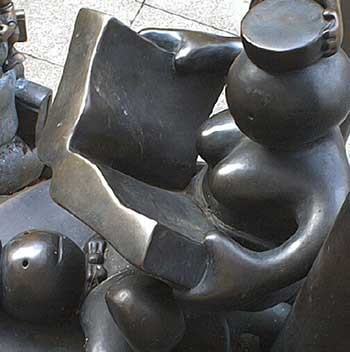 Manly library's change of focus might reflect the new demographic trend.
On the shelf:
'How to get pregnant',
'Childcare for your baby',
'Parenting your complex child',
'Surviving divorce',
'What dog breed is that?'
Subscribe to:
Posts (Atom)