A couple of Channel-billed cuckoos ( Scythrops novaehollandiae) are back in town again, seeking to outsource their child-rearing to the local Crows, Pied Currawongs, Butcherbirds and Australian Magpies. The up to 65 cm long bird with a large (horn-like) bill and a red eye can be heard (audio) at different times of the day. Its call is much louder than that of the Common Koel (Eudynamys scolopacea) (audio). They love eating native figs and fruit. Around Feb./March they fly back to a rapidly cleared PNG.
 Here too in lawny bland-burbia intolerance to trees fills the air with the sound of daily chainsaws and other petrol powered machines. The Fig trees Manly has to offer the visiting bats and birds, such as in Darley Rd and Wenthworth St have no protective devices (cages) to prevent vehicles constantly crunching into them. They are very scarred, most of the bottom branches
  had to make way to the 'wheels of industry'.
Many large, old trees/figs are mysteriously dying at the moment, revealing a 'view'.
At the library plaza of Market Place a pet fanatic even brings in an unleashed cat and locals get amused how it chases the local native birds.
Trees and birds are one of the big assets of Manly -let's look after them.. Trees on Council Land, Manly Council
Images: Figs in Darley Rd. Manly, dead old Fig, Marine Pde
More and image here 0109
12 October 2008
Channel-billed Cuckoos and Fig Trees of Manly

10 October 2008
Banksy's "Village Pet Store and Charcoal Grill"
 “New Yorkers don’t care about art, they care about pets." One could paraphrase it as: Manly-siders also don't care about art or wildlife, they care about pets. Mass hysteria about submissive, privately owned 'pets' and captive creatures in shops, cages and tanks is good business in times of Black Friday, Halloween and Mega Extinction Rates. Something one CAN control.
Banksy's animatronics installation in NYC "Village Pet Store and Charcoal Grill" grasps attention on " our relationship with animals and the ethics and sustainability of factory farming, but it ended up as chicken nuggets singing." News about " the implications of animal cloning on food safety, animal health and welfare and the environment" seem to be sparse. Human cloning. au. pops up occasionally.
Good write-up at the Wooster Collective
Check out the videos on sausages and the sedated wild captive cats, the 'shop',
Good Flickr images
Image: Banksy? Berlin
Video via banscopetstore
08 October 2008
Dead Fish and Noisy Motors at Manly Beach
 Dropping anchors onto the aquatic reserve
In the Marine Reserve today 'leisure crafts' were throwing their heavy anchors into the low reef today to pop some champagne. Motorising the beach, air and land
Helicopters hovered over Manly beach and sub-urbs, giving it that VN ambiance. Are there any restrictions on people perving from above, destroying the space with their noise? How many noisy aircraft routes can Manly Beach handle, in addition to the diesel-spewing coaches, running their air-conditioners hot? Beach findings
On the shore of Manly Beach an unusual number of ocean/leather/mosaic jackets. We mentioned that an unusual amout of puffer fish and moray eel were also washed up onto Manly Beach. They all seem to have been dislodged from the safety of the reef caves of Cabbage Tree Aquatic Reserve. Maybe they are all just ploughed into the industrial beach sweeper and disappear with the tonnes of garbage into the tip? Does anyone record why there were so many dead reef fish last week?
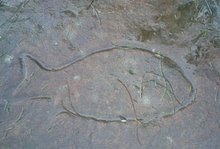
Images: Some of the dead fish (ocean leatherjacket, pdf & Eubalichthys mosaicus) washed up on Manly Beach 071008 and possibly an Eora engraving from the Pittwater region.
Plundering the Cabbage Tree Bay Marine Reserve again


Via Manly Daily 'How can anyone be so bone-headed?' 071008 (Maybe it is has not fallen out of the archives, as the 'red tide' 021008 has.
Images:
Portrait of a male Eastern Blue Groper (Achoerodus viridis) with escorts. Shelly Beach, Manly, NSW, Flickr
Eastern Blue Groper (Achoerodus viridis). Fairy Bower, Manly, NSW, Flickr
Report all illegal taking and vandalising in protected aquatic habitats: Ph: 1800 043 536
- Manly Council Rangers Ph.:9976 1630
- Sydney North Fisheries Office Ph.: 8437 4983
Update: The 'Spearoz' community is also discussing the matter here
06 October 2008
Preventing 'Red Tides' at Shelly Beach, Manly
 Shelly Beach is a small sheltered beach, facing Manly Beach. A coastal walkway, leads along the Cabbage Tree Bay Tree Aquatic Reserve to Shelly, which has one of the few small unbuilt headlands with native vegetation on it. Some of original cabbage tree palms were replanted as they once fringed the watercourses leading to the beach. The headland leading back to Manly beach has been undergoing intense development for years. The beach facilities are also under intense demand.
Dead Fish, how come?
Last week (02 & 03.1008) many dead puffer fish and a moray eel were washed up on Manly beach. We assume, these 'cave dwellers' were from the 'Aquatic Reserve'. On the 051008 the first blooms of an apparent red tide was visible at Shelly Beach. On the 021008 "a mysterious red sludge", believed to be red algae bloom was found on a beach in the Manly area, at Clontarf.(Image)
Nice Beach as a drain, growing harmful bacteria?
The walkway from Manly beach to Shelly beach along the aquatic reserve is studded with old, often decayed pipes of all sizes, draining the dense sub-urban  development on top of the headland, down into the little bay/'reserve'. The mossy green rocks are the sure-sign for 'rich run-off'. The little creek behind the restaurant, has spaghetti-like pipes all leading into it and straight into the beach. Most of the properties, strain to grow water and nutrient intensive foreign vegetation. A large paved car park on top of Shelly, is increasingly denuded, leading to even more run off. Numerous dogs on the beach and unleashed along the walkway help to contribute their untreated feces into the adjacent cabbage bay aquatic reserve. Sydney on the whole “dumps a billion liters of sewage into the ocean every day...” (Maude Barlow, Blue Covenant, 08 p28.) Habitat degradation, generous run off and extreme warming of the atmosphere and the ocean is a guaranteed recipe for 'red tides', then harmful algea (HABs), then hypoxic or 'dead zones'. The beaches become at first unusable, smelly and might irritate the skin and eyes. Later, even just breathing the 'mist' can cause health problems and fish suffocate in the o
 xygen-deprived sludge, “fish-kill” (video). Marine species have their central nervous systems attacked by the poisons generated by the bacteria and also seek to 'leave the ocean' gasping for oxygen. Marine mammals, such as humpbacks are also poisoned and 'beached'. 'Food-species' can become deadly to fish, shellfish and people. Sea and shorebirds fall out of the sky(pdf). The stench would repel any visitor, closing beaches becomes very costly for the human economy. Rehabilitating the ecology of a 'dead zone' is usually left for the next generations.
Beyond denial - Doing something against the red tide
Elsewhere environmental groups are enforcing measurable standards to prevent the fouling of their beaches."..To set numeric limits on the excess nutrients which trigger harmful blooms of blue-green algae...Blue-green algae - also known as cyanobacteria - produce "dermatoxins" that can create severe dermatitis and are known tumor promoters; "neurotoxins" which interfere with nerve cell function; and "hepatotoxins" which attack the liver. Exposure to blue-green algae toxins through ingestion, skin contact or inhalation can cause rashes, skin and eye irritation, allergic reactions, gastrointestinal upset, serious illness, and even death..."
Their drinking water" is now subject to almost year-round blue-green algae blooms as a result of nutrient pollution"
It is too dear to not act
The red tide algae, Karenia brevis, "costs approximately $20 million per bloom in  economic damage off the coast of Florida alone." The beauty of a beach is lost forever.
Ocean Care includes the acknowledgement of eutrophication, it seeks to alter the behaviour of individuals and the authorities bestowed with the stewardship of an biome and urban planning.
Images:
1. Shelly Beach, Google Maps, 2008
2. The walkway from Manly Beach to Shelly beach along the Cabbage Tree Bay Tree Aquatic Reserve on the one hand and the suburb on the other, Google Maps, 2008
3. Shelly Beach looking back onto the walkway with thick streakes of 'red slime' 051008
4. Shelly Beach with 'red slime'', with view to Manly Beach opposite
Update:
Red Tide 11.2010: North Head images, 1 & 2,
05 October 2008
Manly Jazz Festival
 Day two of Manly's Jazz Festival. Car-free for a tiny bit of beach road, pedestrians pushed at the Corso end to the wharf as well against pushy motorists. Maybe, one day they will come around and declare public space for people every Sundays as in other world cities and not just for smelly cars. Maybe the pedestrian areas will truly have no motors in them.
The roaming bands could move with crowds of pedestrians and entertain without the emission intensive stages with hot, blinding spotlights on the audience  (in the day-time), that took days of petrol-fueled erection time. As before - a lot of the amplified music had noise pollution and chemical pollution as a side-effect, as the petrol generators buzzed on. Many push bikes were ou
 t feeling free to move along the beach 'road'.
Bad planning, to place really loud amplified music on top of the penguin habitat.
02 October 2008
Manly Ocean Care Day - Of Albatrosses and Red Tides
 As another 'ocean care day festival' is approaching in Manly it is time to focus on the 'care' bit. In the holiday season the beach is specially subjected to a tidal wave of of unwanted 'convenience' packaging and 'recreational' plastic.
Out of the ordinary was a large Shy Albatross (image) (Diomedea cauta cauta, pdf, measuring some 95-100 cm, wingspan 240-260 ) found at the North Steyne end of the beach on 300908. 10 puffer fish were also rolling on the sand. This giant bird is still hunted for 'sports' and chokes on human plastics. As there is no habitat left for it in the Manly region, the next possible place could be just north of Sydney. Five albatrosses and pelicans have been found poisoned at Tuggerah Lakes. "It was believed the sudden outbreak of botulism was caused by rain washing chemicals and fertilisers into the stagnant water of the lake."
If it isn't run-off from human settlements that has killed the birds and polluted the water, then it is also possible, that it is the mix of high temperatures, due to human-caused emissions, as well as the flushing of unwanted wastes into the water bodies. The result is a warm brew encouraging the growth of toxic micro-organisms. Even if no red tide is visible, the toxins (brevetoxins) still lingering, damage the nervous system, just like the botulism bug. Maybe the shy giant made it out to sea and was overcome by the HABs, to finally get washed up at Manly. Does anyone care?
A red tide is at the moment hovering around the corner in Clontarf's Sandy Bay, (Manly Daily, 021008, image). Red tides love warmth + plenty of human caused run off. They then breed toxins which have the ability to kill life in the ocean/bay and on land. Although there is a fine of $ 1 million for dumping baddies into the water-ways, there seems to be none for doing it with a trickle (eutrophication) over time.
Clontarf / Bantry Bay Estuary Management Planning Process - Data preparation in 0807, (pdf) reveals a lot about the the Sydney Harbour Foreshores and Waterways Area, such as Castle  Rock and Bantry Bay and includes parts of the Balgowlah Heights, Clontarf and Seaforth suburbs.
65.5% of the space is for human habitat, 22.0% for their sealed roads and 10.2% for parks and public spaces. The 'storm water drainage network' is visualised in this document. The appropriation of freshwater is also accounted for. Giant lawns and pools spill into the 'bush', which is often cleared to see the marina (image). The foreshore appears transformed into a space for fossil fuel vessel parking. The estuary/bay is slowly looking like a large boat-parking area. Private dinghies clutter up the 'public' reserve. As in Manly, unleashed dogs are emptied of their untreated feces into the bay.
The environment- human interface is summed up as being in conflict:
The degradation of the environment does not only rob species of a habitat, but it also diminishes life quality for all living and to come. Running out of space and resources in an ever shrinking world
- "Seawalls for protection of properties versus its damaging impact on natural ecosystem
- Groundwater abstraction and possible saline water intrusion in aquifer
- Beach raking for safety versus its impact on invertebrates
- Dog walking off leash and impact on shore birds
- Powered and sailing boats and their wake impacting on seawalls and beach erosion
- Access to mooring versus their impact on sea grass beds, ability to spread caulerpa taxifolia
- Powered boats and the safety aspects for swimmers and kayakers
- Ad hoc boat storage and its impact on amenity and habitat:
- Ad hoc access ways to foreshore for convenience versus destruction of habitat." (pdf)
 is no fun. The diy cocktail of heat, plus draining liquid wastes equals red tides, or dead zones, that are void of life and toxic to ALL. Just breathing the mist is a hazard, eating the contaminated fish/seafood can be deadly. Jelly invasions ( the only creature thriving on this human-made environment ruin the beach- Beach closures, due to toxic blooms or jelly blooms are costly. 'Business as usual' in a risk-society could play it all away in just a generation.
The oceans are getting so hot, acid and degraded by us. Species are either fished out by us or their habitat is ruined. Lobsters, seals, whales, dolphins and crabs etc etc are affected by the red tide toxins and are wishing to leave their habitat, they thereby die.
It would be a sad world which leaves a
red ocean behind
no fish and life in it
no ocean and foreshore birds on the horizon
no beach or bay without a noisy smelly and dangerous motor
no beach or bay without human infrastructure cluttering up the landscape
Let's care!
Images:
1 & 2 Dead Shy Albatross on Manly Beach, 300908
3 Sandy Bay, Clontarf, Google Maps
4 Clontarf/Spit Bridge, Google Maps
Animation: Ocean care day animation, Manly Beach
Links:
Toxic Blooms: Understanding Red Tides, FATHOM
HABs, Harmful Algae and Red Tides, Woods Hole Oceanographic Institution
Sea Birds affected by red tide toxins, Florida conservation 2006
Entanglement in or ingestion of anthropogenic debris in marine and estuarine environments - key threatening process listing, DECC
Rock Snot, a hazardous algae in Tasmania, has had devastating effects on inland river catchments in New Zealand abc 270808
Update 101008
- The red tide at Clontarf mentioned above has been identified as Noctiluca scintillans (Manly Daily p3, 101008). The same type of algae bloom has also been found at Seaforth, west of the Spit Bridge and Woollloomooloo Bay. NSW Health recommends that people avoid contact with all blooms. This dinoflagellate is also linked to " anthropogenic eutrophication...along the southeast coast of Australia". In India, it has been implicated with "the decline of fisheries". At night Noctiluca glows in a bright blue bioluminescence, as viewed on Manly Beach before.
Suspected blooms should be reported to the Regional Algal Committee during business hours (02 4729 8138), or the Department of Environment and Climate Change’s Environment Line (131 555) after hours. Toll-Free Algal Information Line - 1800 999 457 according the the NSW Department of Water and Energy
Update 231008
- Brush et al. Historical Land Use, Nitrogen, and Coastal Eutrophication: A Paleoecological Perspective. Estuaries and Coasts, 2008; DOI: 10.1007/s12237-008-9106-z "During the past 300 years, many of the wetlands have been drained, and the landscape was converted to agricultural fields and urban and suburban development. Since precolonial time, the mesohaline estuary has become increasingly eutrophic and anoxic."
27 September 2008
Manly Beach Bike Week - Sustainable Mobility
 Manly Council is hosting the NSW Bike Week, (pdf) (RTA) on Sunday, 280908 from 10 am to 4 pm at North Steyne.
The key objectives are to
" Raise the profile of the use of bicycles for short local trips.
Promote safe cycling and the use of shared bicycle/ pedestrian facilities."
The Road and Transport Authorities main aim is to improve safety on the roads.
Once one has "dusted off" one's push bike and obtained safety gadgets it is off to a high risk territory of armoured and petrol-powered vehicles.
The motorised community's behaviour hits the attention-economy daily with news of road rage, bullying, 'hit and run' and ploughing into pedestrians or their houses. "Accidents", speeding and intoxicated vehicular manslaughter are the norm. Bodily harm is also caused by  the noise and chemical pollution that is being inflicted on all. Pedestrians and cyclists wishing to share this space seem to be perceived as a lower species with less rights, as they are not obtaining power derived from fossil fuels. Not contributing to Australia's record emissions they are treated as being 'in the way'.
Awareness needs to be raised not in the community that is achieving sustainable mobility, but in the petrol vulnerable car-dependent nation and its mind-sets. Structural change needs to to facilitate safe and emission free transportation.
Many bikes in Manly still arrive on/in cars. The 'leisure bikes' get unpacked with idling motors at t he beach/car-park. Variations range from plastic uniformed racing bikes, to large family groups, with children often on dysfunctional cheap 'throw-away' bikes and mounting-bikes looking for municipality tree-edges to crack. Of course, there are some real-life cyclists arriving on bikes as well. But all are seeking to join in on the heel-to heel packed 2.4 kilometre (1.5-mile) Pacific beach path. The cycle/walkway proper is situated along the beach car park with many cars having hard or sharp protrusions right over the cycle path. At night the beach walkway has racing bikes endangering pedestrians. Off the beach drag, the fragmented bike paths are often parked on. Without the provision of physically-separated bicycle paths the life of a bare body on a wire frame is taking a higher risk. Arriving for ones "short local trip" there are insufficient bike racks to do the shopping. The odd bicycle bar is often taken up by motor-bikes, conquering the pedestrian paths increasingly. Resorting to tie the bike to trees/palms further degrades the neglected trees.
Leaving the bike and attempting to cross any marked pedestrian  path is a struggle, and one had better run. The designated 'pedestrian zones' are most of the time filled with delivery trucks and trades vehicles. Idling is the norm. Car design regulations in Australia are lagging behind causing injury and death to walking people and cyclists. Fatal injuries could be avoided by spending a bit on reducing harm to the 'collided objects'.
"About 300 pedestrians and cyclists are killed in vehicle-related accidents on Australian roads each year and another 3000 sustain serious injuries.Cycling is a wonderful form of mobility, but the mind set of the car addicted community and their practices has to be targeted and structural urban changes have to be realised and enforced.
The most common injuries are serious head injuries, broken legs and ribs and fractures to the pelvis."
Images:
1. Corso 'bike path'
2. Beach bike path with dangerous protrusion in ya face
3. Beach bike path with knife-like instrument at head level
4. Manly Cove pedestrians & push bikes only!, 3 large motorbikes, one idling bus.
Links:
- Video, Physically seperated bike lanes, US
- Fatality Analysis Reporting System with Google Maps, US
- Shocking the suburbs: urban location, housing debt and oil vulnerability in the Australian city , Jago Dodson and Neil Sipe / Urban Research Program
- Pedestrians at risk as car safety rules slip behind, SMH 270908
- Risk for cyclists 'increasing' on Beach Rd, SMH 270908
- Bicycle Paths, Manly Council
- Bikely Maps and Routes
- Sydney Cyclist
- Pedal Mobility
- They complain about birds swooping cyclists in their breeding season as they run out of habitat. Pity, there are no corresponding articles about the deadly dangers posed to pedestrians and push-bike riders by urban tanks steared by aggro drivers at pedestrians, push-bike riders and birds. (Manly Daily 021008, the dead-tree version is most reliable!)
24 September 2008
North Head NP Occupied - More Toxic Diesel in Wildlife Habitat
 North Head, Lady Fairfax walk today. Toilet litter all over on the ground from mass-tourism (without the facilities). The National Parks sign is a sure indicator for what is to be expected: dogs, bikes, litter. The rare Banksia vegetation had been damaged on the 'walkway' by cars. Although there were no black plumes (soot) visible from ocean-going vessels, the entire air around the walk seemed saturated in diesel fumes. And then there it was again - another giant infrastructure development IN the national park, placed on the main 'tourist-attracting' look-out, directly on the cliff of North Head.
Diesel-belching clutter IN the wildlife refuge (NP)
A huge diesel-belching, humming demountable, with a large spinning radar antenna had been placed in the middle of the Sydney Harbour National Park's territory. Seeking to “add value to all aspects of Sydneys port operations... (and) protect the environment and have regard to the interests of the community “, the Sydney Ports Corporation planted this air-conditioned, video and radar surveillance object into a wildlife refuge. This 'state-of-the art' technology (pdf) is to aid in the intensification of trade and logistics from Botany Bay to Sydney Harbour (North Head). Intensify - more for more, 'exploit & open up NPs'
The “Vessel Traffic Service (VTS) provides active monitoring and navigational advice for vessels in particularly confined and busy waterways with complex traffic movements...Sydney’s ports alone handle over $50 billion of international and domestic trade annually. Total trade through Sydney’s ports was 29.2 million mass tonnes, 5.0 per cent higher than last year.” Obtaining ROI in a harbour full of tinnies is not easy. Infrastructure is likely to be erected in various harbour sites and widening the bays (dredging) is already starting in Botany Bay and elsewhere.
Deadly trade
As in colonial times, the growing population (pdf) is still dependent on the boats coming in, bringing the essentials. Only this time, the huge diesel-powered vessels (container ships, tankers, bunk carriers, tugboats and cruise ships) are costing lives and health. Most diesel powered ocean-going vessels are significant contributers to air pollution in the heads, the harbour, ports and cities. Ports, handling the bulk of imports, are among the biggest sources of air pollution and greenhouse gas emission. “Each step of the goods movement process is powered by diesel fuel, which releases greenhouse gases and toxic, smog-forming air contaminants...ports pose "grave health risks" to millions of people living in metropolitan coastal areas, especially those living nearest the ports." In 2002 "60,000 people living in coastal communities along major shipping routes died from lung and heart complaints as a result of high sulfate emissions from ships". Particulate matter from ocean-going ship causes asthma, heart attacks, hospital admissions, and premature mortality. “Particle pollution from shipping to tens of thousands of premature deaths each year, most of them along coastlines in Europe, East Asia, and South Asia." This dirty trade is causing harm to public health and to the environment. The ocean, its life and the atmosphere becoming degraded
"Ships use the tar-like, sulfur-concentrated remains of petroleum left once the gasoline, oil and all other products have been extracted. This high-sulfur fuel is responsible for the significant environmental impacts of ship sulfur emissions. Regionally, sulfur emissions contribute to acid rain, which can pollute freshwater lakes and rivers, and damage vegetation." Even cloud formation over the Pacific is influenced by trade-carrying cargo ships powered by diesel engines."The annual costs of sea traffic’s contribution to air pollution, climate change and marine pollution are estimated to amount to 260 billion euro for the world fleet and 57 billion euro for the EU fleet." These 'externalities' are probably not lower for the Asian/Pacific region.
Intensifying diesel-powered traffic that 'costs the Earth' and has negative impacts on the marine foreshore and protected wildlife refuges is unsustainable.
Links:
- International Maritime Organization
- "In accordance with the Australian Government's responsibilities and policies, Australia's obligations under IMO Conventions and AMSA's functions specified in Section 6(1)(a) of the Australian Maritime Safety Authority Act 1990, AMSA coordinates a national pollution prevention and response strategy to protect Australia's marine environment from pollution caused by shipping and related activities. This document lists the prevention components of this strategy, based largely on several IMO Conventions given effect by domestic legislation, implemented and enforced by Commonwealth and State/NT Governments." Protection of the Sea - Conventions and Legislation in Australia, AMSA, Australian Government
- Protection of the Sea (Prevention of Pollution from Ships) Act 1983, NSW
- The National Parks and Wildlife Service, DECC
- National Parks & Wildlife Act 1974
- NCC/NPA Submission to Taskforce on Tourism and National Parks, Submission of The Nature Conservation Council of NSW and the National Parks Association of NSW and the Blue Mountains Conservation Society. 0808, pdf 1,2MB
Update 111008
"The International Maritime Organization on Thursday adopted stringent new controls on airborne pollution from the world’s 300,000 oceangoing vessels. Emissions from ships steaming into ports from Rotterdam to Shanghai to Long Beach, are blamed for about 60,000 premature deaths around the world annually. Sulfur emissions are a major source of airborne fine particulates, which have been associated with pulmonary and cardiovascular disease. In some ports in Europe and in the United States, environmental groups, using the courts, and local governmental bodies have required ships to shut off their engines and plug in to the local electrical grid to keep ship operations functioning while in port." NYT 101008
22 September 2008
Manly Beach 2048

 “Pungent brown sewage spews into the Pacific ocean. In the background, cranes put up hotels and beachfront apartments."
So runs an intro to another Pacific tourist spot where uncontrolled coastal tourism development kills the 'golden goose' for investors, residents and visitors. Pressures to intensify and commercialise the protected 'green and blue' leads to the degradation of all. Squeezing the proverbial 'goose' to death means a loss of human health, life quality and economic gain. Even more of the Australian species, plants and animals would lose their habitat, that is their right to life.
Imagine!
Manly in the 21st Century could be consumed in the same way, if there is no refraining from grabbing 'what's left'. Developing the trends would give the following constellation:
The pressure is already on (pdf) to convert 'nature' (Sydney Harbour National Park, North Head, Quarantine, Dobroyd, and Garigal National Park) into more of the same, a tide of 'accomodation' and sprawling sub-urban McMansions with their associated infrastructure.
Manly 'town' could become 24/7 neonlit buyosphere which customers could immerse themselves in. Alcohol merchants and casinos high-rise, Las Vegas style could frame the beach. Experiences and bodies could be organised via animators from the entertainment industry. Roofed domes would lessen the deadly uv radiation from scrambling the DNA. Organised 're-creation' is conducted on flood-light filled arenas. All are of course attending in respective plastic uniforms. Sports ovals, swimming pools and golf courses are also day & night air-conditioned and lit. Plastic lawns have long replaced water gobbling/toxic lawn transplants. Every inch of the Earth is paved over with coastal real estate: tourism development (hotels, resorts, restaurants, etc.), and the infrastructure supporting coastal development (e.g. marinas, beaches, recreational fishing facilities.) Breakneck developments turn the area into ear-piercing noise waves on every corner.
The sky is also filled with constant noise: Jumbo planes are seen 'spinning' over the beach, belching poisonous gases and consuming non-renewable energy while delivering more 'customers'. Helicopters and small plane 'joy-rides' are now so numerous that they are on a clear collision course with each other and the many UAVs. Brand names are 'written' into the clouds for all to see, that are not in-dome. Blimps urge all to accelerate the buying of anything now!
The ocean:
Surfing and swimming has long being abandoned, as the nutrient over-enriched coastal waters have turned into a permanent red tide. This anoxic "dead zone," is devoid of fish, but still very rich in stinging jelly blooms. The entire coastal marine ecosystems has been consumed. The sand is so e coli laden, that it is not to be touched. The 'ocean spray', full of HABs, is a health hazard. An industrialised ocean horizon:
Private boating also ceased, due to oil shortages and the unavailability of territory to give these motor-boats 'a good spin'. A dense network of aquaculture infrastructure clutters up the coastal waters. Further out, the ocean horizon is studded with chains of giant artifacts: Desalination factories (pdf), gas- and oil drilling and extraction structures and huge data platforms. No whale has been seen for years that could navigate this dense human ocean clutter.
More frequent violent storms, tornadoes, hurricanes and giant waves mince up the entire set-up due to human-caused climate change. The thick layer of human debris and waste floating on top of the Pacific also gets washed onto the shores. Various chemical spills and scrambled infrastructure do not make 'clean-up' operations easy.
Due to the many desalination factories, the water guzzling life style could be kept up. Visitors on the whole are consuming double the amounts of water via hotels, swimming pools, golf courses and personal use etc. But locals also all have their personal lap pool by the 'beach'. The exotic plants still are watered with petrol pumps as before.
The demand on energy leads from time to time to a crash into 'a candle economy'. Many suffer in their air-conditioning dependent dwellings in the long black-out periods. The nuclear option seems to keep this power-ful life-style alive.
Sewage, another plentiful anti-product which is a slight challenge to the aesthetic and olfactory appeal, could also pose a possible loss in revenue for tourism. The dead zone of the coastal waters is fueled by this waste-water contaminated with toxins and pharmaceuticals.
But all is not without life, people now have their dearest darlings cloned in multiples. One can see them, as before in cafes with up to 6 harnessed dogs.
Huge cats, as well as packs of dogs have gone 'feral' roaming gated estates. The only surviving bird is the Indian myna, seen in millions coating all with its feces. Many black rats are seen living on the garbage. Large swarms of flies, mosquito and ticks are still posing a challenge.
Australian animals can now be admired (for a fee of course) in an event space, previously known as a museum. There they are, the bandicoot, the little penguin and so many more - all stuffed, just like in the 19th Century. Most Australian plants are gone. Some invasive plants and pests are still about, despite the increased toxicity of the weapons used in aerial helicopter spraying.
Uncontrollable fires shroud the area in suffocating smog. Even though there are only weeds left to 'back-burn', the scarcity of water, threatens the 'real estate'.
Many argue that tourists were not drawn by all that 'environmental stuff', they didn't give a hoot about the unique ecology of Manly. They were seeking to spin their body around, often with the aid of petrol or ingestid toxins . This constituted 'fun' and sold well. Human generated 'attractions' have to be erected to offer a peep here or a spin there. Once contained, money could be collected in this Disney-like hybrid simulacra world. Neither locals nor visitors are remembering or missing that 'biodiversity and landscape attractiveness'. The problem is though, that the place has become indistinguishable from so many other (coastal) places in the world and that is a challenge. Like malls and airports, one doesn't know anymore where one is. Looking after the Country in the future:
Myopic objectives could gamble away 'nature' and 'uniqueness' that has no substitute. Unchecked developments and mobile destruction (mass tourism) degrade a place and its resources. 60 % of Australia already has been degraded by relative few people in a short time. 'Customers' flee the degraded tourist traps, locals desert the uninhabitable places seeking refuge in the remaining 40% 'new-found-land'.
Returning North Head, Sydney Harbour National Park, Quarantine Station, Dobroyd, and Garigal National Park to their owners might guarantee a halt to the tidal wave of destruction.The National Parks and reserves are an essential refuge for endemic plants and animals. They also are of great ecological and economic value in framing Manly as a desirable and unique place on the Earth.
Images:
1 North Head, Manly and the Northern Beaches, Google Earth
2 North Head, Dobroyd and part of Sydney Harbour National Park, Google Maps
3 Dobroyd, SHNP viewed from Manly Cove
4 The Pacific ( uncluttered) viewed from North Head
5 North Head cliffs and the Pacific Ocean
Links:
Manly Council Submission to Taskforce on Tourism in National Parks, PDF
Players:
The NSW Government
The Environmental Trust, The Department of Environment and Climate Change (DECC)
Manly Council
NSWALC, NSW Aboriginal Land Council, Land Rights Act
National Parks & Wildlife Act 1974
NCC/NPA Submission to Taskforce on Tourism and National Parks, Submission of The Nature Conservation Council of NSW and the National Parks Association of NSW and the Blue Mountains Conservation Society. 0808, pdf 1,2MB
Areas to 'exploit' and 'open up':
Sydney Harbour National Park (SHNP) North Head, Quarantine Station, Dobroyd, and Garigal National Park.
Coastal Recreation and Tourism:
- UN Atlas of the Oceans
- United Nations University (2008, June 4). Coastal Management Cooperation, Enforcement Key To Avoid Pending Crisis For Millions, UN Experts Report. Retrieved September 22, 2008, via Science Daily
- Mike Davis , House of Cards, Las Vegas: Too many people in the wrong place, celebrating waste as a way of life, Sierra Club
Footprint:
-"You can't have one species growing indefinitely on a planet that is finite." Prof. Bill Rees
Update:
" The vast majority of the Australian population is clinging to the east coast, running out of land and running out of water...2043, when 43 per cent of the Gold Coast has been abandoned to ever-rising sea levels. Australia's swelling population could be accommodated in desert cities." SMH 201209