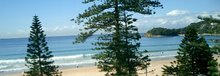
Each year there are fewer Crested Terns visiting Manly Beach.
 More and more fishermen line up along the urban beach. Booze-free zone. Stinking garbage, dead fish, dangerous hooks and plastic junk are left behind.
 A Crested Tern mother had a chick which she hid amongst the Seagulls. Returning from her feeding trip, she was in distress, trying unsuccessfully to regurgitate - a fishing hook and nylon string. Various phone calls were made to volunteer organisations with long waiting loops. Had it been a precious dog, there would have been a swift service. It is unknown if the dependent chick or the mother survived. But then it's all about beach as a tidy and profitable playground for humans. Wildlife, especially shorebirds, are not granted a habitat.
More birds killed by fishing hooks and fishing lines at Manly Beach
Ban fishing on urban beaches. Make Manly beach and the Northern beaches a marine park.
08 January 2011
Ban Fishing on Crowded Urban Beaches - Marine Reserves

20 May 2009
Fishing (hooks) and Albatrosses - Manly Beach
 Another dead Shy Albatross found at the beach. This time it was an obvious victim of 'fishing-by-kill'. The fishing hook was lodged in its eye and the nylon string entangled especially the young bird's legs.
Create more Marine Reserves, eradicate the ineffective and wasteful fishing industry and ban ' recreational' wasting of biodiversity.
More 'recretional fishing' victims at Manly Beach here
01 May 2009
Manly Beach Drift 'wood' - May
 A monthly summary of what has washed onto the shore or beach through the winds, tides, waves or human action. Marine debris, flora and fauna, dead or alive:
Glassing - unintentional/intentional
A stunning lot of freshly cracked G L A S S on the beach. It can be mapped as a post-event phenomena.
On the cemented turf violence with glass, 'glassing' seems to be a popular, mostly alcohol-fuelled activity. There were a lot of bare-footed people on the beach. Which 'stakeholder' is responsible for this potentially dangerous 'externality'?
Airborne Bird Feces and Public Health
At prime visitor time the main cement stairs along the Corso beachfront were sprayed with a high pressure hose. The stairs tend to get caked in bird feces and 'fast food'. The odd butt and wrapping thrown in too. The worker wore no protective mask/ respirator while blowing the nutrient-rich accumulations of bird droppings, feathers and debris in the beach direction. Nearby visitors seated on the stairs received a good dose of of the moist, pulverised, and airborne mix. If OHS is an alien term, then at least the health hazards associated with bird feces and food wastes should be taken into consideration not just in times of pandemics.
Stingers An unusual jelly, a squarish transluscent bell and short, pink tentacles.(Purple Stinger, Pelagica noctiluca?) Never seen before. It seemed the only medusa on the beach.
An almost hot day with dense white clouds. The horizon uncluttered. 010509
Herbicide in runoff
Various plants around Manly suburbs seem to have been sprayed with herbicide. That classical plant around the pole that petrol-fuelled 'gardening' could not eradicate.
 Crested Tern Habitat: Eutrophication Pipes
 At the Manly Life Saving Club, developments race on. Extreme pollution around that premise: a cacophony of debris blowers and diesel-fuelled deliveries of 'fast food' - all blowing into the building. A place to avoid. 040509
More than 24 Crested Terns with offspring. White Cockatoos grazing on conifer seeds. Styropore flakes seem to have come down the hill, washed out of the pipe and got flushed back in. A lot of them. The "Green" machines are disturbing the peace and quite. Fecal matter on the stairs being moistned and dispersed as aerosol by a high pressure hose again. 050509
Unusual mushroom-shaped sponges. Many leg-less seagulls. Why? Large Bluebottles.
All streetlights along North Steyne are on in the daylight. Too much money? Not enough CO2? Pollution from smokers, diesel vehicles and rancid restaurant oils mingling at the beach.
Elsewhere they are flying a blue flag at the beaches to assure users/visitors that the water is clean and the shore-line free of anthropogenic debris. 110509
 Dense schools of different sized fish in the surf. Gannets diving for them (video) Seagulls chasing Crested Terns and Gannets for their rich catch. At places the ocean looked like it was 'boiling' with life. A few Willy Wagtails (Rhipidura leucophrys) checking out the dunes and a few Butcherbirds calling (audio) from the pines. 130509
A very large variety of shells today. Many Crested Terns still fishing. The surf had very large fish nosing around our legs. The usual plastic junk, fishing/diving garbage and chunky glass.
All streetlights blasting energy during the day from Queenscliff to North Steyne Surf Club. This has been going on for ages now, they must have money to burn! Their offspring might ask them one day why this planet has become so uninhabitable. (PDF) 150509
Diesel and noise pollution at the Queenscliff end: The smell of 'kelp' or the substance that flows out of Manly Lagoon has been exchanged for industrialising the beach and lagoon mouth with noisy and stinking machinery. 180509
The last oysters scratched off by very hungry and needy people at the Queenscliff rocks end. Street lights still blasting in the day as if there is no tomorrow. Dead fish and a lot of garden refuse washed down to the beach from the subs. 'Throw-away' lighters and very large,
 sharp pieces of glass. Boat-parking on the Cabbage Tree Bay Aquatic Reserve. Who needs biodiversity when in need of parking that petrol-guzzling 'recreational' aquatic vehicle? 190509
A second Shy Albatross found with a fishing hook in its eye and the fishing string tighly wrapped around its legs. Many dead fish and many sepia. The usual 'event' glass and one-mouthful wrappings.
People that look at things at the beach seem to be either small children or foreigners. For the rest it is a (free) gym or a path to the surf. 200509
Wild weather conditions pound the coast. The row of pines in full seed seem to emit a castanets' sound before the lorikeet frenzy starts. Two Pelicans glide over the beach without a movement.
The sand was covered in small pieces of volcanic rock that have blown in. Large Cuttlefish sepia bones.
 Along the sandstone wall some native vegetation is re-establishing itself, holding the sand in place: Knotted Club Rush (Isolepis nodosa), Pigface (Carpbrotus glaucescens), NZ Spinach (Tetragonia tetragonioides) and Scaevola sp.
At the southern end the surf is lapping at the stairs, signs of erosion become visible.
The heavy rain washed suburbia clean again. Down the hill it all goes, all the unwanted externalities.
The plastic Junkspace contained fishing and surfing paraphernalia. Fast food 'throw-away' cutlery and dishes, a lot of balloons with fancy long strings, dummies, spray cans, furniture and crates.
An adult man flying plastic kite in the air, endangering others. Usually the plastic debris gets tangled in the tall pines and stays there for the birds.
A lot of fruit rolled around the shore: apples, figs, grapefruit, oranges, tropical mysteries. The gulls prefer apple.
The usual daytime light pollution and energy waste from Pine Street to the north all along North Steyne.
Around Pacific St. the dunes are reclaiming lawn territory from the underground.
An army plane flying low over the Pacific horizon. 210509
Wild weather still pounding the shoreline.
Audio: Pounding surf, White Cockatoos screeching.
 Fauna: An abundance of Nudibranch (Glaucilla marginata). Crested Terns are still blending in with the Seagulls.
Jellyfish: Many Velella, the unusual Bluebottles mingling.
Vegetation matter: Most vegetation matter seems anthropogenic, cut branches, weeded grass tufts, weeds etc. Possibly washed down 'externalities' from sub-urbia.
Plastic: Many bags, 'party balloons' and extra long strings and fancy ribbons ready to entangle wildlife.
Glass: Only one extra large, sharp piece today.
Dogs: Black plastic bags, full (of feces) and empty blowing around the shoreline. Illegal dog packs ON the beach.
On the parade: the same pine vegetation as if the council's idling 'green' machine has never been there. 220509
Wild ocean, even the gulls are uncomfortabe at the beach. The volleyball infrastructure on the beach eroded and scrambled like toothpicks. That bit of 'real estate' on the beach won't be 'monetizing' for a while. The stairs are challenged by the pounding waves, the large sharp rocks from under the sand/ beach are exposed by the erosion. 230509
The erosion and plastic pellets have their own post. There was an unusual amount of anthropogenic debris on the beach. Mostly plastic, a lot of it minced. Giant rope knots, plastic cables etc, ideal to entangle. Most crested terns have disappeared. The smell was not the best and it was not kelp! 250509
Erosion, especially at the south end of the beach. Large rocks, cement lumps, iron bars and mysterious fibrous mats surfacing. The last upright volley poles are going.
Plastic junk and plastic ropes and fishing lines, knotted in thick entanglement balls. The "litter free" North Steyne beach was like the rest of the beach full of plastic garabage and plastic resin pellets.
 Kelp is arriving to replenish the (northern end of) beach and grasp the sand. Sea tulips and live marine creatures are also amongst it, so the human community will scream 'stinky weed' again and deprive the beach of what it needs. Strange insensitivity towards the other most overwhelming smells...
Jellyfish, large red/burgundy with a huge bell.
Motorised: Wheelies on the ocean, idling green machines on the parade and tractors at the beach stemming the tide of human junkspace. 260509
Kelp: At the north end of the beach: 150+ cm high kelp covering the pool's edge, the beach and surf. Sea Tulips are also mingling. Swarms of Swallows chasing thick swarms of 'kelpflies' in their habitat.
Sponges: A great variety, many still in their colour.
Jellyfish: a couple of the huge bell in red/burgundy.
Junkspace: Minced plastic junk all along the beach.
In front of the childrens' hospital the pines now even become a tip for long and thick fishing strings, high up in the trees, ready to entangle Lorikeets or any other bird. Junkspace making has many dimensions.
Horizon: Thick brown haze pollution. Romatic fireplaces, pollution from a car-dependent nation? 270509
 Kelp: + 150 cm high especially at the northern end, sloshing in the surf and reaching into the lagoon and pool. All along the beach as well. As it is mixed with Sea tulips and Cunjevoi it will smell of decomposing animals. That is aside from the Manly lagoon smell, the many eutrophication pipes leading into it and the ocean, funneling the 'externalities' of Sub-urbia into the Pacific.
Sponges in great variety, Shark eggcases and Sea Urchins.
Swallow cleaning up the kelp and marine life 'flies'.
Plastic Junkspace: The old finely minced plastic with the plastic resin pellets from days ago, distributed along the dunes. A fresh lot in the thick kelp of mainly plastic bottles and fast food, eat & chuck debris. And all that on a 'litterfree beach'.
Dogs and more dogs illegally at the Queenscliff end of the beach.
Queenscliff cliff edge: Most woody vegetation (trees) rolling down the cliff 'sponatenously'. Even the endemic wetland reed (Phragmites australis) looks as if it is sick and tired of stabilising the cliff edge. Another habitat going for Herons and Ringtail possums. Only a bare and eroding cliff face/headland would be recognisable as iconically 'Australian'. 280509
See also Driftwood of:
April, March, February, January, 2009
01 March 2009
Manly Beach Drift "wood" - March
A monthly summary of what has washed onto the shore or beach through the winds, tides, waves or human action. Marine debris, flora and fauna, dead or alive:
Thick layers of Bluebottles/ Portuguese Man-of-War (Physalia physalis) along the beach and many in the surf with very long tentacles. There was a very large unusual medusa, an approximately 18 cm transluscent bell with short mauve tentacles, arranged in pairs. An impressive creature. (Image)
People fishing, wagging dead fish heads in the water  seem to want to attract sharks to the beach which is full of people. Crested Terns still mingling with Gulls. Some real driftwood, large logs of native trees.
An increasing diversity of jelly fish, bluebottles, round 'buttons' and transluscent blobs. Many dead fish, a headless Weedy Seadragon. Nice shells and kelp species along the Manly end. Extreme rugby between the flags. Smoking carers with newly borns on the beach. Towards Nrth Steyne., kelp and thick in bluebottles. Olfactory mystery and building noises. Huge logs of driftwood. Endless plastic 'party' balloons, full of gas and deflated with fancy looong ribbons, entangling anything in sight, released to share with wildlife and future generations. Family or PR 'fun'. 020309
Serious (commercial?) spearfishing took place at the Queenscliff end of the beach. At the time when life-savers knocked off, the professionally armed diver killed a lot of marine life and dragged it to the beach. Many children were in the water and also gathered around his loot. The very large weapon in a public space seemed most inappropriate. The proximity of an armed hunter in the ocean and on a crowded beach appeared against all beach safety. Apparently it is legal. After the beaching, the heavy and rich 'harvest' was brought to the caves of Queenscliff, where more 'goodies' were bunkered. If it was within the 'bag limit' and what species the heavy bags contained will never be known. 050309
Marine Parks NOW! Three Crested Terns diving. Ravens cleaning up a dead Seagull. Some dead fish, a couple of transluscent blobs (jelly-fish).
Junkspace: Countless plastic 'throw-away' bottles, chucked after a 'convienent' drink. Along the entire length of the beach. Fishing Junk: Long strong plastic ropes/gear and styropore sinkers. 060309
A wild ocean last night blew thick layers of blue bottles onto the beach - the jelly fish variety and the plastic variety. A few tiny Nudibranches were still alive at the beach. They had a black and bright blue colour. Crested Terns were diving. A coconut with many bi-valves with orange edges. A not unpleasant fish smell. Fishing people trying their best to entangle beach users and marine life. A lot of nylon string and plastic toys were left behind.
Rain washed all of suburbia clean. All the toxic fertilised lawn transplants, the foamy car-wash, the untreated dog and cat poo, etc (known as "stormwater", pdf) ends up in one of these holding pools. (eutrophication image) Seagulls bathe in it and then it seaps into Manly Beach and the wider blue Pacific. From marine biodiversity to dead zone.
The sand is a colourful composite of shell bits. Soon shells will not be able to build their hard shells and the 'sand' will disappear. An acid ocean, full of carbon dioxide does not allow for hard shells being build. But there is no sign of slowing Manly's use of fossil fuels. A degraded world will be left behind for the many off-spring they are hurling around the place with fossil fuel. 090309
Generous amounts of garden clippings, prickly pear and other weeds. Balloons, balloons and more... Blue Bottles and the blue 'button' jellyfish. Many cuttlefish bone/sepia. At the Queenscliff end, the smelly problem of 'kelp' stuck in engineering wonders, was 'solved' with the aid of a lot of diesel and heavy machinery. Usually there are many plastic bags on the beach, but this dumped bait packaging seemed unusual. The contents had been pilchards from W.A. Forgotten seems to be the mass mortality of pilchards (Sardinops sagax) during 1995 due to "a novel Herpesvirus". "The deaths occurred along 5000 km of the Australian coastline and 500 km of the New Zealand coastline." It is believed that " the virus was introduced to a naive population. It appears to have a point source and correlates though it is not proven, to an area where a large population of blue fin tuna are kept in pens. They have to be fed on pilchards, which are imported from overseas and dumped into the ocean there." "Bait" has the potential to spread disease, especially with an absence of a 'code of practice'. Australia's 2.89 million "recreational" fishers consume 4000 tonnes of purchased marine fish as bait p.a.
Dumping fishing gear and "bait" at the beach or ocean endangers marine life and has the potential for huge economic damage. 100309 A washed up Yellow-bellied Sea Snake (Pelamis platurus, images ) +30cm long, headless. A beautiful black skin and a very bright yellow underside. Many dead Pufferfish and large Porcupinefish. Crested Terns with hungry offspring. A great variety of kelp and jelly fish. A large coconut full of living bi-vales, 4-edged dark seeds, also alive.
An unusual number of (recession plagued?) anglers with very large buckets. More plastic bait bags blowing in the wind. Freshly cut large fish heads stinking on the beach. Chucked fruit and veg from some boat?. Unusual in today's junkspace, apart from the usual boring 'party balloons' with long strings, was a full condom.
Extreme sport: surf kites seemed to want to raze the heads of walkers and swimmers with their gear at high speed. For joggers a real challenge to dodge the fishinghooks, racing surf kites or slip on a full condom. 110309
Dead birds: 1 young Crested Tern, + 3 Mutton birds. A dead rat - not the native water rat. A few dead fish. A lot of garbage: A new wave of 'convenient' one-mouth-full portions, "mini" this & that, individually wrapped. Stuff it in, swallow and chuck. So easy.
A real epidemic of plastic balloons with entangle strings, every day. Just spottet a "mum-party" yesterday, each pram had some six balloons tied to it. And then 'party!' they are released - off they go - to entangle the marine offspring.
Fishing junk, floaters with nylon string still attached and plastic bait bags. Strange campaigns to only lobby against plastic bags and have a 'blind spot' for all the other ubiquitous plastic junk. Bottles and bottles... 120309
A thick layer of Soldier beetles (Cantharus Lugubris, images) washed up along the beach. More gardens and parks will have less biological control agents now. Nice shells. Plastic fishing junk, a syringe and a lot of freshly cracked sharp glass.. Another spearfish gun at Queenscliff amongst sun - bathers. 160309
A lot of Crested Terns (pdf) mingling with Seagulls, leaving their offspring with them whilst they go diving. With stunning aerial displays they shoot into the shallow pools and bring fish to their young. Often Seagulls chase them to extract the catch. One adult feeder had a fishing string dangling out of its bill which it was desperately trying to extract to continue feeding. More plastic fishing junk on the beach. It's time to make fishing illegal in dense coastal areas. More large pieces of glass on the beach. 180309 In the morning the row of Norfolk Island Pines is abuzz (audio) with Sulphur Crested Cockatoos. The large white cockatoos overpower even the surf. It is rare to hear the large Black Cockatoos. More Wattlebirds have been busy in the pine rows during the day. Cleaning the garbage bins of spiders. In the late evening the pines come alive with the buzz of thousands of colourful screetching Lorikeets. A large bird of prey flying with heavy wing towards the north.
Council's petrol-fuelled gardening and cleaning cuts through all of nature's sounds and ruins the ambience on the beach and walkway.
On the beach, a Raven investigated a golfball. An 'egg' to crack on the footpath or an intelligent removal of hard missiles from the beach? Maybe a weapon to drop on the dog owners holding three to four dogs each in their reins. The hard golfball ended up high in a pine tree.
Large amorphous 'blobs' of transluscent jelly fish. 250309 Illegal dog paws prints at the North Steyne end of the beach in the very early mornings. The size of a pony. An angler was scaling a large fish alive. The flapping and agony of the tortured creature was severe. A couple of Pelicans flying north/west regularly, seeking a habitat. A large array of nice shells. 260309
Hundreds of dead-ish Porcupinefish from one end to the beach to the other, mostly +/- 10 cm. Many fresh Bluebottles/ Portuguese Man-of-War (Physalia physalis) floating in and stinging people. More transluscent jelly blobs. A dead microbat was washed up. Usually they fly along the foreshore.
Advertising in every direction on the beach. Solid state spam in public space. The blue sky, dimmed by "Aerosols, tiny particles or liquid droplets belched into the air by the burning of fossil fuels" visibly at the horizon, additionally gets marked by jet trails. "Jet engine exhaust contains carbon dioxide, oxides of sulfur and nitrogen, unburned fuel, soot and metal particles, as well as water vapor." The pulverised ancient matter, showers back on us through what often appears like a blue sky over the Pacific.280309
15 January 2009
Manly Beach Drift 'wood' - January
 A monthly summary of what has washed onto the shore or beach through the winds, tides, waves or human action. Marine debris, flora and fauna, dead or alive:
Each day washes another type of jelly fish up, today bluebottles, yesterday a mysterious 2 cm 'button' with a dark blue short fringe. The entire beach filled with them. The day before, transluscent blobs. Heating up the ocean, turning it into an acid brew and eradicating the predators of jellyfish (Sunfish, turtle etc) will produce an ever denser 'bloom' of more or less stinging jellies to wade and 'swim' in.
Many different types of kelp in beautiful shapes. A living hermit crab (Pagurus sinuatus) walking about in a big shell. One cuttlefish whole and the other with arms and tentacles cut off, cooking on the sand. 'Cheap bait'? Desperate fishing people swish nets of stinking fishheads on the sand, maybe to attract sharks? An abundance of fishing junk all along, reels, nylon etc.
At the pipes of sub-urban eutrophication lingers a mysterious smell. Intertidal critters do their best to coat the pipe. Terns love the safety of the tall signs. Real driftwood, washed in by the king tide.
The human contribu tion: Smoking all over the beach, toxic butts in the surf. Large groups of young people all with unprotected heads in the water and on the beach. Their coaches and carers are well covered from uv radiation.
On the sand and in the surf, the smell and sound of petrol racing. Roaring, smelly boats in 'operational areas', getting close to bodies in the surf. Buggies racing along the sand, without an apparent urgency for speed. One day it will be termed an 'accident'.
Commercial speed boats spin right into the Cabbage Tree Bay Aquatic Reserve, depriving the marine fauna of a safe habitat. Swimmers and divers are in great danger form aquatic 'wheelies'. The airspace also has more frequent hovering of helicopters, private and commercial 'joy flights'.
On the litter front, the usual 'one mouthful' wrappers and containers, many balloons, gift wrapping and other marine debris on the shore line.
Denise Ellis Kelly pointed out how a speeding motor had killed a Little Penguin. She also mentioned how the shark net tangled and drowned a dolphin at xmas. (Manly Daily, 140109, p. 22) This is probably just the visible 'tip of an iceberg'. The motor boat and living body interface is as deadly and polluting as terestial traffic. Ban, reduce and lower speed. Motorised lifesavers' high speed is only warranted if life is in danger.
Aerial plastic tangle in the form of kites, string and balloons are left in the tall pines for animals to get entangled in. The extreme light pollution along the beach from North Steyne Club to Queenscliff pool is an “ecological trap” for wildlife and a blinding nuisance for people. One light bellows out CO2 pollution during the day as well. What a waste.
150109 Image 2 & 4 :Penguin art exhibition by children in the Manly Library. "Boats can hurt penguins. Slow down!"
A moray eel washed up, strangled by fishing line right behind the neck. Another inhabitat of the Cabbage Bay Marine Reserve reef became victim of fishing by-kill.
More Crested Terns (Sterna bergii) indicating heat to come.
The daily junkspace: unwanted flimsy plastic sun tents, generously left behind when broken down after a low usage rate. Large sheets of plastic tarp and the usual unwanted plastic bits.
On the beach walkway - many cars, unloading their commercial loads for the day. The council “green machine” billowing black smoke, repelling people from using the beach parade. The noise and pollution impact on beach users from driving on pedestrian paths is considerable. Operators stop for long periods to engage in long 'ride on conversations' – all with running motors of course, as it is customary in CO2 belching hot Australia. The accumulated fumes from the diesel-intensive mechanical sweeping and the decibel pollution drives people from the public space which is apparently being 'cleaned' for them. 220109 Another large dead moray eel with a tumor/growth? on the side of its body. A dead frog and many blue bottles. A hot ocean and the feeling of desertification racing. Despite it all, SUVs and airconditioners are pumping up the Hot Planet. 300109
04 December 2008
Mutilated Green Sea Turtle and Fishing Debris
 Green sea turtle, O8R051 was found mutilated by fishing gear debris. It took zoo staff four months to rehabilitate the creature.:
"A fishing line had cut a flipper to the bone and X-rays showed she also had a fish hook lodged in her throat. Her face had been badly bruised when she thrashed out in panic with her flippers in vain attempts to escape the fishing line. The bruising triggered an eye discharge, leaving her almost blind....We see a lot of turtles here... estimating half have swallowed fishing lines or hooks, or have become entangled in lines. Many others have ingested garbage. Still others have been attacked by cats or dogs on beaches." SMH
Once a marine park is established, it would be desirable to prohibit this mutilation, by-kill and mindless sharing of marine debris. 'Recreational Taking & Chucking' is a threat to biodiversity. "We can't expect to have over 93 per cent of our waters open to fishing and be aware of the fact that our marine life is declining and our habitats are being degraded and not expect that trend to continue." (abc) The control of introduced canines assaulting Australian fauna would require a mind-set change.
02 November 2008
Manly Beach Drift "wood" - November
 A summary of what has washed onto the shore or beach through the winds, tides, waves or human action. Marine debris, flora and fauna, dead or alive:
Dead crickets (Gryllidae), along the entire beach, a thick layer 1 to 2 m wide of dead insects. Seagulls were feasting on some of them. There was talk of aerial spraying locust in Sth NSW/North Victoria. Bees in Victoria were protected from the pesticides. Any connection? A dead Petrel. Thick clumps of kelp. Some blue bottles 021108
Rabbit poisoning (sodium monofluoroacetate?) is taking place in the Mona Vale Beach area. An unusual amount of dead birds, fish and insects were observed there. (Manly Daily, 041108, p2) Just a reminder, there were unusual numbers of dead fish (moray eel) at Manly Beach (081008), a dead albatross (021008). There seems to be no monitoring body of these mass ecological occurrences or possible eutrophication. It will be a different 'silent night' without the chirping of the many crickets.
Today, many translucent jellyfish, (10-15 cm round), a nice large shark egg case, maturing kelp and sea gulls and their young all along the beach. 0411108
Many glass-like translucent jelly-blobs, one had rusty/ red tentacles. 5 dead black seabirds, more kelp, fresh large blue bottles. Many plastic lighters. At the rocks off Queenscliff Rockpool, one rock had been cleared of all the oysters. Right in the run off from all the houses and toxic Manly lagoon. Yum! 051108Post weekend frenzy: 8 dead shearwaters, possibly short-tailed shearwaters. No, it was not starvation and exhaustion' which kills them but 'fishing'. One had been trapped by a fishing hook of a human being, it had a long nylon string tangling out of it's beak. Is there any monitoring body for the eradication of wildlife in this biome? A marine wildlife annual database?
Fishing took place just there at Queenscliff Rockpools and at the weekend the ocean was full of boats in full take-mode. The multiple fishing rods on the busy beach are a hazard to people and wildlife. Busy urban coastal areas must be free of 'recreational taking' and sharing of their dangerous debris.
One dead Weedy Seadragon (Phyllopteryx taeniolatus), a lot of kelp, many sepia hulls and very large bluebottles. Full "disposable" nappies were generously left behind. The usual plastic 'convenience' food, drink and toys. Giant sand castles, are being built by large optimistic families, simulating rapid and extreme climate change. 101108 Image: Bird hanging by long nylon string out of its beak.
Polystyrene, the white crumbly plastic that does not biodegrade in various chunks and pebbles. Many plastic dummies and the usual plastic bottles and plastic tops galore. A lot of 'gift wrapping', long enough to entangle any marine creature. A lot of dead winged insects and lost mole crickets.
A lot of grey round pumice again and brownish foam that sits on the sand for a long time. The surf is lapping at the cement stairs.
There is light pollution emanating from new street lights, starting at North Steyne and continuing along half of the beach. One of the mega-lights even stays on all day. Turning the dark sky and the Pacific into an overpowering glare. So much spare energy, blasting emissions like there is no tomorrow. For beach/promenade users it is unpleasant, for birds and insects deadly. Residents living in this 'sport-light' ambiance must be blinded. 141108
A few Crested Terns (Sterna bergii) mingling amongst the Silver Gulls (Larus novaehollandiae), a sure sign for hotter days to come. A fluffy thing, called dog walked along the beach illegally in bright daylight.
The disappearance of the horizon - hardly a day goes by where there is an absence of toxic diesel spewing container ships hovering until they can enter the jammed harbour to spill their o.s. commodities on to hungry consumers. More frequent ships increase the risk of oil or chemical spills, as well as exotic marine pests. They are not just clutter on the horizon of a beautiful beach, but a health hazard to all coastal and harbour residents and wildlife. 171108
Another dead moray eel, large blue bottles and many dead bees and other winged insects. 181108
Large amounts of leaf litter, mostly Brush Box (Lophostemon confertus). Either the rain washed them in to the ocean or some considerate person blew them against the wind with their debis blower. A Magpie checked the litter out. Stunning rainbows. 201108
A cold and rainy day. Sub-urbia washed its load onto the beach, the run-off looked like a mix of dark dust, gum leaves, speckled with jacaranda and bougainvillea flowers. Contractors and residents blow the debris of the 'nature strip' into the common gutter. The unwanted of blandburbia is transported via a million noisy petrol powered machines into Manly Beach, the Pacific. There were also many cigarette butts. A chucked unwanted lobster head, full nappies again. A racing beach buggy did not improve the air.Floating in the water a bright plastic buoy, with a couple of long strong ropes and a heavy lead/metal weight attached to one of the ropes. The inscriptions read:'MANLY JLSC 'Nippers''. Turning the beach into an event zone and leaving potentially deadly junk floating for marine mammals to get entangled in can't be kid's fun or delight any sponsors. Floating plastic debris and the possiblility of entanglement does not seem to be in the spirit of "Ocean Care" or good PR for Manly beach. 231108
A fresh smell today of salt, fresh fish and kelp. Huge waves and golden sand. 241108
Many plastic bags, full nappies and a not so fresh smell 251108Grass stars (inflorescences of Spinifex sericeus) rolling along the beach looking for suitable real estate to bind the sand, stabilising against coming turbulences. Human stampedes limit this colonizing grass in its dune-binding function. A large variety of different kelps today.
Many non-biodegradable balloons sloshing along the beach. Balloons have become a popular way of advertising one's business, as well as staging events and parties. There they are - in all colours, maybe ending up in the intestines of a whale. Later to be found stranded and more than three square feet of plastic would have to be removed from it's bowl.
Many sharp and dangerous pieces of glass of all colours along the beach. Each bottle taking one million years to break down. The disposable diapers were still there - in 450 years they might be gone. The mono filament fishing line tangled around Queenscliff Rock Pool grids will take 600 years to disappear. Many plastic bags. There is a lot of polystyrene and garbage trapped in between the rocks at that location. So much for ocean dumping for one day 261108
> Drift "wood" December 2008


02 October 2008
Manly Ocean Care Day - Of Albatrosses and Red Tides
 As another 'ocean care day festival' is approaching in Manly it is time to focus on the 'care' bit. In the holiday season the beach is specially subjected to a tidal wave of of unwanted 'convenience' packaging and 'recreational' plastic.
Out of the ordinary was a large Shy Albatross (image) (Diomedea cauta cauta, pdf, measuring some 95-100 cm, wingspan 240-260 ) found at the North Steyne end of the beach on 300908. 10 puffer fish were also rolling on the sand. This giant bird is still hunted for 'sports' and chokes on human plastics. As there is no habitat left for it in the Manly region, the next possible place could be just north of Sydney. Five albatrosses and pelicans have been found poisoned at Tuggerah Lakes. "It was believed the sudden outbreak of botulism was caused by rain washing chemicals and fertilisers into the stagnant water of the lake."
If it isn't run-off from human settlements that has killed the birds and polluted the water, then it is also possible, that it is the mix of high temperatures, due to human-caused emissions, as well as the flushing of unwanted wastes into the water bodies. The result is a warm brew encouraging the growth of toxic micro-organisms. Even if no red tide is visible, the toxins (brevetoxins) still lingering, damage the nervous system, just like the botulism bug. Maybe the shy giant made it out to sea and was overcome by the HABs, to finally get washed up at Manly. Does anyone care?
A red tide is at the moment hovering around the corner in Clontarf's Sandy Bay, (Manly Daily, 021008, image). Red tides love warmth + plenty of human caused run off. They then breed toxins which have the ability to kill life in the ocean/bay and on land. Although there is a fine of $ 1 million for dumping baddies into the water-ways, there seems to be none for doing it with a trickle (eutrophication) over time.
Clontarf / Bantry Bay Estuary Management Planning Process - Data preparation in 0807, (pdf) reveals a lot about the the Sydney Harbour Foreshores and Waterways Area, such as Castle  Rock and Bantry Bay and includes parts of the Balgowlah Heights, Clontarf and Seaforth suburbs.
65.5% of the space is for human habitat, 22.0% for their sealed roads and 10.2% for parks and public spaces. The 'storm water drainage network' is visualised in this document. The appropriation of freshwater is also accounted for. Giant lawns and pools spill into the 'bush', which is often cleared to see the marina (image). The foreshore appears transformed into a space for fossil fuel vessel parking. The estuary/bay is slowly looking like a large boat-parking area. Private dinghies clutter up the 'public' reserve. As in Manly, unleashed dogs are emptied of their untreated feces into the bay.
The environment- human interface is summed up as being in conflict:
The degradation of the environment does not only rob species of a habitat, but it also diminishes life quality for all living and to come. Running out of space and resources in an ever shrinking world
- "Seawalls for protection of properties versus its damaging impact on natural ecosystem
- Groundwater abstraction and possible saline water intrusion in aquifer
- Beach raking for safety versus its impact on invertebrates
- Dog walking off leash and impact on shore birds
- Powered and sailing boats and their wake impacting on seawalls and beach erosion
- Access to mooring versus their impact on sea grass beds, ability to spread caulerpa taxifolia
- Powered boats and the safety aspects for swimmers and kayakers
- Ad hoc boat storage and its impact on amenity and habitat:
- Ad hoc access ways to foreshore for convenience versus destruction of habitat." (pdf)
 is no fun. The diy cocktail of heat, plus draining liquid wastes equals red tides, or dead zones, that are void of life and toxic to ALL. Just breathing the mist is a hazard, eating the contaminated fish/seafood can be deadly. Jelly invasions ( the only creature thriving on this human-made environment ruin the beach- Beach closures, due to toxic blooms or jelly blooms are costly. 'Business as usual' in a risk-society could play it all away in just a generation.
The oceans are getting so hot, acid and degraded by us. Species are either fished out by us or their habitat is ruined. Lobsters, seals, whales, dolphins and crabs etc etc are affected by the red tide toxins and are wishing to leave their habitat, they thereby die.
It would be a sad world which leaves a
red ocean behind
no fish and life in it
no ocean and foreshore birds on the horizon
no beach or bay without a noisy smelly and dangerous motor
no beach or bay without human infrastructure cluttering up the landscape
Let's care!
Images:
1 & 2 Dead Shy Albatross on Manly Beach, 300908
3 Sandy Bay, Clontarf, Google Maps
4 Clontarf/Spit Bridge, Google Maps
Animation: Ocean care day animation, Manly Beach
Links:
Toxic Blooms: Understanding Red Tides, FATHOM
HABs, Harmful Algae and Red Tides, Woods Hole Oceanographic Institution
Sea Birds affected by red tide toxins, Florida conservation 2006
Entanglement in or ingestion of anthropogenic debris in marine and estuarine environments - key threatening process listing, DECC
Rock Snot, a hazardous algae in Tasmania, has had devastating effects on inland river catchments in New Zealand abc 270808
Update 101008
- The red tide at Clontarf mentioned above has been identified as Noctiluca scintillans (Manly Daily p3, 101008). The same type of algae bloom has also been found at Seaforth, west of the Spit Bridge and Woollloomooloo Bay. NSW Health recommends that people avoid contact with all blooms. This dinoflagellate is also linked to " anthropogenic eutrophication...along the southeast coast of Australia". In India, it has been implicated with "the decline of fisheries". At night Noctiluca glows in a bright blue bioluminescence, as viewed on Manly Beach before.
Suspected blooms should be reported to the Regional Algal Committee during business hours (02 4729 8138), or the Department of Environment and Climate Change’s Environment Line (131 555) after hours. Toll-Free Algal Information Line - 1800 999 457 according the the NSW Department of Water and Energy
Update 231008
- Brush et al. Historical Land Use, Nitrogen, and Coastal Eutrophication: A Paleoecological Perspective. Estuaries and Coasts, 2008; DOI: 10.1007/s12237-008-9106-z "During the past 300 years, many of the wetlands have been drained, and the landscape was converted to agricultural fields and urban and suburban development. Since precolonial time, the mesohaline estuary has become increasingly eutrophic and anoxic."