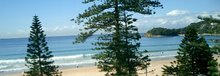
A bit of heat and Manly Beach was packed with people. For most of the visitors, by now 6 - 8 million p.a. (pdf), it seemed unnoticed, that 3 giant Yellow-tailed Black-Cockatoos (Calyptorhynchus funereus) were gliding through the arcade of Norfolk pines. Some of these ancient gigantic Pacific trees (Araucaria heterophylla ) can get up to 57 m tall. Although not endemic to Manly, they fringe the beach and provide a flightpath for the Black Cockatoos going north to the next headland. The tall trees and the giant birds both originated on the Gondwana supercontinent a long time a go. (pdf) The presence of these birds always brings the rain.
> Pines and Birds at Manly Beach
20 September 2008
Black Cockatoos calling the rain

19 September 2008
Little Penguins, Electrocuted Birds, Mauling Dogs, Bogong Moths, Spilled Oil and Artistic Inspiration
 A visit to the the Manly Art Gallery, where the current exhibition is by Bruce Goold. The designer/printmaker displays woodcuts/linocuts of iconic Australian objects. Nautical themes and Aussie flora and fauna get mingled with sub-urban culture jamming. The fragipani, banana and (unfortunately) bamboo convey that coastal holiday feeling.
Some thoughts on the following themes seen there, which are relevant for the northern beaches:
'Telegraph crows' 1995 depicts Australian Crows getting electrocuted in power lines. Think about it every time you flick on that convenient switch, how many birds and other fauna get killed and crippled by this underdeveloped landscape feature bringing power to you.
The design with Bogong moths was very timely as they will start their annual migration next month. This gets too messy for tidy-town then.

The few remaining little penguins in Manly get regularly mauled by off-the-leash dogs. One of their 'habitats' at the Manly Cove is a busy human infrastructure with fireworks, bands and other mass events. The little bird needs to live in a partial marine and partial terrestial territory. This is the space where human impact in Manly is most noticeable.
 Habitat for Manly's endangered Little Penguin population (pdf) , Manly Cove. More than a webcam needed here.
'Pasha Bulka' 2008 visualises the stranding of a huge cargo ship beached on a Newcastle surfing beach in 2007. 'Heavy fuel oil ' ran into the Pacific Ocean. Such scenarios are not unthinkable for the Manly region. For now, we get the sulphur particle emission from ships that are near Manly.
Outside the Art Gallery there were numerous very large motor bikes parked on the “pedestrian and bicycle path only”. Aerial garbage is a new thing here: Plastic kites in Manly Beach pines, a very long nylon fishing line dangling from a tall palm in front of the gallery, waiting for that next bird to entangle. Aqua-parking as far as the eye could see in Manly Cove, right along the penguin's feeding grouds. Wharf construction set the acoustic ambience.
See also Bogong migration incompatible with humans
Links:
- Endangered Population of Little Penguins (Eudyptula minor) at Manly, NP, pdf
- Caution: Electrocution! Suggested Practices for Bird Protection on Power Lines, BUND, pdf
Update: 0709 The slaughter of 11 Little Penguins by a dog/s in their last mainland habitat on mainland NSW.
17 September 2008
Wobbegong Dreaming at Shelly Beach Aquatic Reserve
 The Spotted Wobbegong (Orectolobus maculatus) is a shark that lives in temperate to tropical rocky reefs. It likes to rest in caves during the day and at night it inhabits the bottom of the shores. Occasionally it ventures offshore. Sea grass beds are the preferred nursery. It has nice spots and a substantial 'beard'. If all is well, it can become 100 years old and measure up to three metres.
But there is a hitch, which is that the majority of Australians live along this very coast-line. The interface of shark habitat and the human field of activities has led to the near eradication of this species.
In the last 20 years the Spotted Wobbegong declined by 60 %, more in NSW
The coastal habitat has human infrastructure sprawling all over, sea grass beds are becoming rare.
Extractive practices are seeking to plunder or commericalise every bit of the creature:
Commercial fishing with a high rate of by-kill extracted many, sometimes chucking them if there was no market for them. “Recreational”, sports-fishing competitions and spearfishing do the rest.
 All is well, now that the remaining wobbegongs in the 'wild' are tagged with radio transmitters and seven were bred in captivity, then also tagged and released into Shelly Beach Reserve. ”...Acoustic study and tracking devices will ensure that we can find much more about it.” Fitting electronic devices onto or into juvenile creatures usually employs invasive methods, as the gear is glued on with epoxy resin or suction pads. The ethics of this practice is questionable. Data-gathering from the dry comfort of the screen and DNA mapping might just reveal that the object turned into flake or by-kill yet again. Managing the mind-sets and practices of their own kind might ensure a sustainable habitat and an effective biodiversity management.
Large boats throw their heavy anchors into this delicate aquatic reserve. The noise and chemical pollution they cause is not compatible with a reserve for 'wildlife'. Suburbs drain their effluent into the shores and at night keen divers disturb creatures in their habitats with bright torches.
Just yesterday there were, yet again people line fishing IN the Cabbage Tree Bay Aquatic Reserve. Spearfishing in it has also been reported.
Links:
Spotted Wobbegong, IUCN Programme
Cabbage Tree Bay Aquatic Reserve, Shelly Beach, Manly
NSW AMSA Position Statement on Marine Protected Areas and No-take Marine Sanctuaries, 2008, pdf
Australian shark fishing out of control ,The Nature Conservation Council?
The cost of Recreational Fishing and Boating on the Moreton Bay Marine Park, Bay Journal
Marine, National Parks Association of NSW, advocating the establishment of marine sanctuaries in NSW, only 6.5 % of NSW marine habitat is protected.
16 September 2008
Manly's Plastic Legacy - From Plastic Toy to Fish
 Time has come to pack the urban tank with plenty of plastic gear and drive to the beach. Unpack the bikes, prams, pack of dogs and convienence food and drink. At the end of the day, the full plastic-poo bags are left, leaking silently. The plastic wrapping for each mouth-full are 'blowin in the wind'. A large range of plastic toys, fast-food containers and lighters are being moved by the waves. The industrial beach cleaning machinery cannot keep up.
Finally, the Pacific becomes the tip full of trash. It is thought t hat 80 % of marine garbage originates from the shores. Most of the inferior plastic toys are broken by frustrated kids seeking non-plastic stimulation. The plastic that does not end up in the ocean, gets heaped up in the streets, awaiting petrol-transport to the 'land-fill'-tip, which is next to a national park. Some have started to recycle this plastic deluge in to art.
In the end, the terrestial tip leaches into the groundwater and the 'marine tip' grinds up all the plastic into tiny little pellets, leaching toxins. These in turn enter the food chain. An inheritance for all the off-spring and the remaining ecology from a plastic world. Map showing where people are most desperate to keep developing human beings entertained via (mostly plastic) toys.
Map: Toys Import, map no. 58 via WorldMapper, © Copyright 2006 SASI Group (University of Sheffield) and Mark Newman (University of Michigan)
"Is there a present that a child or family member just has to have and you can't find it in any store?" Kidsource, 2000
- Keep the Sea plastic free
13 September 2008
Manly Restaurants & Eateries - a Wishlist

 There are some very good restaurants in Manly. Council made an effort to bring the “the basics of food safety, cleanliness, and hygiene practices” to the eateries and restaurants recently. The NSW Food Authority introduced a ' name and shame' register. As we are frequenting these premises with our friends, MNLY has a wish-list.
We'd like:
- a regularly cleaned place, preferably using non-toxic materials
- the provision of hand washing facilities for staff and customers
- a fragrance- free environment
- a smoke-free environment, in and outdoors
- a spam-free ambiance
- an absence of dogs (and their feces) in the food and drink establishments
- an absence of toxic car fumes and unventilated gas heaters in the sitting areas
- that it is stated whether the water was filtered
- that it is mentioned on the menu where the fish/seafood comes from, esp wrt aqua-'culture'.
- In some places the paucity of cleaning is obvious. Some premises elsewhere are disclosing their ecological cleaning agents and the frequency of cleaning.
- The bathroom does not necessarily have to be designed, as is fashionable in event gastronomy, or even cleaned with ecological sound materials. But the bottom line should be clean facilities and functional hand washing basins ( hot water, soap & towels) for staff and customers in times of recurring norvirus, hepatitis and Sydney belly. Toilet paper helps.
- Various toilets offer synthetic fragrance sprays in small toilet cubicles to mask odours, due to lack of ventilation. Entering the premises one is forced to inhale these harmful substances. (pdf)
- The right to breathe while eating out
- Climate damaging flat screens have been installed in many places to pour some solid state spam over the customer held hostage to programs of shameless self-promotion of sales people. Each of the LCD displays is a huge energy guzzler, some use the equivalent energy of 7 fridges (de). These unsolicited, non-informative messages ruin the atmosphere. The choice of music is often, soothing to the staff, but incompatible with the clientele.
- Dogs, prohibited in all food and drink serving places, regularly are seen sitting on laps, eating off the plate, kissing their owner. Staff handle doggy bowls and human implements simultaneously without concern. The dog saliva on the table just gets redistributed with the same old rag, that is used for all tables. True, as seen in real life!
- Unflued gas-heaters, an unhealthy and wasteful form of heating are approaching the end of season now. The doors open up and more vehicle pollution and noise is made available.
Reducing Risks when eating out
Links:
What is an 'air-freshener'?
Health Risks from Perfume: The Most Common Chemicals Found in Thirty-One Fragrance Products by a 1991 EPA Study
What is a fragrance, video
The hidden threats lurking in synthetic fragrances and indoor air “fresheners” pdf
Pharmaceuticals and Personal Care Products as Pollutants (PPCPs)
Common Synthetic Fragrances Found to Harm Wildlife, Humans
Household fragrances may be harming aquatic wildlife
Update 061211
We also would like to eat ethically wrt to industrial relations. Don't serve up up poverty wages, lack of sick leave, and discrimination. Guide (US)
11 September 2008
Smoking and its socialised effects in Manly
 Secondhand smoke exposure in Manly's public places, such as the beach, the streets, lanes and out-door eateries is causing direct physical injury to people wishing to share these public spaces. Lunch-time would be a prime time to enforce the law in these places. The no-smoke signs are a prefered smoking location.
After the big rain, the beach was thick with butts, causing the leaching of toxins into the environment. The paved environments are also carpeted with this toxic anti-product.
Mega litter and toxic run-off into beaches and waterways:
- 7 billion cigarette butts are littered by Australia's 3.7 million smokers every year.
- Cigarette butt litter still accounts for around 50% of all the litter in Australia
Cause of dangerous and costly fires:
- "..for every 1,000 smouldering butts that are discarded, 40 fires could result."
- 7% of Australia's bushfires are caused by discarded cigarettes - that's over 4,500 fires a year caused by cigarettes and smoking materials.

10 September 2008
Manly's Bandicoot & Wildlife Code
Replacing the unique with the ever-same
The unique Manly treasures, such as bandicoots (little penguins etc) and the sprawl of human urbanisation make for a predictable outcome. Wildlife habitat and sprawling sub-urbia are incompatible. Attempts to limit the negative impacts by "best practice" recommendations and "awareness education" are dubious. We are assured that the owners of the St Patrick's Estate townhouses were given their bandicoot awareness education. "The houses themselves also had to be bandicoot-friendly.."
Manly's surging dog (cat etc) population is making a practical statement to replace the unique Australian biodiversity with a monoculture of foreign animals. The interface between wildlife refuge and human infrastructure and their destructive packs is the killer-zone.
Effective protection of threatened Australian wildlife
Manly’s North Head developments are said to be contingent on " keeping their dog in at night and never letting their cat outdoors unless it is in a sealed cat run." But there are dogs ON the beach (illegally) every morning and night, sometimes even defecating ON the beach on a busy Sunday. They are un-leashed most of the time, hunting little penguins or hunting bandicoots at night in Shelly Beach bushland. With a lack of enforcement and a population wanting to expand the ever-same, the diverse uniqueness of the Manly ecology is sacrificed.
via Pets curfew in building code, Manly Daily 100908
See also:
Bandicoot Habitat I
More on Bandicoots in MNLY
Images: 0808 all via Google Maps
1. - 3. National Park, St Patrick's Estate townhouses developments
4. End of Osborne Rd
5. Montpelier Pl./ Bower St. development


21 August 2008
Watching Whales and Dolphins in their habitat
WATCH the beauty of these free whales and dolphins in the ocean, unencumbered by human artefacts and not harassed by human noises. Great work by Okeanos – Foundation for the Sea which is concerned with whale welfare. More resources on the impacts of human noises and their blog.
20 August 2008
Whale Calf Rescue, Sydney, Pt. II
 An abundance of vessels and a new abundance of whales in the "least concern" category set the scene in this inter-species competition. The infant 'Moby Dick' seeks protection in the sheltered bay of the Sydney Basin.
Speculation has it, that it was "abandoned". As the bay of Pittwater is synonymous with yacht racing the Humpback calf turns into a 5 tonne 'problem'. Coaxed out into the deep Pacific, it would have been unclear whether the 5 m mammal was the responsibility of Zoo vets, NSW Parks and Wildlife Service, international agencies or even marine experts. The lone infant returned for the sheltered bay, seeking out what is most plentiful there, namely boats. Voices say that it would "have to be put down", "destroyed" or "euthanized".
Options of feeding it krill outside of captivity are dismissed, despite the 1997 baby whale rescue in the U.S."...The whale was hand-reared back to health before being released into the wild 14 months later. Our veterinarians and our animal care teams immediately went to work to try and save the animal" Such a rescue of a fellow mammal infant would only take a fraction of the budget of dog food or imported seafoods.
Human caused stressors to whales:
- In the anthropocene, megafauna (Megaptera novaeangliae) have been radically depleted due to commercial exploitation. Just recently were they allowed a little bounce back. The bounce comes to a halt with vessel strikes or collisions. Whales are slow to respond to approaching boats, especially those trying to smash race records."A collision with a ship’s propellers can sheer off a whale’s tail, slice them apart, or cause huge contusions." Speed in the marine environment is as deadly as it is on roads. Speed restrictions would reduce the likelihood and severity of vessel collisions. A set-aside Area to be Avoided (ATBA) in the prime migration season would reduce the risks of being separated, severely injured or killed on the annual trek.
- Noise : The roaring of the industrialised marine commerce or 'sport' is interfering with whale communication. The noise can cut off vocal, behavioral and physiological responses between a whale and its offspring. To get entangled in our debris is a further hindrance.
- Human-caused climate change deprives whales of food. Krill populations decline in rising temperatures, which " will require migratory whales like this Humpback whale to swim further for less food."
- Mining the oceans with invasive, noisy and polluting practices "Oil and gas exploration expose whales to noise pollution, oil spills, chemical pollution, vessel collisions and entanglement with or ingestion of marine debris."

Share the habitat!
- Effectively protect these highly migratory marine mammals in their habitat.
- Impose (seasonal) speed restrictions in areas frequented by whales and other protected fauna.
- Create a protected crucial habitat as an Area to be Avoided (ATBA).
- Divert some of the attention and budget bestowed on pets to unique marine mammal protection.
- Reconsider mining and dredging Megaprojects on the coastline
Previous:
Humpback whale calf lost in Sydney's buzz, Pt I
Desalination, a Megaproject or Water Conservation and Whales
Links:
-Melville, Herman, 1819-1891. Moby-Dick
- "Vessel Collisions with Whales: The Probability of Lethal Injury Based on Vessel Speed," (PDF) by Ms. Vanderlaan and Dr. Taggart,MARINE MAMMAL SCIENCE, 23(1): 144–156 (January 2007), C# 2006 by the Society for Marine Mammalogy, DOI: 10.1111/j.1748-7692.2006.00098.x
- IUCN, the International Union for Conservation of Nature
Images:
1. Humpback whale, Brehm, Alfred, Brehms Thierleben, via Zeno
2."The Large Fish eating the Little ones", Bruegel d. Ä., Pieter, via Zeno
Updates 210808
- Now the military has been approached about towing it out to sea again. Imagine the smelly giant carcass in the middle of a yachting bay! abc 210808
- One person was attempting to feed the whale, but authorities stepped in.
- Event hungry people are moving in on the starving whale, keeping authorities busy to enforce the required exclusion zone, Manly Daily 210808
- Image:" The baby whale with wounds on its back thought to be from swimming under the yachts" SMH Blog 210808
- Meetings are on: tow out 'with the sharks' again or euthanise. Feeding option, a 'can't do'. SMH 210808
- A carcass in the Pitwater Bay would be smelly, an obstacle for yachts and would attract sharks.
- The death penalty has been pronounced by the the National Park and Wildlife Service: ".. the calf would be killed by lethal injection overnight or in the morning... Aboriginal "whale whisperer" Bunna Lawrie, who spent time with the whale this afternoon, patting the calf and singing to it..He heard me singing and came over. I looked at him and he was full of life. He had a few scratches and cuts on him and I was a bit worried about his eyes...All we have to do is get it out to sea, nurse it out there and guard and wait for pod of whales. Let the whales figure out if they can accept it. A mother may think it can feed two." SMH 210808
Update 220808:
- Euthanasia for the lost whale calf. A cost-effective and widely used chemical club on Australian wildlife. New experts will seek the truth in the entrails of the mammal and the remaining bones will serve “research” (sounds familiar!). So much for the human wildlife interface. via SMH 220808
MORE Starving Whales:
- Another starving humpback whale is in the overfished Baltic sea. It " is getting critical ... the whale is having trouble nourishing itself." Greenpeace " is now prepared to intervene to stop the whale from beaching itself." Spiegel 200808
Update 110908:
An application has been lodged for a licence to explore for gas in a 6,000 kilometre zone between Sydney's and Port Stephens, north of Newcastle. Seismic tests could interfere with whale migration. In Alaska the whale watching industry it taking mining operators to court. Gas exploration on the coastline has the potential to devastate the beaches and ruin the whale habitat. abc 110908
Update 180908
- "The International Fund for Animal Welfare (Ifaw) says undersea noise blocks animals' communication and disrupts feeding. Levels of noise in the world's oceans are causing serious problems for whales, dolphins and other marine mammals. Humanity is literally drowning out marine mammals" BBC 150908
Update 111008
- Speed limits for large commercial ships travelling coastal waters populated by whales migrating have been applied by the U.S. government.Ships must now go below 10 knots in specified coastal regions. 091008 The NEW YORK TIMES
Update 171008
Autopsy results: The male calf "was suffering from acute pneumonia, serious body and pancreas emaciation, acute intestinal erosion and ulcers in the stomach and there were a number of infected shark bites as well" abc 171008 But why did he get so ill in the ocean?
Update 211008
"NOAA officials today issued a regulation that will implement new measures to protect endangered North Atlantic right whales. The regulation will, for the first time, require large ships to reduce speeds to ten knots in areas where the whales feed and reproduce, as well as along migratory routes in between. The goal of the regulation is to reduce the risk of ship collision with the whales." But it would also lessen the possibility of separating the mother and calf in busy traffic! More on ship strike noaa news 211008
Update 061208
More on disruptive noise in the oceans for marine mammals:
"Ocean Noise: Turn it Down", pdf
Noise from vessels, increased seismic surveys for oil and gas, off-shore construction and recreation, and a new generation of military sonars can interfere with whales. "The United Nations Environment Programme's Convention on Migratory Species conference in Rome, are urging governments and industry to adopt quieter engines for ships, tighter rules on the use of seismic surveys, and new, less intrusive sonar technologies by navies...Ship noise in the Pacific Ocean has doubled every decade over the past 40 years and the global shipping fleet is expected to double in size by 2025, after doubling between 1965 and 2003.There is now evidence linking loud underwater noises with some major strandings of marine mammals.
By 2050 the chemistry of seawater could increase in acidity by 0.3 pH units... this change in ocean acidity would allow sounds to travel up to 70 percent farther underwater." Environmental News Service 031208
19 August 2008
Humpback whale calf lost in Sydney's buzz
 Imagine a baby and its carer get separated at a busy freeway node – impossible to find each other again, the weakened child mistakes a parked SUV for its mother and attempts, in vain, to get nourishment. Helpful creatures manoeuvre it out into the 'wide and open spaces' where it might be hopefully reunited with its mother.
Humpback calf lost in Pittwater
Such is the story (sad video) of a very young humpback calf found in isolation from its mother in busy Pittwater bay, north of Sydney. These slow-moving marine mammals, with their offspring in tow are on age-old journeys across the globe. For eons they have traversed their same marine territories. First, they were massacred by Australian whalers, now the whale watching industry has to lure the tourist dollar. Their habitat has also changed rapidly: The sheltered bays and the open ocean are more like the terrestial world's car-parks, oozing repair workshops, endless wider roads to shoot private mobility capsules along. The largest obstacle to their efficient flow are soft-bodied, slow-moving organisms, known as pedestrians and wildlife.
Boating Habitat
Aqua motoring in the Pittwater region (or anywhere else) operates according to t he same mind-set. One look at Google Maps reveals the area is criss-crossed with boats racing and most of the shores are more akin to "car-parks". Industrialising and commercialising the water-bodies and the marine habitat brings about many "externalities" for the environment. Eutrophication from combustion powered boats, from sprawling sub-urbs and the associated 'shared debris' turns the beautiful Pacific and its bays progressively into dead zones. Not just for seasonal visiting whales - but for all living creatures. If they do not get entangled by anthropogenic debris or get infected, human business also robs them of their habitat, the open ocean.
Mega fauna is in the way
The intensification is a take-over by the terrestial mammals of the habitat of the whales, that do not have any other habitat to survive in. On the open oceans, whales are simply in the way of busy shipping lanes and other boats.. "In places where marine traffic is heavy, vessels fast and whale numbers expanding, violent encounters are increasingly common.” As on our roads - many cetacean and other marine animals are being maimed or killed by the 'collisions'. The wildlife of the oceans is becoming a "a hazard to sea craft" in their own habitat. In some areas the International Maritime Organization has designated an "Area to Be Avoided" for container ships to avoid killing them.
Noise
Even when not assaulted by aqua motoring the noise and vibration caused by the  human racket will diminish their life or even kill them: "The throb of mighty engines and the thrash of propellers as 60,000 huge vessels plough the world’s sea lanes; the hammer of diesels and scream of outboards as 4 million fishing boats and more than 10 million ferries and pleasure craft surge to and fro; the thump and ping of military and fishing sonars; the deafening crash of seismic ships seeking oil and gas; the blare of acoustic harassment devices; the grinding of drills and dredges; the low-frequency growl of scientific experiments designed to monitor global warming."
Could it be, that in such a hostile habitat the whale and its calf became seperated though a degraded habitat and many missiles interjecting their journey?
> > Part II, Whale calf rescue, Sydney Basin
See also:
Desalination, Drilling rigs Sth of Sydney & Whale migration
More on Whales
MSM Updates:
- 'Out with the sharks', abc news, 190808
- Three weeks old calf "abandoned" and "doomed to die" speculations, SMH, 190808
- "The baby has further injured himself from its attempts to rub up on boats, with clearly visible sores on its back. In a last-ditch effort they convinced the whale to follow their boat out to sea, and it disappeared from view about 1km off Barrenjoey headland. It wasn't in good condition." Manly Daily, 190808
Images:
1. Part of Warren Langley's, Manly Visions, glass art at Manly Library
2. & 3. dotAtelier, inspired by Eora Rockengravings of the Pittwater region.
13 August 2008
Desalination - a Megaproject ! or Water Conservation and Whales
 Today's news of the construction of a 16-storey drilling platform off Kurnell, Cape Solander assured us that "The six-month operation will..not have any impact on migrating whales. I have every confidence the whales will swim around it..There will be no impact on the residents of Kurnell"
Will the whales still make it past Manly?
Could Manly become another 'Kurnell'?
Once water conservation is off the agenda, the high cost and high energy option of desalination plants appears to be the only way to continue unsustainable practices on the driest continent. The environmental costs, apart from turning the sea/shore into an industrial zone (image) are carried by the wildlife and its biome.
The following reading list is highly recommended on topics that will not disappear in our life-time:
Desalination projects & transparency:
Phil Dickie of melaleuca media investigatives the options of desalination plants in "Making Water - Desalination option or distraction for a thirsty word" 0707 for WWF’s Global Freshwater Programme. "The first global survey of desalination from a non-industry perspective" (pdf) Regarding Australia:"All of the areas where seawater desalination is rapidly assuming a more prominent water supply role had more cost effective and less potentially environmentally damaging alternatives available. This is particularly true of demand management, water conservation and water efficiency measures, where many of even the more advanced economies such as Australia do not uniformly require easily achievable water and energy efficiency standards in new buildings."
Megaprojects & Transparency:
Bent Flyvbjerg, on megaprojects, Chapter 1 of his book Megaprojects and Risk: An anatomy of Ambition, by Bent Flyvbjerg, Nils Bruzelius, and Werner Rothengatter (Cambridge University Press, 2003). Some of his interests are transparency in policy planning and strategic misrepresentation wrt megaprojects.
Links:
- Towra Point Nature Reserve, Kurnell
- Botany Bay National Park
- NSW Fisheries - Towra Point Aquatic Nature Reserve
- Amid Water Shortage, Australia Looks to the Sea, Patrick Barta, The Wall Street Journal, 110308
- Ecotoxicological marine impacts from seawater desalination plants, Rachid Miriaand Abdelwahab Chouikhib, Desalination and the Environment Volume 182, Issues 1-3, 1 November 2005, Pages 403-410
- Environmental impacts of water desalination along the coastal region of Israel and the Palestinian Authority (pdf) (environmental impacts and noise pollution)
- Sydney Water, Desalination Factsheet
- Riverkeepers fighting to not mush up the "small aquatic organisms into the cooling mechanism; the resulting impingement and entrainment from these operations kill or injure billions of aquatic organisms every year." (pdf)
- Protests against desalination in Victoria, abc 140708
- Scorched Earth for water plant we might not need, SMH, 0807 (Great image of the 'scorched earth' near Towra Point Nature Reserve!)
Image: GoogleMaps, Cape Solander , Kurnell, (NB note the ocean colour, approx. 2007)
Update 210808
- Plans to dredge Botany Bay as part of a $1 billion port expansion, taking 60 hectares of land to construct five new shipping berths. abc 190808
Update 300808
- "Australia could be using 400 per cent more energy to supply its drinking water by 2030 if the policy trend towards seawater desalination were to continue...seawater desalination was likened to a petrol-guzzling "six cylinder" family car by one of Australia's top water bureaucrats at a major summit in Melbourne." The Age 290808
- On offshore drilling platforms in the coastal path of hurricanes, the ecological and economic damage. Science Daily 290808
- What's the Deal With Offshore Drilling? Will it do any good at all? Jacob Leibenluft, Slate, 120808 (A good overview of the environmental impacts of offshore industrial activities)
Update 091008
- Peak Energy also was concerned about the impact on the sea dragons at Kurnell.
- Water and Desalination Factories by M. Barlow, Environmental Folly
- Climate-caused acidity of oceans, creates a noisier environment for whales, apart from the construction and operation noise of such a large infrastructure (click graphic!)
08 August 2008
Hindering the physical and neurological development of children
 As reported before: Extended time, flat on the back, lacking sensual interaction is a form of deprivation for developing human beings. The average child might now spend extended time in a 'convenient' capsule. “Parents are not picking up their infants when the infants are awake... you get a stroller and car seat combo. And because the car seat snaps in and out of the stroller and the vehicle, often the baby simply stays put after reaching a destination.” These “mobility” gadgets might appear as a convenient “life saver” for parents in their 4x4s/cars.
For the capsule-bound and interaction-deprived infant it often means:
- motor delays
- “.. developmental, cognitive, and organizational skills delays, eye-tracking problems, and behavioral issues”
- the flattening of the baby's skull, occurs “in infants who spend too much time on their backs while awake.”
- This syndrome is also termed 'Flat-head syndrome' or plagiocephaly.
 “In recent years, craniofacial centers and primary care providers reported a dramatic increase of up to 600 percent in referrals for misshapen heads.” Various service industries and products (eg cranial helmets) have sprung up, promising 'corrections' of the unintentional cranial modification. The hindered development of the neurological network will most likely be a life-long handicap.
 Experts are urging “parents and caregivers to ensure that babies get enough "tummy time" throughout the day while they are awake and supervised”. Quality interaction is needed to produce a human being through interactive behaviour. "Increasing the amount of time your baby lies on his or her tummy promotes muscle development in the neck and shoulders; helps prevent tight neck muscles and the development of flat areas on the back of the baby's head; and helps build the muscles baby needs to roll, sit and crawl" "It's important to get our infants out of devices that constrain mobility and onto their tummies so they can focus on neck muscle balance as they interact with their caregivers," “We're going to have to be more actively involved with them” - beyond a 'rotate daily'.
 Have a look at the Manly poodle & pram parade, check out the adults' active interaction with their mobile or the dog/s. In the eateries, do the kids stare at the wall, while the grown-ups are interacting with each other and the environment?
Some cafes/eateries in Europe have introduced pram parking at the front door, fold it up and into a slot. The baby/or multiples are then carried or walked to the area where the group wishes to engage with one another.
Experts urge parents/caregivers to facilitate mobility for their infants and not constrain mobility. Craniofacial deformities and a deficient neurological network can be prevented. 'Activities to Help You Position, Carry, Hold and Play with Your Baby' advises on basic interaction.
Images:
1. Heinrich Zille, Children practicing handstand via Zeno
2 Edward James Muggeridge, Healthy child crawling via Zeno.
3 Edward James Muggeridge, Healthy child crawling via Zeno
4 Heinrich Zille, Children practicing handstand via Zeno
Links:
-Child Development: Lack Of Time On Tummy Shown To Hinder Achievement, American Physical -Therapy Association (070808)
-Intentional head molding, head flattening or headshaping and other body hacks
- More on the child's development guided by interpersonal communication (language development and though) and culture via Lev Vygotsky
Update:
New study possibly links cognitive and motor delays with 'flat head syndrome' in young babies 15022010
Subscribe to:
Posts (Atom)