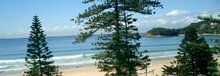
Although the industrial age is apparently well behind us, the machinery in Sub-urbia never stands still. Hills are flatted, huge holes ripped into sandstone and luxury-tack is erected. The day shift of industrial building armies moves in with serious mining equipment. The noise can be heard over valleys and bays. Decibel is a foreign word. At knock-off time the residents return home, get their power-tools out and build into the night. The stealing of one's peace is unregulated or at least not enforced (seriously).The wheels of industry have priority over the well-being of people. The apparent way out is to build a bunker. Huge walls go up in Sydney. Triple insulation of windows, etc. If all fails, flee to Sea Change and start all over. Clear the bush...
31 July 2005
Mining the subs

What water shortage?
 According to the SMH (30.07.05 p 20) French environmentalists are accusing golf clubs and private swimming pool owners of wasting water. This is no problem in the lucky country. Private lap pools are a common feature in houses specifically near the ocean and public pools. Both authorities and real estate consumers vote for swimming in private enclosures. Keeping endless lawns green to push balls about also requires huge amounts of water. Sydney Water can’t be serious if this form of water privatisation is encouraged. Also turning a blind eye to the many residents washing their cars in restricted times.
We won’t get into the ‘grey water’ that leaves the pools, golf courses, driveways and industry etc. The Manly Lagoon is grey-silver. This is an unsustainable, irresponsible way of mining a resource and privatising it. But the toxic sludge is shared amongst all species.
28 July 2005
Whales

A whale was sighted today at 4.15 pm leaving the Heads and racing north. It stayed closely hugged to North Head cliffs and seemed in a big hurry. The buzzing helicopter continuously encircling the headland might have contributed to the mammal' s exit.
At first a large long shade was visible in the water, then the plume from time to time and then it hurried along the cliff face and I heard a loud exhaling sound once. The back was very arched while it sped out to the open ocean.
These big-brained, breathing mammals, giving birth to live young, might have be on their traditional migration routes for the last 15 - 36 million years.
In some of the last thousands of years the aquatic mammal to land mammal relationship is well documented. Various engravings in the region of whales and tales by the saltwater people speak of custodianship. The first encounters of British and Saltwater people also involved a whale at North Head (Car-rang-gel) (The tale of a whale: significant Aboriginal landscapes of the Northern Beaches, Lee, Emma, 1973)
The utilisation of the animals as cheap oil led settlers to resort to whaling over a long time. The Right Whale was named the 'right' whale, because it was easy to hunt. The animal was not just reduced to tonnes of blubber, but also served as an icon in the Western mind. Moby Dick (here the book) presented the (white) whale as the "metaphor for the elements of life that are out of our control". A big job in colonial empires, terrestrial or aquatic.
Now there is a 'scientific' need for the cetaceans which this time round turns them not into oil, but kebabs. The spectacle-hungry audiences in powerful boats also are impinging on the whale's habitat. The whale industry is re-born: 'whale-watching'.
For eons the whales have undertaken one of the longest journeys of any animal in the world. After feeding in the Antarctic waters, they migrate along the coast of Australia between June and August to meet up. 8 hours sleep, harbours and bays would provide a good rest, specifically when young ones are in the pod.
Engaging in playful behaviour, such as breaching, spyhopping or tail slapping is typical for them. They are vivid communicators. They sing songs to each other, The Humpback Whale song is reminiscent of human singing. The Killer Whale still has that bit of wolf-sound left.
Collaborative food acquisition such as 'bubblenet feeding' is a specialty of the Humpback.
Well, today's whale had the double plume of a Southern Right Whale, but the dorsal fin of a Humpback and it vocalized and I'm happy IT is there.
So, do not hassle them on the water, or trample the bush to bits and say NO to whaling. They are wonderful giants and they are still here….
manly whales Sydney Harbour
26 July 2005
Slaughter on the roads
In some parts of the world I have seen bridges over roads and highways so that animals can cross in safety. The cost of these bridges, which are built only for the animals, is seen as one of the costs of road building. Community groups make it clear that it is not acceptable to see their wildlife squashed all over the roads by cars.
In this country, the carnage goes unseen and without protest. In Manly, where there are a lot of green spaces, you can see blood and squashed bodies every morning on roads which adjoin parks. These native animals are not even removed from the roads by the culprits or witnesses, but just run over repeatedly until they are flat like a carpet.
Roads which separate two city parks offer no way for animals to cross without running the gauntlet of speeding traffic. Why are people so insensitive, that they allow such barbarism to continue without saying a word?
23 July 2005
Organic food
 When it comes to healthy food and shopping for organic fruit and veges, the best place is the Manly Food Cooperative. Unpackaged food is available at fair prices and it is even cheaper if you are a member.
21 July 2005
Shopping which doesn't cost the Earth
 If I go shopping at the supermarket I get the feeling that I am doing the wrong thing. I get so much packaging and mostly unfresh food. Where has all that stuff been before I use it? What chemicals are in it? Can I take the genetically-modified substances? How did it get here? What am I doing to the world when I buy here?
In Manly, one of the places I like to shop without a heavy heart is the Manly Food Coop. Organic fruit and vegetables, bulk food and sustainable goods are sold at reasonable prices to the public and even more cheaply to participating members. The profits are shared via prices.
Waste minimisation and recycling is one of the basic principles of the food coop. You need to bring shopping bags and containers. You can be sure that what you buy there is good for you and does not cost the Earth by undermining the basis for life on this planet. Plastic bags will not choke turtles because of your shopping trip, nor will agricultural land be rendered toxic.
Fauna report
 Yesterday was the first sighting of a Blue-tongue in the garden and a large whale spout out from North Head. The lorikeets have young, calling all day. At the same time the industrialised gardening armies swing into action. Blade wielding they are a great danger to the the Eastern Blue-tongue (Tiliqua scincoides scincoides). The Blue-tongue likes hot sandstone and native tussocky grasses and leaf litter (untidy!). Industrial landscapes, such as lawns do not allow for both and additionally cut up a lot of lizards. Many are also killed by cars as they take the hot road to be a nice hot sandstone. Snail bait and cats & dogs are the other dangers to this ancient reptile.
20 July 2005
Link collection for Mnly
 The Mnly blog is now looking after their own bookmark collection. Anyone can organise and share their links on this service. There are many more free and collaborative bookmarking services around. We intend to collect relevant links, articles and images related to our topics of living sustainably with the environment. In a broad sense the links will also be relevant to Sydney and Australia on the whole. You can also access the o.g. links from the right sidebar as 'Social Bookmarks Australia'.
Furthermore there is also a tag with Technorati for 'Manly' now. This aggregates everybodies photos and articles that are tagged with the word 'Manly' and you can also click it in the right sidebar.
Also note that the dynamic panel picture show in the right sidebar is home made with JavaScript, all according to the principle of 'many pieces loosly joined'.
19 July 2005
Lorikeets
 The lorikeets arrive at Manly beach just before sunset. They spend the night there in the Norfolk pines which grow along the length of the beach. You can hear their performance in this MP3 recording.
At first you can hear the waves of the surf with the first birds arriving. Rapidly the birds get louder as they fill the trees. Their sounds agitate the others to ever louder and more intense communication. They reach a crescendo after about 4 minutes. Then they quieten down for the night until dawn.
Not all trees are preferred by the lorikeets. It is not clear what their criteria are, but as they fly from tree to tree they accumulate in the trees with the most lorikeet-friendly qualities. This is what you can hear.
This MP3 is about 1.5 Mb and lasts for about 5 minutes. Enjoy the development of the sound as if you were at Manly Beach at sunset.
Listen to lorikeets
Tolerating the disappearance of Australians
 The deep appreciation of things 'foreign' is shown by the high ratio of pet ownership. Barbie-dogs, fierce property defending dogs or obese cats are all chosen by the great majority of Manly residents. Dogs, mostly locked up in the home, yelp for ages once the Valium stops working. The ones imprisoned in backyards all day are no better off.
For some the cute nature of the Australian fauna is discovered, Lorikeets are attracted to balconies with sugar water, birds are fed with inappropriate substances. 'The hand-out' system makes the giver feel 'generous' and in-charge. It is a system of turning them into pets without the onerous responsibility of ownership. Minimum input, maximum gain.
What is definitely not on is allowing habitat for 'them', the native, endemic animals. The war of the species is on and there shall be no survivors. First there is the 'development' of the human species, more & more of the same. 20 garage-houses, private lap-pools at the beach etc. If the knock-em-down-building-process has not erased all soil and vegetation, the 'landscaping' will do the rest to design 'them' out. On the boring weekends the frenzy of tidying up the (remaining) vegetation takes place. Petrol gardening with mega-decibels. A good pesticide, herbicide and fungicide cocktail tops the job off.
Gone is the habitat of the birds, the bandicoots, the lizards, ringtails, the frogs etc. No place and resources to rest, feed or breed and sustainably live. Should some survive by accident the dogs, cats and cars will get them in due time.
The slaughter of native birds in gardens is mainly due to irresponsible cat owners. Fed on tonnes of other species they pounce on the birds like oversized wrestlers and kill for sport. The dogs have their go on the little penguins and anything else that moves. If the long nosed bandicoot, which once covered all of Sydney, now confined to Manly, survives the elimination of its urban bushland with rows of housing, then the next joy-rider to North Head will flatten the little creature for sure. Every day 7000 animals are struck by cars in NSW alone, that's 2.5 million a year. (Manly Daily, 19.07.2005)
Tolerance of things Australian would mean, leaving some habitat to them, allowing other species to prosper as well. Taking joy and pride out of the bio-diversity that could be passed responsibly to the next generations. But the exchange-value thinking, greed and ignorance do not allow for such generous inclusion. It is about mining the place and then moving to other frontier land.
Yes, there might be the odd person out there growing a Robin Gordon or even leaving a native tree, there are the authorities that 'recommend', 'appeal' and 'promote awareness'. To create a substantial urban bushland in the private and in the public form does take considerable knowledge, good will and resources to realise in a community. Deregulatory policies, lack of enforcement and hunger for cash-flow give the official consent to the 'done thing'.
The bandicoot, the penguin, the ringtail possum will all make cute posters one day of extinct species 'that we had and for unexplainable reasons, they all disappeared...''
18 July 2005
All green, blue and sand and 15 min. to the city
 There is one special thing about Manly, it has the best of Sydney Harbour National Park, great walks in bushland and heath, fantastic beaches and it is 15 minutes to the CBD (city).
It just had to be said!
15 July 2005
Land and Ocean report
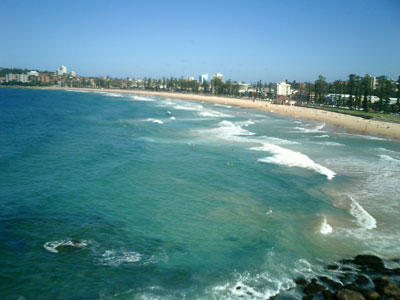 Nearly got run over today in Manly by a yob-mobile, cars parked all over the curb as well. The Pedestrian Council of Australia shows some stunning images how motorists are ignoring the law. Please update site!!
At North Head (Car-rang-gel) today yachts and tin-cans hassled whales on their ancient migration routes. 85 bucks a ride at high speed to chase whale and offspring. The whale (watching) industry is almost as lucrative as in colonial times.
On the sub-urban frontier the British box hedges are grown with the help of the horticultural industry. Rip out these flouring Callistemons, in with wood chips and hedges from Elsewhere.
90% of Manly's sustainably cultured environment is now degraded by settler activities.
There are many native plants that could be planted or encouraged. Endemic plants (PDF) are of course the most appropriate fauna for the area. Many more food and habitat plants could be grown for the endemic fauna. Fruit for the Grey-headed Flying Fox, flowers for the Lorikeets, large trees for the many possums.
For human beings too urban agriculture could could co-exist with the 'bush'. A mapped fruit alert directs the communities' attention to appreciate the abundance of urban activism.